Skip to content
Harder Kulm Experience Audio Guide
Walking Tour

Harder Kulm Experience Audio Guide

Updated 3 mars 2026
Cover: Harder Kulm Experience Audio Guide

Harder Kulm Experience Audio Guide

Walking Tour Tour

0:00 0:00

TL;DR: An audio guide for the Harder Kulm funicular from Interlaken (567 m) to Harder Kulm at 1,322 meters -- Interlaken's home mountain and the gateway viewpoint to the Bernese Oberland. This guide covers the 10-minute funicular ride, the Two Lakes Bridge (Zwei-Seen-Steg) glass viewing platform, and the panorama that frames the Eiger, Monch, and Jungfrau above the twin lakes of Thun and Brienz.


Journey Overview

Summit Harder Kulm, 1,322 m (4,337 ft)
Transport Harderbahn funicular: Interlaken (567 m) to Harder Kulm (1,322 m)
Journey time 10 minutes (one way)
Track length 1,436 m
Maximum gradient 64%
Operator Jungfrau Railways (jungfrau.ch)
Ticket price CHF 38 return from Interlaken (2026 prices)
Swiss Travel Pass 50% discount
Key attractions Two Lakes Bridge (Zwei-Seen-Steg) viewing platform, panoramic restaurant, ibex colony
Audio guide duration Approximately 30 minutes of narrated highlights
Season Mid-April to late November

Introduction -- Interlaken's Balcony

[Duration: 3 minutes]

Welcome to this ch.tours audio guide for Harder Kulm -- Interlaken's home mountain and one of the quickest routes to a world-class Alpine panorama anywhere in Switzerland.

In just 10 minutes, the Harderbahn funicular will lift you from the streets of Interlaken to a forested ridge at 1,322 meters, where a glass-floored viewing platform extends into the void between two lakes. From this platform, you will look directly at the Eiger, Monch, and Jungfrau -- the three peaks that define the Bernese Oberland -- while Lake Thun (Thunersee) glitters to the west and Lake Brienz (Brienzersee) glitters to the east. The two lakes, the town of Interlaken between them, and the wall of high peaks beyond: it is a panorama that justifies the journey to Switzerland all by itself.

Harder Kulm has been a popular viewpoint since the 19th century, when Interlaken was the basecamp for Grand Tour travelers visiting the Bernese Oberland. The funicular was built in 1908, replacing the mule path that had served visitors for decades, and it has been lifting tourists to the summit ever since. The Two Lakes Bridge (Zwei-Seen-Steg), a dramatic glass and steel viewing platform cantilevered out from the cliff edge, was added in 2011 and has become one of the most photographed viewpoints in the Bernese Oberland.

The name "Harder" comes from the local dialect and is unrelated to difficulty -- the mountain is actually one of the easiest summit experiences in the region. The "Kulm" means summit or peak. Together, Harder Kulm is simply "the summit of the Harder" -- Interlaken's friendly, accessible balcony over the Alps.


Stage 1: The Harderbahn Funicular

[Duration: 7 minutes of narration across 10 minutes of travel]

Departure from Interlaken

Elevation: 567 m

The Harderbahn valley station sits on the north side of Interlaken, across the Aare river from the main town. Interlaken's position between Lake Thun and Lake Brienz -- "between the lakes," as the name says -- is visible even from the valley station. The Aare river, which connects the two lakes, flows through Interlaken and continues northwest toward Bern and eventually the Rhine.

The funicular cabin departs and immediately begins a steep ascent through deciduous forest. The maximum gradient is 64%, which is steep even by Swiss funicular standards. You feel the incline in the tilt of the cabin -- the seats are angled to keep you roughly level, but the forest outside tilts dramatically.

Through the Forest

The forest on the Harder is a classic Central Swiss mixed forest: beech (Fagus sylvatica), Norway maple (Acer platanoides), and ash (Fraxinus excelsior) at the lower elevations, transitioning to Norway spruce (Picea abies) and silver fir (Abies alba) as you climb. The undergrowth is rich in ferns, mosses, and shade-loving wildflowers.

The Harder is part of a limestone ridge that runs along the north side of the Interlaken valley, separating the lake basin from the Habkern valley to the north. The rock is Cretaceous limestone, approximately 90 to 100 million years old, deposited on the floor of a shallow sea and later uplifted by the same tectonic forces that created the Alps.

Wildlife on the Harder

The Harder is home to a semi-wild colony of Alpine ibex (Capra ibex) and chamois (Rupicapra rupicapra). The ibex, which you may see on the rocky slopes near the summit, are impressive animals -- males can weigh up to 100 kg and carry curved horns over 90 cm long. The ibex was hunted to extinction in most of the Alps by the 19th century, surviving only in the Italian Gran Paradiso region. Reintroduction programs beginning in 1906 have successfully restored populations across Switzerland, and the Harder colony is one of the most accessible for visitors to observe.

The ibex are most often seen in the early morning or late afternoon on the rocky outcrops near the summit station. They are remarkably sure-footed, navigating near-vertical rock faces with an ease that seems to defy physics. Their hooves are uniquely adapted -- the outer edge is hard for gripping rock, while the inner sole is soft and flexible for friction on smooth surfaces.


Stage 2: The Harder Kulm Summit Experience

[Duration: 14 minutes of narration for approximately 1-2 hours of exploring]

The Two Lakes Bridge (Zwei-Seen-Steg)

Elevation: 1,322 m

Walk from the funicular station to the Two Lakes Bridge, a two-minute stroll along a level path. The platform is a steel and glass structure that extends out from the cliff edge, with a glass floor panel in its center. Step onto the glass and you are standing above a drop of several hundred meters, with the town of Interlaken directly below.

The bridge is named for the two lakes visible from it: Lake Thun (Thunersee) to the west and Lake Brienz (Brienzersee) to the east. Interlaken sits on the narrow strip of land between them, and from the Harder Kulm, you can see both lakes simultaneously -- a perspective that makes the town's name literal and immediate.

The Panorama

The view from the Two Lakes Bridge and the adjacent terraces is one of the most celebrated in the Bernese Oberland. Let me orient you.

South -- the Jungfrau massif: Directly ahead, the Eiger (3,967 m), Monch (4,107 m), and Jungfrau (4,158 m) rise in a wall of rock and ice. From Harder Kulm, you are looking at them from the north -- the same perspective that inspired the first Alpine tourists and still defines the Bernese Oberland's visual identity. The Jungfraujoch, the saddle between the Monch and Jungfrau where Europe's highest railway station sits at 3,454 m, is visible as a notch in the ridge.

To the left of the Eiger, the Wetterhorn (3,692 m) rises above the Grindelwald valley. The Wetterhorn's first ascent in 1854 by Alfred Wills is often cited as the beginning of the Golden Age of Alpinism. To the right of the Jungfrau, the Breithorn (3,780 m -- not to be confused with the Breithorn at Zermatt) and the Bluemlisalp (3,661 m) continue the chain of high peaks.

West -- Lake Thun (Thunersee): Lake Thun stretches to the west, a deep blue body of water 17.5 km long and up to 217 meters deep. The lake was carved by the Aare Glacier during the Ice Ages, and its shores are dotted with castles, villages, and medieval churches. The most famous, Spiez Castle, is visible on the southern shore on clear days -- a fairy-tale castle on a promontory above the water. The town of Thun, at the western end of the lake, is the gateway to the Bernese Oberland from Bern.

East -- Lake Brienz (Brienzersee): Lake Brienz extends to the east, smaller than Thunersee but often more intensely colored. Brienzersee is famous for its turquoise-green water -- the color comes from glacial flour (finely ground rock particles) carried into the lake by the Lutschine and Aare rivers from the glaciers above. The color is most intense in late spring and summer, when glacier meltwater is at its peak.

The Giessbach Falls, one of the most beautiful waterfalls in Switzerland, plunges 400 meters down the forested cliffs on the southern shore of Lake Brienz. The falls are illuminated at night and are accessible by a historic funicular from the lake shore. The village of Brienz, at the eastern end of the lake, is famous for woodcarving -- the Swiss tradition of carved wooden figures and chalets originates here.

North: Behind you, to the north, the rolling hills of the Emmental and the Mittelland stretch toward the Jura. The forested ridges of the Niederhorn and the Gemmenalphorn are in the middle distance, and on clear days, the Jura ridge is visible as a distant dark line on the horizon.

The Panoramic Restaurant

The Harder Kulm restaurant occupies a historic building at the summit, originally constructed in the early 20th century and renovated multiple times. The terrace is one of the finest outdoor dining spots in the Bernese Oberland, with tables directly facing the Eiger, Monch, and Jungfrau. The menu features regional specialties, and the rosti with local cheese is a reliable choice.

Sunset and Evening

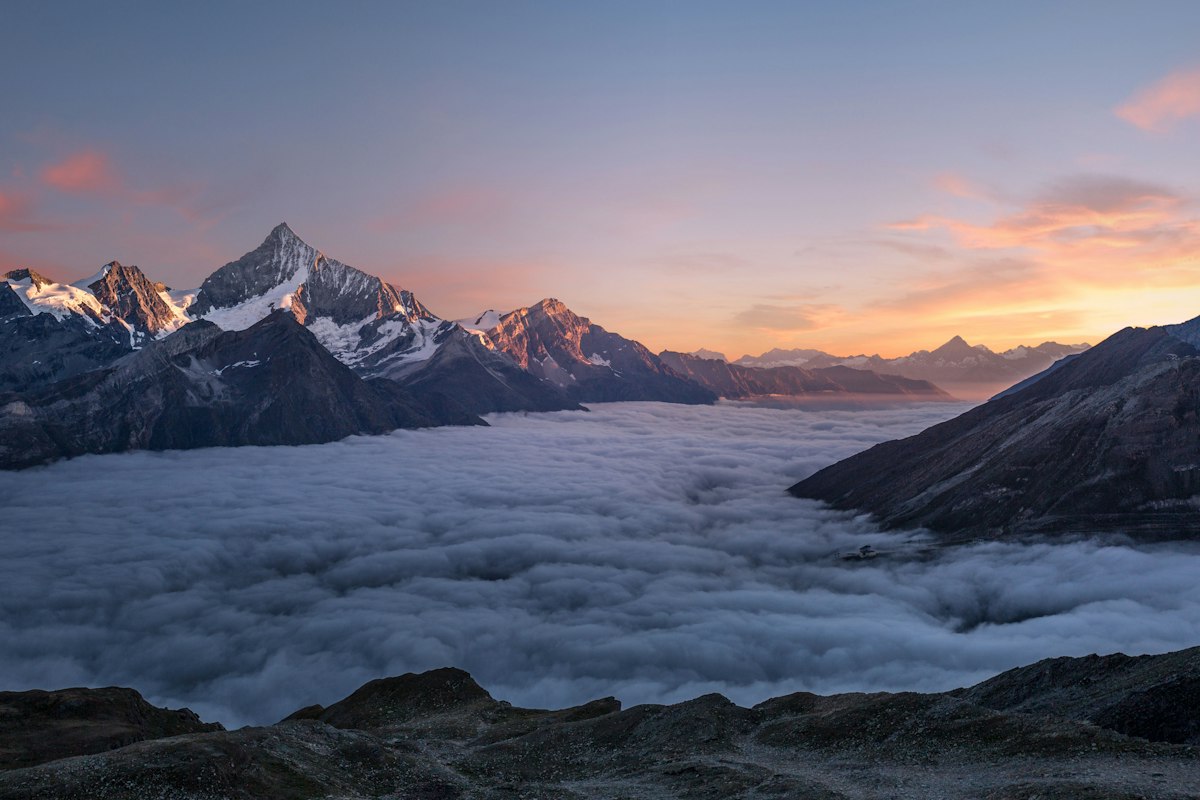
Harder Kulm is one of the best sunset viewpoints in the Bernese Oberland. In summer, the funicular runs until 21:00 or later (check the seasonal schedule), and watching the sun set behind the Bluemlisalp and the alpenglow light up the Eiger north face in shades of pink and gold is one of Interlaken's great experiences. The restaurant offers special sunset dinner packages that combine a meal with the evening light show.

Geology of the Harder Ridge

The Harder ridge is composed of the same Cretaceous limestone (Schrattenkalk) that forms many of the Pre-Alpine peaks of the Bernese Oberland. This rock, deposited approximately 110 to 120 million years ago on the floor of a shallow tropical sea, was later uplifted and tilted by the Alpine orogeny. The layers are visible in the cliff faces below the summit -- horizontal bands of grey and cream limestone, sometimes containing fossil fragments.

The Harder ridge is part of the Helvetic nappe system -- a series of massive rock sheets that were pushed northward over the Swiss Mittelland during the collision of the European and African tectonic plates. The geological complexity of the Harder is significant: beneath the limestone surface, layers of marl and shale create natural springs that emerge on the forested slopes, feeding small streams and creating the lush vegetation cover that characterizes the mountain.

The two lakes visible from the Harder Kulm -- Thunersee and Brienzersee -- were once a single, larger lake that filled the entire Interlaken valley during the late glacial period, approximately 10,000 years ago. The Lutschine river, flowing from the Lauterbrunnen and Grindelwald valleys, deposited enormous quantities of gravel and sediment at the point where it entered the lake, gradually building up the alluvial fan that now forms the dry land of Interlaken. Over thousands of years, this sediment fan grew until it divided the single lake into two separate bodies of water. Interlaken sits on this alluvial fan -- literally between the lakes, on land created by glacier meltwater.

The History of Tourism at Harder Kulm

The Harder has been a popular viewpoint since the early 19th century, when the first Grand Tour visitors to Interlaken discovered that the north side of the valley offered the finest views of the Jungfrau massif. A simple inn was established near the summit in the 1830s, and a mule path was constructed to make the ascent more comfortable.

The Harderbahn funicular was built in 1908 by the engineer Hans Studer, using the Strub rack system on a standard funicular design. The line was electrified from the start -- an early adopter of electric traction -- and has operated continuously since opening, with interruptions only for major maintenance. The current carriages date from a 2007 modernization that introduced panoramic windows while retaining the original alignment and infrastructure.

The Two Lakes Bridge (Zwei-Seen-Steg), added in 2011, transformed the Harder Kulm from a pleasant local viewpoint into an internationally recognized destination. The cantilevered platform, designed by the architectural firm Briccola & De Maddalena, extends 18 meters from the cliff edge and includes a glass floor panel that reveals the drop beneath. The bridge was inspired by similar viewing platforms at other Swiss mountains and has become one of the most photographed locations in the Bernese Oberland, particularly at sunset.

Hiking Options

For those wanting to extend the visit, several hiking trails depart from Harder Kulm. The ridge walk north to the Augstmatthorn (2,137 m) is a classic Bernese Oberland hike -- approximately 3 to 4 hours one way, with increasingly expansive views and a good chance of seeing ibex and chamois on the ridge. The trail is exposed in places and requires reasonable fitness and sure-footedness, but it is not technically difficult. The final ridge to the Augstmatthorn summit is narrow and exposed, with views plunging steeply to Lake Brienz on one side and the Habkern valley on the other.

A gentler option is the panoramic trail south from Harder Kulm along the ridge, which offers continuous views of the Jungfrau massif and descends gradually through forest back toward Interlaken. This walk takes approximately 1.5 to 2 hours and is suitable for all fitness levels.

In autumn, the forests on the Harder are spectacular -- the beech trees turn golden, the maples blaze red, and the combination of autumn foliage, blue lakes, and snow-capped peaks creates one of the finest color compositions in the Bernese Oberland. The Harderbahn operates until late November, allowing visitors to enjoy the full autumn display.


Closing

[Duration: 3 minutes]

Your ch.tours Harder Kulm audio guide ends here. In just 10 minutes of funicular travel, you have gained 755 meters of altitude and arrived at one of the defining viewpoints of the Bernese Oberland -- a view that has drawn visitors to Interlaken for over two centuries.

Harder Kulm is the perfect introduction to the Bernese Oberland. It requires no special fitness, no high-altitude acclimatization, and no full-day commitment. Yet the view -- the twin lakes, the Eiger-Monch-Jungfrau trio, the glaciers and forests and the town of Interlaken laid out below you -- contains the essence of everything that makes this region extraordinary.

The great Victorian travelers who came to Interlaken -- Lord Byron, Felix Mendelssohn, Johannes Brahms, Mark Twain -- all looked up at these same peaks from the valley floor. From Harder Kulm, you see what they saw, but from above, with a perspective that reveals the full scale of the landscape they struggled to describe.

For deeper exploration of the Bernese Oberland, the ch.tours guides for the Jungfraujoch, Schilthorn, Niederhorn, Brienzer Rothorn, and Niesen all cover summits visible from where you are standing now.

Thank you for traveling with ch.tours today.


Source: ch.tours | Audio Guide Script | Last updated: March 2026 | Data from Jungfrau Railways (jungfrau.ch), Interlaken Tourism (interlaken.ch), MySwitzerland.com, SBB (sbb.ch), Swisstopo

Transcript

TL;DR: An audio guide for the Harder Kulm funicular from Interlaken (567 m) to Harder Kulm at 1,322 meters -- Interlaken's home mountain and the gateway viewpoint to the Bernese Oberland. This guide covers the 10-minute funicular ride, the Two Lakes Bridge (Zwei-Seen-Steg) glass viewing platform, and the panorama that frames the Eiger, Monch, and Jungfrau above the twin lakes of Thun and Brienz.


Journey Overview

Summit Harder Kulm, 1,322 m (4,337 ft)
Transport Harderbahn funicular: Interlaken (567 m) to Harder Kulm (1,322 m)
Journey time 10 minutes (one way)
Track length 1,436 m
Maximum gradient 64%
Operator Jungfrau Railways (jungfrau.ch)
Ticket price CHF 38 return from Interlaken (2026 prices)
Swiss Travel Pass 50% discount
Key attractions Two Lakes Bridge (Zwei-Seen-Steg) viewing platform, panoramic restaurant, ibex colony
Audio guide duration Approximately 30 minutes of narrated highlights
Season Mid-April to late November

Introduction -- Interlaken's Balcony

[Duration: 3 minutes]

Welcome to this ch.tours audio guide for Harder Kulm -- Interlaken's home mountain and one of the quickest routes to a world-class Alpine panorama anywhere in Switzerland.

In just 10 minutes, the Harderbahn funicular will lift you from the streets of Interlaken to a forested ridge at 1,322 meters, where a glass-floored viewing platform extends into the void between two lakes. From this platform, you will look directly at the Eiger, Monch, and Jungfrau -- the three peaks that define the Bernese Oberland -- while Lake Thun (Thunersee) glitters to the west and Lake Brienz (Brienzersee) glitters to the east. The two lakes, the town of Interlaken between them, and the wall of high peaks beyond: it is a panorama that justifies the journey to Switzerland all by itself.

Harder Kulm has been a popular viewpoint since the 19th century, when Interlaken was the basecamp for Grand Tour travelers visiting the Bernese Oberland. The funicular was built in 1908, replacing the mule path that had served visitors for decades, and it has been lifting tourists to the summit ever since. The Two Lakes Bridge (Zwei-Seen-Steg), a dramatic glass and steel viewing platform cantilevered out from the cliff edge, was added in 2011 and has become one of the most photographed viewpoints in the Bernese Oberland.

The name "Harder" comes from the local dialect and is unrelated to difficulty -- the mountain is actually one of the easiest summit experiences in the region. The "Kulm" means summit or peak. Together, Harder Kulm is simply "the summit of the Harder" -- Interlaken's friendly, accessible balcony over the Alps.


Stage 1: The Harderbahn Funicular

[Duration: 7 minutes of narration across 10 minutes of travel]

Departure from Interlaken

Elevation: 567 m

The Harderbahn valley station sits on the north side of Interlaken, across the Aare river from the main town. Interlaken's position between Lake Thun and Lake Brienz -- "between the lakes," as the name says -- is visible even from the valley station. The Aare river, which connects the two lakes, flows through Interlaken and continues northwest toward Bern and eventually the Rhine.

The funicular cabin departs and immediately begins a steep ascent through deciduous forest. The maximum gradient is 64%, which is steep even by Swiss funicular standards. You feel the incline in the tilt of the cabin -- the seats are angled to keep you roughly level, but the forest outside tilts dramatically.

Through the Forest

The forest on the Harder is a classic Central Swiss mixed forest: beech (Fagus sylvatica), Norway maple (Acer platanoides), and ash (Fraxinus excelsior) at the lower elevations, transitioning to Norway spruce (Picea abies) and silver fir (Abies alba) as you climb. The undergrowth is rich in ferns, mosses, and shade-loving wildflowers.

The Harder is part of a limestone ridge that runs along the north side of the Interlaken valley, separating the lake basin from the Habkern valley to the north. The rock is Cretaceous limestone, approximately 90 to 100 million years old, deposited on the floor of a shallow sea and later uplifted by the same tectonic forces that created the Alps.

Wildlife on the Harder

The Harder is home to a semi-wild colony of Alpine ibex (Capra ibex) and chamois (Rupicapra rupicapra). The ibex, which you may see on the rocky slopes near the summit, are impressive animals -- males can weigh up to 100 kg and carry curved horns over 90 cm long. The ibex was hunted to extinction in most of the Alps by the 19th century, surviving only in the Italian Gran Paradiso region. Reintroduction programs beginning in 1906 have successfully restored populations across Switzerland, and the Harder colony is one of the most accessible for visitors to observe.

The ibex are most often seen in the early morning or late afternoon on the rocky outcrops near the summit station. They are remarkably sure-footed, navigating near-vertical rock faces with an ease that seems to defy physics. Their hooves are uniquely adapted -- the outer edge is hard for gripping rock, while the inner sole is soft and flexible for friction on smooth surfaces.


Stage 2: The Harder Kulm Summit Experience

[Duration: 14 minutes of narration for approximately 1-2 hours of exploring]

The Two Lakes Bridge (Zwei-Seen-Steg)

Elevation: 1,322 m

Walk from the funicular station to the Two Lakes Bridge, a two-minute stroll along a level path. The platform is a steel and glass structure that extends out from the cliff edge, with a glass floor panel in its center. Step onto the glass and you are standing above a drop of several hundred meters, with the town of Interlaken directly below.

The bridge is named for the two lakes visible from it: Lake Thun (Thunersee) to the west and Lake Brienz (Brienzersee) to the east. Interlaken sits on the narrow strip of land between them, and from the Harder Kulm, you can see both lakes simultaneously -- a perspective that makes the town's name literal and immediate.

The Panorama

The view from the Two Lakes Bridge and the adjacent terraces is one of the most celebrated in the Bernese Oberland. Let me orient you.

South -- the Jungfrau massif: Directly ahead, the Eiger (3,967 m), Monch (4,107 m), and Jungfrau (4,158 m) rise in a wall of rock and ice. From Harder Kulm, you are looking at them from the north -- the same perspective that inspired the first Alpine tourists and still defines the Bernese Oberland's visual identity. The Jungfraujoch, the saddle between the Monch and Jungfrau where Europe's highest railway station sits at 3,454 m, is visible as a notch in the ridge.

To the left of the Eiger, the Wetterhorn (3,692 m) rises above the Grindelwald valley. The Wetterhorn's first ascent in 1854 by Alfred Wills is often cited as the beginning of the Golden Age of Alpinism. To the right of the Jungfrau, the Breithorn (3,780 m -- not to be confused with the Breithorn at Zermatt) and the Bluemlisalp (3,661 m) continue the chain of high peaks.

West -- Lake Thun (Thunersee): Lake Thun stretches to the west, a deep blue body of water 17.5 km long and up to 217 meters deep. The lake was carved by the Aare Glacier during the Ice Ages, and its shores are dotted with castles, villages, and medieval churches. The most famous, Spiez Castle, is visible on the southern shore on clear days -- a fairy-tale castle on a promontory above the water. The town of Thun, at the western end of the lake, is the gateway to the Bernese Oberland from Bern.

East -- Lake Brienz (Brienzersee): Lake Brienz extends to the east, smaller than Thunersee but often more intensely colored. Brienzersee is famous for its turquoise-green water -- the color comes from glacial flour (finely ground rock particles) carried into the lake by the Lutschine and Aare rivers from the glaciers above. The color is most intense in late spring and summer, when glacier meltwater is at its peak.

The Giessbach Falls, one of the most beautiful waterfalls in Switzerland, plunges 400 meters down the forested cliffs on the southern shore of Lake Brienz. The falls are illuminated at night and are accessible by a historic funicular from the lake shore. The village of Brienz, at the eastern end of the lake, is famous for woodcarving -- the Swiss tradition of carved wooden figures and chalets originates here.

North: Behind you, to the north, the rolling hills of the Emmental and the Mittelland stretch toward the Jura. The forested ridges of the Niederhorn and the Gemmenalphorn are in the middle distance, and on clear days, the Jura ridge is visible as a distant dark line on the horizon.

The Panoramic Restaurant

The Harder Kulm restaurant occupies a historic building at the summit, originally constructed in the early 20th century and renovated multiple times. The terrace is one of the finest outdoor dining spots in the Bernese Oberland, with tables directly facing the Eiger, Monch, and Jungfrau. The menu features regional specialties, and the rosti with local cheese is a reliable choice.

Sunset and Evening

Harder Kulm is one of the best sunset viewpoints in the Bernese Oberland. In summer, the funicular runs until 21:00 or later (check the seasonal schedule), and watching the sun set behind the Bluemlisalp and the alpenglow light up the Eiger north face in shades of pink and gold is one of Interlaken's great experiences. The restaurant offers special sunset dinner packages that combine a meal with the evening light show.

Geology of the Harder Ridge

The Harder ridge is composed of the same Cretaceous limestone (Schrattenkalk) that forms many of the Pre-Alpine peaks of the Bernese Oberland. This rock, deposited approximately 110 to 120 million years ago on the floor of a shallow tropical sea, was later uplifted and tilted by the Alpine orogeny. The layers are visible in the cliff faces below the summit -- horizontal bands of grey and cream limestone, sometimes containing fossil fragments.

The Harder ridge is part of the Helvetic nappe system -- a series of massive rock sheets that were pushed northward over the Swiss Mittelland during the collision of the European and African tectonic plates. The geological complexity of the Harder is significant: beneath the limestone surface, layers of marl and shale create natural springs that emerge on the forested slopes, feeding small streams and creating the lush vegetation cover that characterizes the mountain.

The two lakes visible from the Harder Kulm -- Thunersee and Brienzersee -- were once a single, larger lake that filled the entire Interlaken valley during the late glacial period, approximately 10,000 years ago. The Lutschine river, flowing from the Lauterbrunnen and Grindelwald valleys, deposited enormous quantities of gravel and sediment at the point where it entered the lake, gradually building up the alluvial fan that now forms the dry land of Interlaken. Over thousands of years, this sediment fan grew until it divided the single lake into two separate bodies of water. Interlaken sits on this alluvial fan -- literally between the lakes, on land created by glacier meltwater.

The History of Tourism at Harder Kulm

The Harder has been a popular viewpoint since the early 19th century, when the first Grand Tour visitors to Interlaken discovered that the north side of the valley offered the finest views of the Jungfrau massif. A simple inn was established near the summit in the 1830s, and a mule path was constructed to make the ascent more comfortable.

The Harderbahn funicular was built in 1908 by the engineer Hans Studer, using the Strub rack system on a standard funicular design. The line was electrified from the start -- an early adopter of electric traction -- and has operated continuously since opening, with interruptions only for major maintenance. The current carriages date from a 2007 modernization that introduced panoramic windows while retaining the original alignment and infrastructure.

The Two Lakes Bridge (Zwei-Seen-Steg), added in 2011, transformed the Harder Kulm from a pleasant local viewpoint into an internationally recognized destination. The cantilevered platform, designed by the architectural firm Briccola & De Maddalena, extends 18 meters from the cliff edge and includes a glass floor panel that reveals the drop beneath. The bridge was inspired by similar viewing platforms at other Swiss mountains and has become one of the most photographed locations in the Bernese Oberland, particularly at sunset.

Hiking Options

For those wanting to extend the visit, several hiking trails depart from Harder Kulm. The ridge walk north to the Augstmatthorn (2,137 m) is a classic Bernese Oberland hike -- approximately 3 to 4 hours one way, with increasingly expansive views and a good chance of seeing ibex and chamois on the ridge. The trail is exposed in places and requires reasonable fitness and sure-footedness, but it is not technically difficult. The final ridge to the Augstmatthorn summit is narrow and exposed, with views plunging steeply to Lake Brienz on one side and the Habkern valley on the other.

A gentler option is the panoramic trail south from Harder Kulm along the ridge, which offers continuous views of the Jungfrau massif and descends gradually through forest back toward Interlaken. This walk takes approximately 1.5 to 2 hours and is suitable for all fitness levels.

In autumn, the forests on the Harder are spectacular -- the beech trees turn golden, the maples blaze red, and the combination of autumn foliage, blue lakes, and snow-capped peaks creates one of the finest color compositions in the Bernese Oberland. The Harderbahn operates until late November, allowing visitors to enjoy the full autumn display.


Closing

[Duration: 3 minutes]

Your ch.tours Harder Kulm audio guide ends here. In just 10 minutes of funicular travel, you have gained 755 meters of altitude and arrived at one of the defining viewpoints of the Bernese Oberland -- a view that has drawn visitors to Interlaken for over two centuries.

Harder Kulm is the perfect introduction to the Bernese Oberland. It requires no special fitness, no high-altitude acclimatization, and no full-day commitment. Yet the view -- the twin lakes, the Eiger-Monch-Jungfrau trio, the glaciers and forests and the town of Interlaken laid out below you -- contains the essence of everything that makes this region extraordinary.

The great Victorian travelers who came to Interlaken -- Lord Byron, Felix Mendelssohn, Johannes Brahms, Mark Twain -- all looked up at these same peaks from the valley floor. From Harder Kulm, you see what they saw, but from above, with a perspective that reveals the full scale of the landscape they struggled to describe.

For deeper exploration of the Bernese Oberland, the ch.tours guides for the Jungfraujoch, Schilthorn, Niederhorn, Brienzer Rothorn, and Niesen all cover summits visible from where you are standing now.

Thank you for traveling with ch.tours today.


Source: ch.tours | Audio Guide Script | Last updated: March 2026 | Data from Jungfrau Railways (jungfrau.ch), Interlaken Tourism (interlaken.ch), MySwitzerland.com, SBB (sbb.ch), Swisstopo