Skip to content
Gornergrat Experience Audio Guide
Walking Tour

Gornergrat Experience Audio Guide

Updated 3 mars 2026
Cover: Gornergrat Experience Audio Guide

Gornergrat Experience Audio Guide

Walking Tour Tour

0:00 0:00

TL;DR: An audio guide for the Gornergrat cogwheel railway from Zermatt (1,604 m) to the Gornergrat summit at 3,089 meters -- offering the finest close-up panorama of the Matterhorn and views of 29 peaks above 4,000 meters. This guide covers the 33-minute rack railway ascent, the Gorner Glacier viewpoint, the 3100 Kulmhotel Gornergrat (the highest hotel in the Swiss Alps), and the identification of the extraordinary ring of 4,000-meter peaks visible from the summit.


Journey Overview

Summit Gornergrat, 3,089 m (10,132 ft)
Railway Gornergrat Bahn: Zermatt (1,604 m) to Gornergrat (3,089 m)
Track length 9.34 km
Journey time 33 minutes (one way)
Maximum gradient 20%
Operator Gornergrat Bahn (gornergrat.ch)
Ticket price CHF 100 return from Zermatt (2026 prices)
Swiss Travel Pass 50% discount
Key attractions 29 four-thousanders visible, Matterhorn panorama, Gorner Glacier, Riffelsee, 3100 Kulmhotel Gornergrat
Audio guide duration Approximately 45 minutes of narrated highlights
Year opened 20 August 1898 -- first fully electric rack railway in Switzerland

Introduction -- The Matterhorn's Grandstand

[Duration: 4 minutes]

Welcome to this ch.tours audio guide for the Gornergrat -- the finest viewpoint for the Matterhorn and one of the most spectacular mountain panoramas on Earth. Over the next 33 minutes, a cogwheel railway will carry you from the streets of Zermatt at 1,604 meters to a rocky ridge at 3,089 meters, and the view that awaits you at the top is, by any measure, extraordinary.

Let me give you the headline number: from the Gornergrat summit, you can see 29 peaks above 4,000 meters. Twenty-nine. There are only 82 four-thousanders in the entire Alps, and more than a third of them are visible from this single point. The Monte Rosa massif (4,634 m, the highest point in Switzerland) is directly before you. The Matterhorn (4,478 m) stands to the southwest, its pyramidal silhouette so perfect it almost looks artificial. The Weisshorn (4,506 m), the Dent Blanche (4,357 m), the Dom (4,545 m, the highest peak entirely within Switzerland), the Liskamm (4,527 m), Castor and Pollux, the Breithorn (4,164 m) -- the list goes on and on. No other viewpoint in the Alps places you at the center of such a concentration of high peaks.

The Gornergrat Bahn, the railway you are about to ride, opened on 20 August 1898. It was the first fully electric rack railway in Switzerland, a technological leap that required laying 9.34 km of track from the village to the summit ridge, with a maximum gradient of 20%. The railway was built in just three years -- from 1896 to 1898 -- using construction methods that seem impossibly ambitious: dynamiting rock ledges, building stone bridges across ravines, and laying track on permafrost at over 3,000 meters. The line has operated continuously since opening, running year-round and carrying visitors in every season.

The railway departs from a station directly opposite the Zermatt main station -- cross the street and you are there. Board the train, find a seat on the right side for the best Matterhorn views during the ascent, and let the mountain come to you.


Stage 1: Zermatt to Riffelalp

[Duration: 8 minutes of narration across approximately 12 minutes of travel]

Departure from Zermatt

Elevation: 1,604 m

The Gornergrat Bahn departs Zermatt and immediately begins climbing through the upper streets of the village. Zermatt is car-free -- combustion engines have been banned since 1947 -- and the only motorized vehicles you see are the small electric taxis and delivery carts that serve the village. The ban was originally motivated not by environmentalism but by the narrow medieval streets and the desire to preserve the village's character for tourism.

Look to the right as the train climbs above the village. The Matterhorn (4,478 m) is visible from the first minutes of the journey, rising above the rooftops. Its distinctive shape -- a four-sided pyramid with faces oriented toward the four cardinal compass points -- is the result of erosion by glaciers that carved each face from a different direction simultaneously. The Matterhorn is a horn peak (Pyramidalberg), one of the textbook examples of this landform in geological science.

The first ascent of the Matterhorn, on 14 July 1865 by Edward Whymper and his party of seven, is one of the most famous and tragic events in mountaineering history. Four of the seven-member team fell to their deaths during the descent when a rope broke above the north face. The disaster shocked Victorian society and was debated in the House of Commons. Whymper himself never fully recovered from the trauma and the controversy that followed.

Climbing Through the Larch Forest

Elevation: 1,604 m to 2,222 m

The train climbs through a forest of European larch (Larix decidua) -- the only conifer in Europe that sheds its needles in autumn. In October, the larch forests above Zermatt turn a brilliant gold that contrasts spectacularly with the white peaks and blue sky. The autumn larch display draws photographers from around the world, and the Gornergrat railway through the golden forest is one of the iconic images of Swiss autumn.

In summer, the larch forest is a deep, rich green, and the undergrowth is full of bilberry bushes, Alpine rhododendrons, and wild strawberries. The forest thins as you climb, and by approximately 2,000 meters, the trees are scattered and stunted, twisted by wind and snow into characteristically gnarled shapes.

Riffelalp

Elevation: 2,222 m

The train pauses at Riffelalp, where the Riffelalp Resort (2,222 m) claims to be the highest luxury hotel accessible by rail in the Swiss Alps. The resort has its own tiny tramway -- the Riffelalp Tram -- that connects the railway station to the hotel, operating on a 675-meter track that is one of the shortest and highest tramways in the world.

From Riffelalp, the Matterhorn view is already commanding. The mountain fills the southwestern sky, its Hornli Ridge (the normal ascent route) clearly visible as the right-hand skyline of the peak. On a clear morning, you can often see climbers on the ridge as tiny dots against the rock.


Stage 2: Riffelalp to Rotenboden

[Duration: 8 minutes of narration across approximately 10 minutes of travel]

Riffelberg

Elevation: 2,582 m

The next stop, Riffelberg, offers a widening panorama. As you gain altitude, more of the surrounding peaks emerge from behind the foreground ridges. The Monte Rosa massif (4,634 m) begins to appear to the south -- a broad, heavily glaciated mass that is the highest mountain in Switzerland and the second highest in the Alps after Mont Blanc.

The Riffelberg was the site of Mark Twain's satirical account of an Alpine expedition in "A Tramp Abroad" (1880), in which he described reaching the Riffelberg as if it were a major Himalayan ascent, complete with a large expedition party, supplies, and dramatic perils. The satire was aimed at the breathless mountaineering literature of the Victorian era, and it remains very funny.

The Gorner Glacier

As you climb above Riffelberg, look to the left (south). The Gorner Glacier (Gornergletscher) comes into view -- the second-largest glacier in the Alps after the Aletsch. The Gorner Glacier is approximately 12 km long and covers roughly 40 square kilometers of the Monte Rosa massif. Its surface is a chaotic landscape of crevasses, seracs, and dark moraine stripes -- bands of rock debris carried within and on top of the flowing ice.

The Gorner Glacier has been retreating significantly. In the mid-19th century, it extended much further down the valley, and historical photographs show its terminus far below its current position. Like all Alpine glaciers, it is losing mass annually, and the dark moraine debris on its surface accelerates melting by absorbing solar heat. Glaciologists at ETH Zurich maintain a permanent monitoring station on the Gorner Glacier, and their data contributes to the global record of glacier retreat.

Rotenboden -- the Riffelsee

Elevation: 2,815 m

Rotenboden station, at 2,815 meters, is worth a stop on a clear day. A five-minute walk from the station brings you to the Riffelsee, a small alpine lake that is one of the most photographed spots in Switzerland. On a calm day, the Matterhorn reflects perfectly in the still waters of the lake -- the classic Matterhorn mirror image that appears on postcards, chocolate boxes, and tourism advertisements worldwide.

The Riffelsee is frozen from approximately October to June. The best conditions for the reflection photograph are in July, August, and September, in the early morning or late afternoon when the wind is calm. If conditions are right, it is worth stepping off the train and walking to the lake. The train runs frequently, and you can catch the next one.

The area around the Riffelsee is also excellent for observing Alpine flora at high altitude. Despite the elevation, the meadows support a surprising diversity of plants: the glacier crowfoot (Ranunculus glacialis), which holds the altitude record for flowering plants in the Alps (found up to 4,274 m on the Finsteraarhorn); the purple saxifrage (Saxifraga oppositifolia); and various species of gentian and Alpine aster. These plants have evolved remarkable adaptations to survive -- compact rosette forms that resist wind, thick waxy leaves that reduce water loss, and dark pigmentation that absorbs heat.


Stage 3: Rotenboden to Gornergrat Summit

[Duration: 6 minutes of narration across approximately 8 minutes of travel]

The Final Ascent

Elevation: climbing from 2,815 m to 3,089 m

The final stretch of the Gornergrat Bahn climbs above the tree and shrub line into a landscape of bare rock, scree, and permanent snow patches. The railway track is laid on rock and gravel, and in winter, the snow can reach the level of the carriage windows. Snowplows attached to the front of the trains keep the line open year-round.

As you approach the summit, the panorama expands to its full glory. Peaks appear in every direction, and the sense of being surrounded by high mountains intensifies. The Monte Rosa massif, which has been visible for several stations, now reveals its full scale -- a wall of ice and rock 4,634 meters high, the highest point in Switzerland.

Arrival at Gornergrat

Elevation: 3,089 m

The train reaches the summit terminus at 3,089 meters. Step onto the platform and walk to the viewing terrace. You are standing on a narrow rocky ridge with panoramic views in every direction, and the sight is overwhelming.


Stage 4: The Gornergrat Summit Experience

[Duration: 14 minutes of narration for approximately 1-2 hours of exploring]

Identifying the 29 Four-Thousanders

The Gornergrat panorama is best understood by rotating slowly and identifying the peaks. Let me guide you through them.

Southwest -- the Matterhorn: The Matterhorn (4,478 m) is directly to the southwest, unmistakable in its isolation and symmetry. From the Gornergrat, you see the east face and the Hornli Ridge (the normal ascent route, on the right skyline). The Matterhorn is technically in the Pennine Alps, on the Swiss-Italian border -- the Italian side of the mountain is known as Monte Cervino.

The mountain was famously the last great Alpine peak to be climbed, its first ascent on 14 July 1865 coming just hours before an Italian team approached from the other side. Today, approximately 3,000 climbers attempt the Matterhorn each year via the Hornli Ridge, and it remains a serious mountaineering objective despite its touristic fame. The Hornli Hut (3,260 m), the starting point for the normal route, is visible from the Gornergrat as a small structure on the ridge descending to the right of the summit.

South -- Monte Rosa and the Gorner Glacier: The Monte Rosa massif dominates the southern view. Its highest point, the Dufourspitze (4,634 m), was named after Guillaume-Henri Dufour, the Swiss general who led the federal army during the Sonderbund War of 1847 and later founded the International Red Cross. The first ascent was made on 1 August 1855 by a party led by Charles Hudson (who would die on the Matterhorn ten years later).

Between you and Monte Rosa, the Gorner Glacier fills the valley. To the left of Monte Rosa, the Liskamm (4,527 m) -- known as the "man-eater" for its avalanche-prone ridges -- rises as a long, corniced ridge of ice.

Southeast -- Castor, Pollux, and the Breithorn: Continuing to the southeast, the twin summits of Castor (4,223 m) and Pollux (4,092 m) are visible. Beyond them, the Breithorn (4,164 m) is the most-climbed 4,000-meter peak in the Alps -- its normal route from the Klein Matterhorn cable car station is a glacier walk of moderate difficulty that attracts thousands of mountaineers each year.

East -- the Strahlhorn, Rimpfischhorn, and Allalinhorn: To the east, the Strahlhorn (4,190 m), Rimpfischhorn (4,199 m), and Allalinhorn (4,027 m) form a wall of glaciated peaks above the Findel Glacier.

Northeast and North -- the Weisshorn and Dom: Looking northeast, the Weisshorn (4,506 m) is one of the most beautiful mountains in the Alps -- a near-perfect pyramid of ice and rock that many mountaineers consider more aesthetically satisfying than the Matterhorn. Further north, the Dom (4,545 m) is the highest peak entirely within Swiss territory (Monte Rosa straddles the Italian border).

The Weisshorn's first ascent in 1861 by John Tyndall, the Irish physicist who pioneered the study of glaciers and the greenhouse effect, was one of the great achievements of the Golden Age of Alpinism (roughly 1854-1865).

The 3100 Kulmhotel Gornergrat

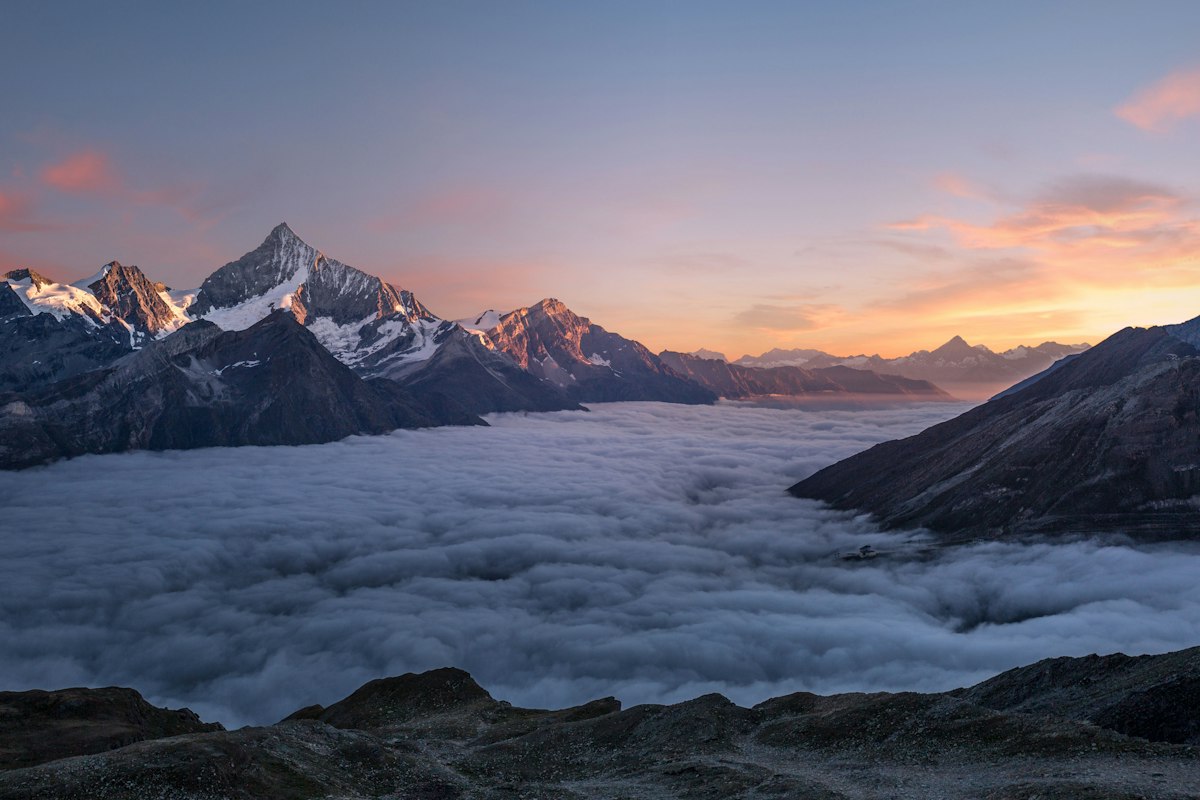
The hotel at the summit -- the 3100 Kulmhotel Gornergrat -- is the highest hotel in the Swiss Alps. Originally built in 1896 alongside the railway, the current building was renovated in 2018 and offers modern rooms with floor-to-ceiling windows facing the Matterhorn and Monte Rosa. Sleeping at 3,100 meters is an experience in itself -- the night sky, free of light pollution, is spectacular, and sunrise on the Matterhorn (the "golden hour" when the peak glows pink and gold) is visible directly from the hotel windows.

The hotel also houses the Stellarium Gornergrat, a small astronomical observatory used by the University of Bern for research and public stargazing sessions. The altitude and the dry, clear air of the Zermatt valley make the Gornergrat one of the best astronomical observation sites in Switzerland.

Gorner Glacier Viewpoint

Walk along the summit ridge to the south side for the best views of the Gorner Glacier. From this vantage point, you can see the full sweep of the glacier from its source on the Monte Rosa massif to its terminus far below. The dark lateral moraines -- lines of rock debris pushed to the glacier's edges by the flowing ice -- are clearly visible, as are the medial moraines where tributary glaciers merge.

The surface of the Gorner Glacier is heavily crevassed in its lower reaches, where the gradient steepens and the ice fractures under stress. These crevasses can be 30 meters deep or more and are a serious hazard for mountaineers crossing the glacier. In summer, meltwater streams run across the ice surface and plunge into crevasses with a roar audible from the Gornergrat.


The Descent

[Duration: 5 minutes of narration]

Walking Down vs. Taking the Train

The descent from the Gornergrat to Zermatt can be made by train, on foot, or by a combination of both. The hiking trail from the summit to Zermatt takes approximately 3 to 4 hours and passes through the Riffelsee area, the larch forests, and the Alpine meadows, with the Matterhorn as a constant companion. The trail is well-marked and not technically difficult, but the altitude and the length require reasonable fitness.

A popular option is to ride the train from the summit to Rotenboden (2,815 m), walk down to the Riffelsee for photographs, then continue on foot to Riffelberg (2,582 m) and take the train the rest of the way. This gives you the best of both -- the iconic Riffelsee views and a manageable walk, without the full three-hour descent.

Zermatt in the Evening

Returning to Zermatt in the late afternoon or evening is a pleasure. The car-free village comes alive with visitors strolling the main street (Bahnhofstrasse), dining at restaurants with terrace views of the Matterhorn, and shopping in the boutiques and sport shops that line the pedestrian zone. The Matterhorn Museum -- Zermatlantis, a subterranean museum in the village center, tells the story of the first ascent and the development of Zermatt as a mountaineering capital. The actual broken rope from the 1865 Matterhorn disaster is on display -- a haunting artifact.


Closing

[Duration: 3 minutes]

Your ch.tours Gornergrat audio guide ends here. In 33 minutes of railway travel, you have ascended from the streets of Zermatt to a ridge at 3,089 meters surrounded by the greatest concentration of high peaks in the Alps. Twenty-nine four-thousanders. The Matterhorn. Monte Rosa. The Gorner Glacier. The view from the Gornergrat is not just scenic -- it is a lesson in Alpine geology, glaciology, and the history of mountaineering, all delivered in a single, breathtaking panorama.

The Gornergrat Bahn has been making this journey since 1898 -- over 125 years of continuous service. In that time, the glaciers visible from the summit have retreated dramatically, the villages below have grown, and the technology of the railway has been updated multiple times. But the mountains remain. The Matterhorn is still there, in the same place, in the same shape, as immovable and indifferent as it was when Edward Whymper first saw it. That is the paradox of the Alps: they are changing constantly -- glaciers retreating, rock falling, climate shifting -- and yet they feel eternal.

For more Zermatt experiences, the ch.tours guides for Zermatt village, the Matterhorn Glacier Paradise (Klein Matterhorn), and the Five Lakes Walk cover the full range of what this remarkable mountain region offers.

Thank you for traveling with ch.tours today.


Source: ch.tours | Audio Guide Script | Last updated: March 2026 | Data from Gornergrat Bahn (gornergrat.ch), Zermatt Tourism (zermatt.ch), MySwitzerland.com, SBB (sbb.ch), Swisstopo, Swiss Alpine Club (SAC)

Transcript

TL;DR: An audio guide for the Gornergrat cogwheel railway from Zermatt (1,604 m) to the Gornergrat summit at 3,089 meters -- offering the finest close-up panorama of the Matterhorn and views of 29 peaks above 4,000 meters. This guide covers the 33-minute rack railway ascent, the Gorner Glacier viewpoint, the 3100 Kulmhotel Gornergrat (the highest hotel in the Swiss Alps), and the identification of the extraordinary ring of 4,000-meter peaks visible from the summit.


Journey Overview

Summit Gornergrat, 3,089 m (10,132 ft)
Railway Gornergrat Bahn: Zermatt (1,604 m) to Gornergrat (3,089 m)
Track length 9.34 km
Journey time 33 minutes (one way)
Maximum gradient 20%
Operator Gornergrat Bahn (gornergrat.ch)
Ticket price CHF 100 return from Zermatt (2026 prices)
Swiss Travel Pass 50% discount
Key attractions 29 four-thousanders visible, Matterhorn panorama, Gorner Glacier, Riffelsee, 3100 Kulmhotel Gornergrat
Audio guide duration Approximately 45 minutes of narrated highlights
Year opened 20 August 1898 -- first fully electric rack railway in Switzerland

Introduction -- The Matterhorn's Grandstand

[Duration: 4 minutes]

Welcome to this ch.tours audio guide for the Gornergrat -- the finest viewpoint for the Matterhorn and one of the most spectacular mountain panoramas on Earth. Over the next 33 minutes, a cogwheel railway will carry you from the streets of Zermatt at 1,604 meters to a rocky ridge at 3,089 meters, and the view that awaits you at the top is, by any measure, extraordinary.

Let me give you the headline number: from the Gornergrat summit, you can see 29 peaks above 4,000 meters. Twenty-nine. There are only 82 four-thousanders in the entire Alps, and more than a third of them are visible from this single point. The Monte Rosa massif (4,634 m, the highest point in Switzerland) is directly before you. The Matterhorn (4,478 m) stands to the southwest, its pyramidal silhouette so perfect it almost looks artificial. The Weisshorn (4,506 m), the Dent Blanche (4,357 m), the Dom (4,545 m, the highest peak entirely within Switzerland), the Liskamm (4,527 m), Castor and Pollux, the Breithorn (4,164 m) -- the list goes on and on. No other viewpoint in the Alps places you at the center of such a concentration of high peaks.

The Gornergrat Bahn, the railway you are about to ride, opened on 20 August 1898. It was the first fully electric rack railway in Switzerland, a technological leap that required laying 9.34 km of track from the village to the summit ridge, with a maximum gradient of 20%. The railway was built in just three years -- from 1896 to 1898 -- using construction methods that seem impossibly ambitious: dynamiting rock ledges, building stone bridges across ravines, and laying track on permafrost at over 3,000 meters. The line has operated continuously since opening, running year-round and carrying visitors in every season.

The railway departs from a station directly opposite the Zermatt main station -- cross the street and you are there. Board the train, find a seat on the right side for the best Matterhorn views during the ascent, and let the mountain come to you.


Stage 1: Zermatt to Riffelalp

[Duration: 8 minutes of narration across approximately 12 minutes of travel]

Departure from Zermatt

Elevation: 1,604 m

The Gornergrat Bahn departs Zermatt and immediately begins climbing through the upper streets of the village. Zermatt is car-free -- combustion engines have been banned since 1947 -- and the only motorized vehicles you see are the small electric taxis and delivery carts that serve the village. The ban was originally motivated not by environmentalism but by the narrow medieval streets and the desire to preserve the village's character for tourism.

Look to the right as the train climbs above the village. The Matterhorn (4,478 m) is visible from the first minutes of the journey, rising above the rooftops. Its distinctive shape -- a four-sided pyramid with faces oriented toward the four cardinal compass points -- is the result of erosion by glaciers that carved each face from a different direction simultaneously. The Matterhorn is a horn peak (Pyramidalberg), one of the textbook examples of this landform in geological science.

The first ascent of the Matterhorn, on 14 July 1865 by Edward Whymper and his party of seven, is one of the most famous and tragic events in mountaineering history. Four of the seven-member team fell to their deaths during the descent when a rope broke above the north face. The disaster shocked Victorian society and was debated in the House of Commons. Whymper himself never fully recovered from the trauma and the controversy that followed.

Climbing Through the Larch Forest

Elevation: 1,604 m to 2,222 m

The train climbs through a forest of European larch (Larix decidua) -- the only conifer in Europe that sheds its needles in autumn. In October, the larch forests above Zermatt turn a brilliant gold that contrasts spectacularly with the white peaks and blue sky. The autumn larch display draws photographers from around the world, and the Gornergrat railway through the golden forest is one of the iconic images of Swiss autumn.

In summer, the larch forest is a deep, rich green, and the undergrowth is full of bilberry bushes, Alpine rhododendrons, and wild strawberries. The forest thins as you climb, and by approximately 2,000 meters, the trees are scattered and stunted, twisted by wind and snow into characteristically gnarled shapes.

Riffelalp

Elevation: 2,222 m

The train pauses at Riffelalp, where the Riffelalp Resort (2,222 m) claims to be the highest luxury hotel accessible by rail in the Swiss Alps. The resort has its own tiny tramway -- the Riffelalp Tram -- that connects the railway station to the hotel, operating on a 675-meter track that is one of the shortest and highest tramways in the world.

From Riffelalp, the Matterhorn view is already commanding. The mountain fills the southwestern sky, its Hornli Ridge (the normal ascent route) clearly visible as the right-hand skyline of the peak. On a clear morning, you can often see climbers on the ridge as tiny dots against the rock.


Stage 2: Riffelalp to Rotenboden

[Duration: 8 minutes of narration across approximately 10 minutes of travel]

Riffelberg

Elevation: 2,582 m

The next stop, Riffelberg, offers a widening panorama. As you gain altitude, more of the surrounding peaks emerge from behind the foreground ridges. The Monte Rosa massif (4,634 m) begins to appear to the south -- a broad, heavily glaciated mass that is the highest mountain in Switzerland and the second highest in the Alps after Mont Blanc.

The Riffelberg was the site of Mark Twain's satirical account of an Alpine expedition in "A Tramp Abroad" (1880), in which he described reaching the Riffelberg as if it were a major Himalayan ascent, complete with a large expedition party, supplies, and dramatic perils. The satire was aimed at the breathless mountaineering literature of the Victorian era, and it remains very funny.

The Gorner Glacier

As you climb above Riffelberg, look to the left (south). The Gorner Glacier (Gornergletscher) comes into view -- the second-largest glacier in the Alps after the Aletsch. The Gorner Glacier is approximately 12 km long and covers roughly 40 square kilometers of the Monte Rosa massif. Its surface is a chaotic landscape of crevasses, seracs, and dark moraine stripes -- bands of rock debris carried within and on top of the flowing ice.

The Gorner Glacier has been retreating significantly. In the mid-19th century, it extended much further down the valley, and historical photographs show its terminus far below its current position. Like all Alpine glaciers, it is losing mass annually, and the dark moraine debris on its surface accelerates melting by absorbing solar heat. Glaciologists at ETH Zurich maintain a permanent monitoring station on the Gorner Glacier, and their data contributes to the global record of glacier retreat.

Rotenboden -- the Riffelsee

Elevation: 2,815 m

Rotenboden station, at 2,815 meters, is worth a stop on a clear day. A five-minute walk from the station brings you to the Riffelsee, a small alpine lake that is one of the most photographed spots in Switzerland. On a calm day, the Matterhorn reflects perfectly in the still waters of the lake -- the classic Matterhorn mirror image that appears on postcards, chocolate boxes, and tourism advertisements worldwide.

The Riffelsee is frozen from approximately October to June. The best conditions for the reflection photograph are in July, August, and September, in the early morning or late afternoon when the wind is calm. If conditions are right, it is worth stepping off the train and walking to the lake. The train runs frequently, and you can catch the next one.

The area around the Riffelsee is also excellent for observing Alpine flora at high altitude. Despite the elevation, the meadows support a surprising diversity of plants: the glacier crowfoot (Ranunculus glacialis), which holds the altitude record for flowering plants in the Alps (found up to 4,274 m on the Finsteraarhorn); the purple saxifrage (Saxifraga oppositifolia); and various species of gentian and Alpine aster. These plants have evolved remarkable adaptations to survive -- compact rosette forms that resist wind, thick waxy leaves that reduce water loss, and dark pigmentation that absorbs heat.


Stage 3: Rotenboden to Gornergrat Summit

[Duration: 6 minutes of narration across approximately 8 minutes of travel]

The Final Ascent

Elevation: climbing from 2,815 m to 3,089 m

The final stretch of the Gornergrat Bahn climbs above the tree and shrub line into a landscape of bare rock, scree, and permanent snow patches. The railway track is laid on rock and gravel, and in winter, the snow can reach the level of the carriage windows. Snowplows attached to the front of the trains keep the line open year-round.

As you approach the summit, the panorama expands to its full glory. Peaks appear in every direction, and the sense of being surrounded by high mountains intensifies. The Monte Rosa massif, which has been visible for several stations, now reveals its full scale -- a wall of ice and rock 4,634 meters high, the highest point in Switzerland.

Arrival at Gornergrat

Elevation: 3,089 m

The train reaches the summit terminus at 3,089 meters. Step onto the platform and walk to the viewing terrace. You are standing on a narrow rocky ridge with panoramic views in every direction, and the sight is overwhelming.


Stage 4: The Gornergrat Summit Experience

[Duration: 14 minutes of narration for approximately 1-2 hours of exploring]

Identifying the 29 Four-Thousanders

The Gornergrat panorama is best understood by rotating slowly and identifying the peaks. Let me guide you through them.

Southwest -- the Matterhorn: The Matterhorn (4,478 m) is directly to the southwest, unmistakable in its isolation and symmetry. From the Gornergrat, you see the east face and the Hornli Ridge (the normal ascent route, on the right skyline). The Matterhorn is technically in the Pennine Alps, on the Swiss-Italian border -- the Italian side of the mountain is known as Monte Cervino.

The mountain was famously the last great Alpine peak to be climbed, its first ascent on 14 July 1865 coming just hours before an Italian team approached from the other side. Today, approximately 3,000 climbers attempt the Matterhorn each year via the Hornli Ridge, and it remains a serious mountaineering objective despite its touristic fame. The Hornli Hut (3,260 m), the starting point for the normal route, is visible from the Gornergrat as a small structure on the ridge descending to the right of the summit.

South -- Monte Rosa and the Gorner Glacier: The Monte Rosa massif dominates the southern view. Its highest point, the Dufourspitze (4,634 m), was named after Guillaume-Henri Dufour, the Swiss general who led the federal army during the Sonderbund War of 1847 and later founded the International Red Cross. The first ascent was made on 1 August 1855 by a party led by Charles Hudson (who would die on the Matterhorn ten years later).

Between you and Monte Rosa, the Gorner Glacier fills the valley. To the left of Monte Rosa, the Liskamm (4,527 m) -- known as the "man-eater" for its avalanche-prone ridges -- rises as a long, corniced ridge of ice.

Southeast -- Castor, Pollux, and the Breithorn: Continuing to the southeast, the twin summits of Castor (4,223 m) and Pollux (4,092 m) are visible. Beyond them, the Breithorn (4,164 m) is the most-climbed 4,000-meter peak in the Alps -- its normal route from the Klein Matterhorn cable car station is a glacier walk of moderate difficulty that attracts thousands of mountaineers each year.

East -- the Strahlhorn, Rimpfischhorn, and Allalinhorn: To the east, the Strahlhorn (4,190 m), Rimpfischhorn (4,199 m), and Allalinhorn (4,027 m) form a wall of glaciated peaks above the Findel Glacier.

Northeast and North -- the Weisshorn and Dom: Looking northeast, the Weisshorn (4,506 m) is one of the most beautiful mountains in the Alps -- a near-perfect pyramid of ice and rock that many mountaineers consider more aesthetically satisfying than the Matterhorn. Further north, the Dom (4,545 m) is the highest peak entirely within Swiss territory (Monte Rosa straddles the Italian border).

The Weisshorn's first ascent in 1861 by John Tyndall, the Irish physicist who pioneered the study of glaciers and the greenhouse effect, was one of the great achievements of the Golden Age of Alpinism (roughly 1854-1865).

The 3100 Kulmhotel Gornergrat

The hotel at the summit -- the 3100 Kulmhotel Gornergrat -- is the highest hotel in the Swiss Alps. Originally built in 1896 alongside the railway, the current building was renovated in 2018 and offers modern rooms with floor-to-ceiling windows facing the Matterhorn and Monte Rosa. Sleeping at 3,100 meters is an experience in itself -- the night sky, free of light pollution, is spectacular, and sunrise on the Matterhorn (the "golden hour" when the peak glows pink and gold) is visible directly from the hotel windows.

The hotel also houses the Stellarium Gornergrat, a small astronomical observatory used by the University of Bern for research and public stargazing sessions. The altitude and the dry, clear air of the Zermatt valley make the Gornergrat one of the best astronomical observation sites in Switzerland.

Gorner Glacier Viewpoint

Walk along the summit ridge to the south side for the best views of the Gorner Glacier. From this vantage point, you can see the full sweep of the glacier from its source on the Monte Rosa massif to its terminus far below. The dark lateral moraines -- lines of rock debris pushed to the glacier's edges by the flowing ice -- are clearly visible, as are the medial moraines where tributary glaciers merge.

The surface of the Gorner Glacier is heavily crevassed in its lower reaches, where the gradient steepens and the ice fractures under stress. These crevasses can be 30 meters deep or more and are a serious hazard for mountaineers crossing the glacier. In summer, meltwater streams run across the ice surface and plunge into crevasses with a roar audible from the Gornergrat.


The Descent

[Duration: 5 minutes of narration]

Walking Down vs. Taking the Train

The descent from the Gornergrat to Zermatt can be made by train, on foot, or by a combination of both. The hiking trail from the summit to Zermatt takes approximately 3 to 4 hours and passes through the Riffelsee area, the larch forests, and the Alpine meadows, with the Matterhorn as a constant companion. The trail is well-marked and not technically difficult, but the altitude and the length require reasonable fitness.

A popular option is to ride the train from the summit to Rotenboden (2,815 m), walk down to the Riffelsee for photographs, then continue on foot to Riffelberg (2,582 m) and take the train the rest of the way. This gives you the best of both -- the iconic Riffelsee views and a manageable walk, without the full three-hour descent.

Zermatt in the Evening

Returning to Zermatt in the late afternoon or evening is a pleasure. The car-free village comes alive with visitors strolling the main street (Bahnhofstrasse), dining at restaurants with terrace views of the Matterhorn, and shopping in the boutiques and sport shops that line the pedestrian zone. The Matterhorn Museum -- Zermatlantis, a subterranean museum in the village center, tells the story of the first ascent and the development of Zermatt as a mountaineering capital. The actual broken rope from the 1865 Matterhorn disaster is on display -- a haunting artifact.


Closing

[Duration: 3 minutes]

Your ch.tours Gornergrat audio guide ends here. In 33 minutes of railway travel, you have ascended from the streets of Zermatt to a ridge at 3,089 meters surrounded by the greatest concentration of high peaks in the Alps. Twenty-nine four-thousanders. The Matterhorn. Monte Rosa. The Gorner Glacier. The view from the Gornergrat is not just scenic -- it is a lesson in Alpine geology, glaciology, and the history of mountaineering, all delivered in a single, breathtaking panorama.

The Gornergrat Bahn has been making this journey since 1898 -- over 125 years of continuous service. In that time, the glaciers visible from the summit have retreated dramatically, the villages below have grown, and the technology of the railway has been updated multiple times. But the mountains remain. The Matterhorn is still there, in the same place, in the same shape, as immovable and indifferent as it was when Edward Whymper first saw it. That is the paradox of the Alps: they are changing constantly -- glaciers retreating, rock falling, climate shifting -- and yet they feel eternal.

For more Zermatt experiences, the ch.tours guides for Zermatt village, the Matterhorn Glacier Paradise (Klein Matterhorn), and the Five Lakes Walk cover the full range of what this remarkable mountain region offers.

Thank you for traveling with ch.tours today.


Source: ch.tours | Audio Guide Script | Last updated: March 2026 | Data from Gornergrat Bahn (gornergrat.ch), Zermatt Tourism (zermatt.ch), MySwitzerland.com, SBB (sbb.ch), Swisstopo, Swiss Alpine Club (SAC)