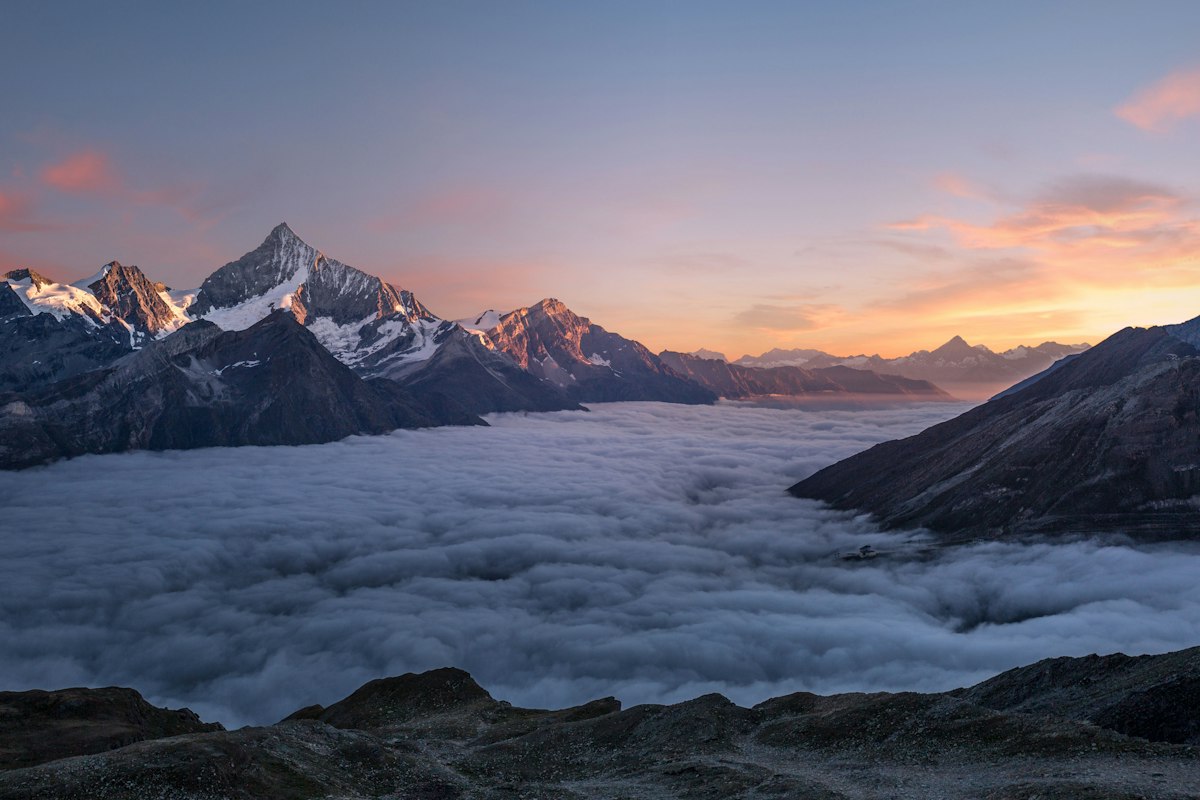
TL;DR: A 90-minute audio companion for the classic ascent of the Rigi from the lakeside village of Weggis via aerial cableway and cogwheel railway to the summit at 1,798 metres. This guide covers Weggis's mild microclimate and subtropical gardens, the cable car ride to Rigi Kaltbad, the Mario Botta mineral baths, Europe's first mountain railway, the summit panorama, and the extraordinary history of the mountain that launched Swiss tourism. The Rigi is where it all began, and this is the most scenic way to reach the top.
Tour Overview
| Duration | ~90 minutes (narration across the full journey) |
| Distance | Weggis lakefront to Rigi Kulm summit (via cable car and cogwheel railway) |
| Elevation | 435 m (Weggis) to 1,798 m (Rigi Kulm) |
| Difficulty | Easy (all transport-based; optional short walks at each stop) |
| Start | Weggis Schiffstation (boat landing) |
| End | Rigi Kulm (summit) |
| Best Time | Clear mornings for the panorama; autumn for foliage; winter for snow and inversion views |
| Accessibility | Cable car and cogwheel railway are wheelchair-accessible; summit platform has ramps |
Introduction
[00:00]
Welcome to the most historic mountain journey in Switzerland. I am your ch.tours guide, and over the next 90 minutes, I am going to accompany you from the subtropical gardens of Weggis on the shore of Lake Lucerne to the summit of Rigi Kulm, 1,798 metres above sea level, where a 360-degree panorama awaits that has been astonishing visitors for over two centuries.
The Rigi is not the highest mountain in Switzerland. It is not even the highest in the canton of Lucerne. At 1,798 metres, it is dwarfed by the great peaks of the Bernese Oberland and the Valais. But the Rigi does not need height to command attention. What it has is position: it rises as an isolated massif between Lake Lucerne to the south and west, Lake Zug to the north, and the Lauerzer See to the east, surrounded by water and lowland on all sides. This island-like isolation gives it a panorama that no higher peak can match, because there are no neighbouring mountains to block the view. From the summit, the gaze sweeps uninterrupted across the entire chain of the Swiss Alps, from the Saentis in the east to the Bernese Oberland in the west, a horizon of over 200 kilometres of snow-capped peaks.
The Rigi was the birthplace of Swiss mountain tourism. The first summit hotel opened in 1816. Queen Victoria was carried to the top in a sedan chair in 1868. Mark Twain climbed it on foot in 1878 and wrote about the experience with characteristic wit. And on 21 May 1871, the Vitznau-Rigi-Bahn hauled its first passengers up the mountain, becoming Europe's first mountain railway and changing forever the relationship between humans and high places.
Today, you will ascend the Rigi from Weggis, one of the most beautiful of the many possible approaches. The journey combines a cable car ride from Weggis to Rigi Kaltbad with a cogwheel railway from Rigi Kaltbad to the summit. It is a journey of about 45 minutes in total, but we will take longer, stopping to explore Weggis, Rigi Kaltbad, and the summit in detail.
Let us begin at the water's edge.
Chapter 1: Weggis -- The Swiss Riviera
[06:00]
GPS: 47.0334°N, 8.4325°E
You are in Weggis, a small town of about 4,500 people on the north shore of Lake Lucerne, nestled in a sheltered bay at the foot of the Rigi's western slopes. Weggis has been called the "Riviera of Central Switzerland," and when you look around, you will understand why.
The town's position is remarkable. It faces south and west, catching the maximum amount of sunshine, and the bulk of the Rigi behind it blocks the cold north winds. The result is a microclimate significantly warmer than the surrounding region. Temperatures in Weggis are typically 2-3 degrees higher than in Lucerne, just across the lake, and the frost-free period is considerably longer. This mild climate allows subtropical and Mediterranean plants to flourish here, far north of their normal range.
Walk along the Seestrasse, the lakefront promenade, and you will see palm trees, fig trees, magnolias, camellias, and even banana plants growing in the parks and gardens. The Weggis park, a landscaped garden along the waterfront, is particularly lush, with exotic plantings that create an atmosphere more reminiscent of Lake Maggiore than central Switzerland. In spring, the camellias and magnolias bloom weeks before the same species flower in less sheltered locations.
Weggis has been a resort since the 19th century, when the combination of mild climate, lake views, and mountain backdrop attracted wealthy visitors from across Europe. Grand hotels were built along the waterfront, and the town developed a reputation for genteel comfort that it retains to this day. It is a quiet place, favoured by those who prefer tranquility to the bustle of Lucerne, and its pace of life is noticeably slower than that of its urban neighbour across the lake.
Mark Twain stayed in Weggis during his 1897 visit to Switzerland and described it with affection. The town has marked his connection with a small memorial on the lakefront.
Practical tip: The most atmospheric way to reach Weggis is by boat from Lucerne. The paddle steamer takes about 45 minutes and offers magnificent views of the lake and surrounding mountains. The Swiss Travel Pass covers the boat fare.
Chapter 2: The Lake and Its Legends
[16:00]
GPS: 47.0340°N, 8.4310°E
Before you leave the lakefront, take a moment to contemplate the water before you. Lake Lucerne, the Vierwaldstaettersee, the Lake of the Four Forest Cantons, is the most complex and historically significant lake in Switzerland. Its shape is extraordinary: four long arms, separated by mountain promontories, extend in different directions, creating a body of water that is simultaneously one lake and many. The lake occupies a total area of 114 square kilometres and reaches a maximum depth of 214 metres.
Each arm of the lake has its own character and its own history. The arm you are facing, the Kuesnachter See, extends south toward Lucerne. To the east, hidden behind the Buergenstock promontory, lies the Urnersee, the Lake of Uri, where the legendary oath of the Swiss Confederation was sworn at the Ruetli meadow in 1291. The lake has been the cradle of Swiss identity for over 700 years, and the mountains that rise from its shores, the Rigi, the Pilatus, the Buergenstock, the Mythen, form the iconic landscape of Central Switzerland.
The lake also played a crucial role in trade and transport for centuries. Before the construction of roads and railways, the lake was the highway of central Switzerland. Boats carried goods, people, and livestock between the communities on its shores, and the control of lake traffic was a source of wealth and political power. The founding of the Swiss Confederation itself was partly motivated by the desire to control the Gotthard Pass route, which began with a boat journey across this lake.
Look across the water to the Buergenstock, the steep-sided promontory that divides the lake. Its cliffs rise almost vertically from the water, and the Hammetschwand Lift, the highest exterior elevator in Europe at 153 metres, is visible as a thin vertical line on the rock face. Beyond the Buergenstock, the peaks of the Bernese Oberland glimmer on the horizon.
Chapter 3: The Cable Car to Rigi Kaltbad
[24:00]
GPS: 47.0348°N, 8.4340°E
Walk from the lakefront to the Luftseilbahn Weggis-Rigi Kaltbad, the cable car station. The station is a short walk from the boat landing, well signposted, and the cable car departs every 15-30 minutes depending on the season.
The cable car carries you from 435 metres at Weggis to 1,438 metres at Rigi Kaltbad in approximately 10 minutes, a vertical gain of over 1,000 metres in a journey that barely gives you time to absorb the changing landscape below. As the car rises, the town of Weggis shrinks to a cluster of rooftops, the lake expands into a vast blue expanse, and the mountains of the Bernese Oberland emerge above the nearer ranges like a second, higher horizon.
Watch the vegetation change as you ascend. The subtropical gardens of Weggis give way to mixed deciduous forest of beech, maple, and ash. Higher up, the deciduous trees are replaced by spruce and fir, the coniferous forest belt that characterises Swiss mountains between about 800 and 1,500 metres. Above the treeline, which on the Rigi occurs at roughly 1,500-1,600 metres, the forest opens into alpine meadows, the Alpen that give the Alps their name.
The Rigi's meadows are among the richest in central Switzerland. Because the mountain is essentially limestone, the soils are alkaline, and they support a different suite of plants from the acidic granitic mountains elsewhere in the Alps. In late spring and early summer, the meadows blaze with wildflowers: gentians, orchids, alpine asters, globeflowers, and dozens of other species. The Rigi has been a favourite destination for botanists since the 18th century, and over 800 plant species have been recorded on its slopes.
As you near the top of the cable car ride, the landscape of Rigi Kaltbad comes into view: a gentle plateau of meadows and scattered buildings at the midpoint of the mountain, where the cable car from Weggis meets the cogwheel railway from Vitznau.
Chapter 4: Rigi Kaltbad and the Mineral Bath
[34:00]
GPS: 47.0440°N, 8.4850°E
Step out of the cable car at Rigi Kaltbad and into one of the most serene settings on the mountain. Kaltbad means "cold bath," a name that dates back to the medieval period when a cold mineral spring here was used for therapeutic bathing. The spring still flows, but today's bathing experience at Rigi Kaltbad is anything but cold.
The Mineralbad & Spa Rigi Kaltbad, designed by the Ticinese architect Mario Botta and opened in 2012, is a geometric jewel set into the mountainside. Botta's design is characteristically bold: a series of rectangular volumes in warm-toned local stone, with clean lines and precisely proportioned openings that frame views of the lake and mountains like architectural paintings. The outdoor pool, heated to 35 degrees, offers what may be the most spectacular bathing panorama in Switzerland: you float in warm mineral water while gazing across the vast expanse of Lake Lucerne to the snow-covered peaks of the Bernese Oberland beyond.
Botta, born in Mendrisio in Ticino in 1943, is one of Switzerland's most internationally celebrated architects. His work is characterised by strong geometric forms, the use of local materials, and a sensitivity to landscape that makes his buildings seem to grow from their settings rather than being imposed upon them. At Rigi Kaltbad, he has created a space where the ancient practice of mountain bathing meets contemporary architectural thinking, a fitting contribution to a mountain with a 200-year tradition of welcoming visitors.
Beyond the spa, Rigi Kaltbad is a small settlement with a handful of hotels, restaurants, and the railway station. The famous Rigi panorama trail begins here, a gentle 6.8-kilometre walk to the summit that is one of the most popular hiking routes in Central Switzerland. But today, we are taking the railway.
Walk to the cogwheel railway station. The train to Rigi Kulm departs approximately every 30 minutes.
Practical tip: The mineral bath is open daily. A two-hour visit costs approximately CHF 35. Towels and robes can be rented. Booking is recommended on weekends.
Chapter 5: Europe's First Mountain Railway
[44:00]
GPS: 47.0450°N, 8.4855°E
Board the Rigi Bahn cogwheel train for the journey from Kaltbad to Kulm. As the train begins its ascent, I want to tell you the story of the railway itself, because it is one of the great stories of Swiss engineering and enterprise.
On 21 May 1871, the Vitznau-Rigi-Bahn carried its first passengers from Vitznau on the lakeshore to Rigi Staffelhoehe, just below the summit. It was the first mountain railway in Europe, and its creation was an act of extraordinary ambition and technical ingenuity.
The driving force behind the railway was Niklaus Riggenbach, a Swiss engineer born in Basel in 1817. Riggenbach had worked on railways throughout Europe and had become fascinated by the problem of climbing steep gradients. Conventional railways, relying on the friction between smooth steel wheels and smooth steel rails, could not climb slopes steeper than about 4-5 percent. Mountain slopes were far steeper than that, and the conventional wisdom of the 1860s held that railways could never serve mountain destinations.
Riggenbach's solution was the rack-and-pinion system, in which a toothed wheel, the pinion, mounted beneath the locomotive, engages with a toothed rail, the rack, laid between the running rails. The mechanical engagement between pinion and rack provides positive traction regardless of the gradient, allowing the train to climb slopes of 25 percent and more. Riggenbach patented his rack system in 1863 and spent the next eight years securing funding, obtaining concessions, and supervising construction.
The engineering challenges were immense. The railway climbs from 435 metres at Vitznau to 1,750 metres at the summit station, a vertical gain of 1,315 metres over a track length of 6.9 kilometres. Gradients reach 25 percent, which means the train climbs one metre for every four metres of forward travel. Bridges, retaining walls, and cuttings had to be carved into the mountainside, much of the work done by hand with picks and shovels.
The first locomotive, named "Stadt Luzern," weighed seven tonnes and could haul a single carriage holding 40 passengers up the mountain in about 60 minutes. The boiler was tilted forward to keep water over the firebox on the steep gradient, a characteristic feature of early rack-railway locomotives.
Listen to the sound of the cogwheel as the train climbs. The distinctive clicking rhythm of the pinion engaging with the rack rail is a sound that has echoed across the Rigi for over 150 years. It is the sound of an idea that changed the world: the idea that mountains were not barriers but destinations.
Chapter 6: The Ascent and the Changing View
[56:00]
GPS: 47.0500°N, 8.4860°E
As the train climbs from Kaltbad toward the summit, the view expands with every metre of elevation gained. Press your face to the window and watch the geography of Central Switzerland unfold.
Below and to the west, Lake Lucerne reveals more and more of its complex form. You can now see multiple arms of the lake simultaneously: the Kuesnachter See near Lucerne, the Weggiser Becken where you began, and perhaps, if the air is clear, the distant arm of the Urnersee reaching toward the Gotthard. The city of Lucerne is visible as a cluster of buildings where the lake narrows and the Reuss river flows out toward the north.
To the south, the Bernese Oberland presents itself in full majesty. The Jungfrau, the Moench, and the Eiger, the famous triumvirate, are visible as a wall of ice and rock on the horizon. Between you and them lies the entire breadth of the Swiss Mittelland, the fertile central plateau that contains most of Switzerland's population and agriculture. The Mittelland is rarely beautiful in the conventional sense -- it is a landscape of gentle hills, scattered towns, and tidy farmland -- but seen from above, in the context of the Alps behind and the Jura ahead, it has a quiet grandeur of its own.
To the north, Lake Zug appears, a smaller, darker body of water than Lake Lucerne, surrounded by orchards and gentle hills. Beyond Lake Zug, the Zurich Oberland rises in a series of forested ridges, and on the clearest days, the antenna on the Uetliberg, Zurich's house mountain, is visible as a tiny spike against the sky.
The train passes through stretches of alpine meadow where cattle graze in summer, their bells creating the gentle clinking that is the quintessential sound of the Swiss mountains. The Rigi's alpine pastures have been grazed for centuries, and the annual Alpabzug, the ceremonial descent of the cattle to the lowlands in autumn, is celebrated with flower-decked cows, traditional costumes, and considerable merriment.
Chapter 7: Rigi Kulm -- The Summit
[68:00]
GPS: 47.0565°N, 8.4855°E
The train arrives at Rigi Kulm, the summit station, at 1,752 metres. Walk from the station up the short path to the summit marker at 1,798 metres, the true high point of the Rigi massif.
You are now standing on one of the most historically significant viewpoints in the world. This is not hyperbole. The panorama from Rigi Kulm played a central role in the development of modern tourism, the environmental movement, and the Romantic artistic tradition. When people began coming here in large numbers in the early 19th century, they were not just looking at a view; they were participating in a new way of experiencing nature that would reshape Western culture.
The first summit hotel was built in 1816 by a local innkeeper named Martin Buergi. It was a simple wooden structure offering basic accommodation and food, but its location was revolutionary. For the first time, visitors could spend the night on a mountain summit and watch the sunrise from above the clouds. The experience was electrifying. Guests woke before dawn, gathered on the summit, and watched as the eastern sky brightened, the peaks of the Alps caught the first light, and the valleys below filled with golden colour. Many described the experience in quasi-religious terms, as a revelation of nature's grandeur that transcended ordinary perception.
The guest books of the Rigi summit hotels, preserved in the Swiss National Museum, read like a registry of 19th-century European culture. Queen Victoria came in 1868, ascending by sedan chair because the railway had not yet been built. She described the sunrise as "most splendid." Victor Hugo visited and called the panorama "one of the most immense horizons one can contemplate on this earth." Mark Twain climbed the Rigi on foot in 1878, missed the sunrise because he overslept, and wrote about the experience with self-deprecating humour that became one of the most famous passages in his travel book "A Tramp Abroad."
The Rigi's influence on the arts was equally profound. Painters including J.M.W. Turner, who visited around 1842, made the Rigi one of the most depicted mountains in 19th-century European art. Turner painted the Rigi at different times of day and in different weather conditions, producing a series of watercolours that captured the mountain's atmospheric moods with unprecedented subtlety.
Chapter 8: The Panorama and Conclusion
[78:00]
GPS: 47.0565°N, 8.4855°E
Walk slowly around the summit platform and take in the full 360-degree panorama. I will orient you.
Face south. The entire Alpine chain stretches across the horizon, from the Saentis and the Appenzell Alps in the east (far right) through the Glarner Alps, the peaks above the Gotthard, and the massifs of the Bernese Oberland (the Jungfrau, Moench, and Eiger prominent in the centre-left) to the peaks above Interlaken and Lake Thun in the west. On the clearest days, over 200 individual peaks are visible. The Alpine panorama board on the summit platform identifies the major peaks and their distances.
Face east. Lake Zug lies directly below, with the distinctive silhouette of the Zugerberg beyond it. The Mythen, two sharp pyramidal peaks that are the emblems of the canton of Schwyz, rise above the town of Schwyz. Further east, the Glarner Alps form a rugged horizon.
Face north. The Mittelland stretches away in a patchwork of green and gold, dotted with towns and threaded with rivers. The Jura Mountains form a long, low ridge on the far horizon, blue-grey in the distance. On exceptional days, the Black Forest in Germany is visible beyond the Jura, over 100 kilometres away.
Face west. Lake Lucerne dominates the middle ground, with Pilatus (2,129 m) rising steeply on the far shore. Pilatus is the Rigi's great rival in the contest for the finest viewpoint in Central Switzerland, and from here, you can judge the competing claim with your own eyes. Beyond Pilatus, the Emmental hills roll toward Bern.
Now lower your gaze to the land immediately below the summit. The Rigi's slopes fall away steeply to the three lakes that surround it, and the combination of the mountain's modest height and its extreme isolation creates the curious sensation that you are floating above the landscape rather than standing on solid ground. This sensation, the feeling of hovering between earth and sky, is what the Romantics came here to experience, and it has lost none of its power.
The Rigi has been called the "Queen of the Mountains" since at least the early 19th century, a title that acknowledges not its height but its grace, its accessibility, and the generosity of its panorama. It was here that ordinary people first discovered the joy of standing on a mountaintop, here that the idea of mountain tourism was born, and here that a small cogwheel railway proved that technology could bring the sublime within everyone's reach.
The return journey is yours to plan. You can descend by the same route, taking the cogwheel railway to Kaltbad and the cable car to Weggis. You can ride the Vitznau-Rigi-Bahn down the south side of the mountain to Vitznau and take a boat back to Lucerne. Or you can take the Arth-Rigi-Bahn down the north side to Arth-Goldau and connect by train. All three routes are covered by the Swiss Travel Pass, and each offers a different perspective on the mountain.
Whichever route you choose, carry the view with you. Two hundred years of visitors to Rigi Kulm have tried to describe what they saw from this spot, and none has quite succeeded. The panorama resists words, resists photographs, resists every attempt to contain it. It can only be experienced, and now you have experienced it.
Thank you for making the journey from Weggis to Rigi Kulm with me. This has been your ch.tours audio guide.
Practical Information
- Getting there: Boat from Lucerne to Weggis (45 min by paddle steamer, 30 min by motor vessel); bus 2 from Lucerne Bahnhof to Kuesnacht and boat
- Cable car Weggis-Rigi Kaltbad: Runs every 15-30 min; journey 10 min; covered by Swiss Travel Pass
- Cogwheel railway Kaltbad-Kulm: Runs every 30 min; journey 20 min; covered by Swiss Travel Pass
- Round trip options: Ascend via Weggis, descend via Vitznau or Arth-Goldau (or vice versa) for a varied experience
- Sunrise experience: Special early-morning trains run in summer for the Rigi sunrise; book via rigi.ch
- Dining: Summit restaurant at Rigi Kulm; Mineralbad restaurant at Kaltbad; multiple lakefront restaurants in Weggis
- Winter: The Rigi is accessible year-round; winter views above the fog are spectacular; limited skiing and sledging available
- Swiss Travel Pass: Covers all transport on this route (boats, cable car, cogwheel railways)