Duration: Full day experience (approximately 2 hours hiking, plus transport) Hiking Distance: 5.5 km (summit area trails and descent segments) Elevation Gain: 250 m ascent / 350 m descent (hiking segments) Summit Elevation: 2,128 m (Pilatus Kulm, Tomlishorn) Difficulty: T1-T2 (easy to moderate, some exposed summit trails) Best Season: May to November GPS Summit: 46.9788N, 8.2537E (Pilatus Kulm) GPS Alpnachstad: 46.9525N, 8.2713E
Introduction
Welcome to the Pilatus Golden Round Trip, one of the great experiential journeys in central Switzerland. This is not simply a hike; it is a full-day circular adventure that combines a lake cruise on Lake Lucerne, the world's steepest cogwheel railway, hiking on the summit of Mount Pilatus, and a descent by aerial cable car and gondola, all woven together into a seamless circuit.
Mount Pilatus has loomed over the city of Lucerne for millennia, its dramatic, jagged profile visible from every street and bridge. At 2,128 metres, it is not the highest peak in the region, but its isolated position and striking rock formations give it a commanding presence. The mountain has inspired legends since antiquity. Its name is popularly, though probably incorrectly, linked to Pontius Pilate; medieval legend held that the Roman governor's restless spirit inhabited a lake near the summit, and for centuries the authorities of Lucerne forbade people from climbing the mountain for fear of disturbing the ghost and bringing storms upon the city.
The Golden Round Trip typically follows this circuit from Lucerne: boat across Lake Lucerne to Alpnachstad, cogwheel railway to Pilatus Kulm, hiking on the summit, aerial cableway to Frakmuentegg, gondola to Kriens, and bus back to Lucerne. You can also do the circuit in reverse. This audio guide covers the hiking segments on the mountain itself.
You have arrived at Pilatus Kulm by the cogwheel railway from Alpnachstad. This railway, with a maximum gradient of 48 percent, is the steepest rack railway in the world. It uses a unique horizontal cogwheel system designed by Eduard Locher and has been in operation since 1889.
Waypoint 1: Pilatus Kulm Station (2,073 m)
GPS: 46.9785N, 8.2535E
Step off the train and into another world. Pilatus Kulm is a dramatic summit environment, with sheer limestone cliffs dropping away on all sides, a complex of hotel buildings perched on the ridge, and a network of trails that thread through the rocky terrain.
The two summit hotels, Hotel Pilatus-Kulm and Hotel Bellevue, have been welcoming guests since the nineteenth century. The Pilatus-Kulm, originally built in 1890, has been extensively renovated into a modern mountain hotel while retaining its historic character. Staying overnight here, as on the Rigi, is a classic Swiss mountain experience, with the chance to watch the sunset over the Alps and see the lights of Lucerne twinkling far below.
Look at the rock around you. Pilatus is composed of Schrattenkalk, a hard Cretaceous limestone formed roughly 120 million years ago in a warm, shallow sea. This limestone is rich in fossils, including the rudists, reef-building bivalves that were the dominant reef organisms of the Cretaceous period, before corals took over that role. The rock has been sculptured by millions of years of erosion into the dramatic fins, towers, and channels that give Pilatus its distinctive profile.
From the station, several trails branch out across the summit area. We will follow the main path east toward the Tomlishorn, the highest point on the mountain.
Next waypoint: 500 m, approximately 12 minutes.
Waypoint 2: The Dragon Path (2,090 m)
GPS: 46.9790N, 8.2550E
The trail from Pilatus Kulm to the Tomlishorn follows the Drachenweg, the Dragon Path. This is fitting, as Pilatus is Switzerland's dragon mountain. For centuries, locals reported sightings of dragons in the caves and on the cliffs of Pilatus. The most famous account, from 1421, describes a farmer named Stempflin who allegedly fell into a dragon's cave and spent the winter among the creatures, who were docile and spent the cold months in hibernation.
The dragon legend is commemorated throughout the Pilatus experience: the logo of the Pilatus railway features a dragon, and the summit trail is the Dragon Path. While the dragons were almost certainly products of imagination, influenced by the mountain's genuinely eerie atmosphere of mist, echoing rockfall, and strange rock formations, they are a charming part of Pilatus's cultural heritage.
The trail here is carved into the limestone ridge, with metal railings on the exposed sections. The views to the south are sensational: the Bernese Alps fill the horizon, with the distinctive profiles of the Eiger, Moench, and Jungfrau visible to the southwest. Below, the town of Alpnach and the southern arm of Lake Lucerne, the Alpnacher See, lie spread out like a map.
Watch your footing on the rock. The Schrattenkalk is fissured and can be slippery when wet. The karst erosion has created small channels and holes in the rock surface that can catch unwary feet.
Next waypoint: 400 m, approximately 10 minutes.
Waypoint 3: Tomlishorn Summit (2,128 m)
GPS: 46.9788N, 8.2537E
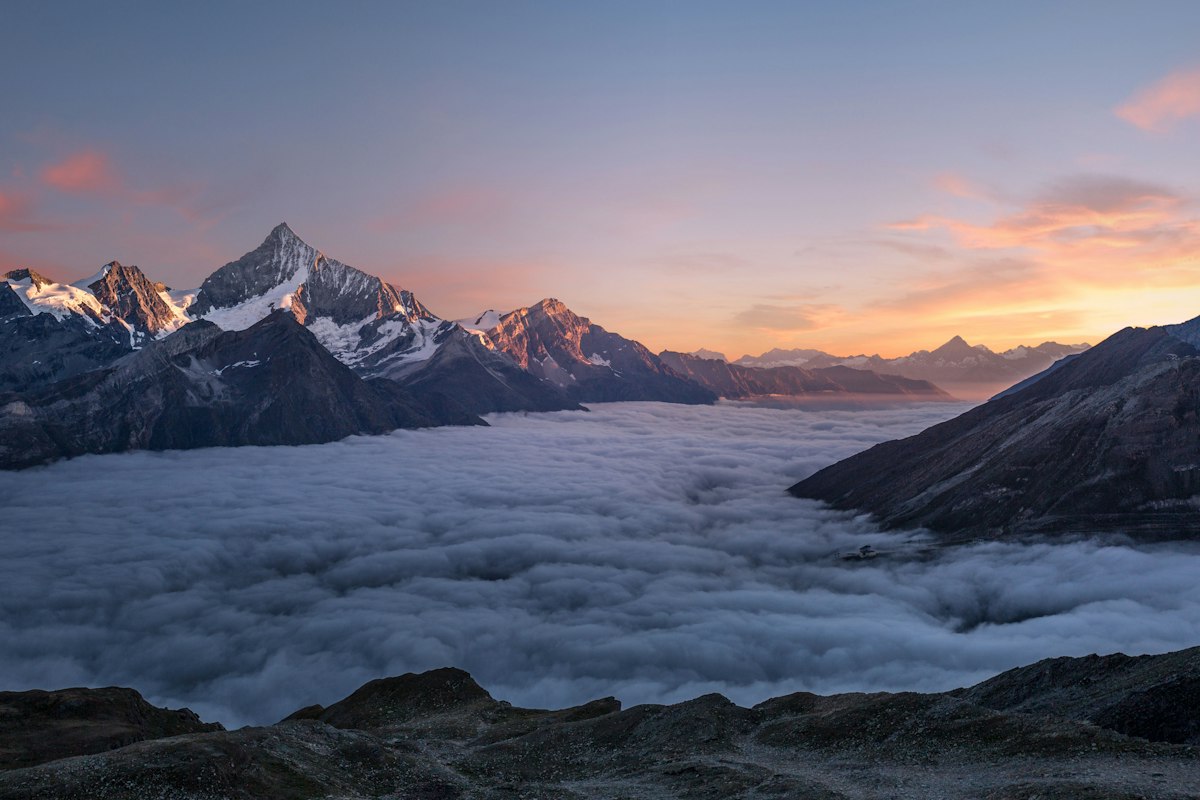
You are standing on the highest point of Mount Pilatus. The Tomlishorn, at 2,128 metres, is marked by a summit cross and offers a 360-degree panorama.
The view from here is considered one of the finest in central Switzerland, rivalling the Rigi across the lake. To the south, the full chain of the Alps is visible, from the Bernese Oberland through the peaks of central Switzerland to the Glaernisch and Toedi in the east. The Titlis, at 3,238 metres, is the highest ice-capped peak visible to the south.
To the north, Lake Lucerne occupies the middle distance, its complex shape filling the valley below. The city of Lucerne is visible at the lake's western end, and beyond it, the green hills of the Swiss Mittelland roll northward to the Jura.
Lake Lucerne is one of the most irregular lakes in Switzerland, with multiple arms extending into different valleys. This complex shape reflects its glacial origin: the lake occupies a series of troughs carved by different branches of the Reuss glacier during the Ice Ages. The deepest point, 214 metres, is near the Vitznau shore.
The summit cross here is a tradition found on nearly every significant peak in Switzerland. The practice dates back to the Counter-Reformation of the sixteenth century, when the Catholic cantons of central Switzerland placed crosses on their mountains as a declaration of faith. Today, the crosses are maintained as cultural landmarks regardless of religious sentiment.
Next waypoint: 500 m, approximately 10 minutes.
Waypoint 4: The Esel Summit (2,119 m)
GPS: 46.9790N, 8.2520E
A short walk from the Tomlishorn brings you to the Esel, the second of Pilatus's twin peaks at 2,119 metres. The name "Esel" means donkey, a humble name for a lofty summit. Its origin is debated, but may refer to the shape of the rock when seen from a particular angle.
The Esel is slightly more accessible than the Tomlishorn and was historically the main viewpoint for visitors arriving by the cogwheel railway. A viewing gallery is carved into the rock near the top, providing protected viewpoints even in windy conditions.
From the Esel, look down toward the Obhaupt and the area around the Pilatus hotels. The complex sits on a narrow ridge, with precipitous drops on both sides. The engineering required to build and maintain these structures at over 2,000 metres on exposed rock is remarkable. Everything from building materials to food and fuel must be transported up the mountain, either by the cogwheel railway or by helicopter.
Between the Esel and the hotel complex, notice the unique rock formations. The limestone has been eroded into fins, ribs, and channels by millennia of rain and frost. These karren, as geologists call them, are textbook examples of karst erosion on limestone. Rainwater, made slightly acidic by dissolved carbon dioxide from the atmosphere, slowly dissolves the calcium carbonate in the limestone, carving intricate patterns over thousands of years.
Next waypoint: 300 m, approximately 8 minutes.
Waypoint 5: The Pilatus Summit Gallery (2,080 m)
GPS: 46.9790N, 8.2530E
The summit area of Pilatus includes several tunnels and galleries carved through the rock, connecting different parts of the mountain. These tunnels provide sheltered passage in bad weather and create dramatic framing effects, with views of the Alps visible through arch-shaped openings in the rock.
Walking through these galleries, you can examine the rock at close quarters. Look for the fossil shells embedded in the limestone. The most common are small, round cross-sections of crinoid stems, the skeletal elements of sea lilies. You may also spot the larger shells of brachiopods and the spiral chambers of small ammonites. These organisms lived and died in the warm Cretaceous sea 120 million years ago, and their remains were compacted into the limestone that now forms the summit of Pilatus.
The temperature inside the galleries is noticeably cooler than outside. The rock absorbs and retains cold, and in the deeper passages the temperature remains around 5 to 8 degrees Celsius year-round. In winter, ice formations develop in some of the galleries, creating natural ice sculptures that persist into late spring.
Next waypoint: 800 m, approximately 15 minutes.
Waypoint 6: Obhaupt Area and Trail to Tomlishorn North (2,050 m)
GPS: 46.9795N, 8.2510E
The Obhaupt is the broad platform area between the two summit peaks, where the hotels and the railway station are located. From here, additional walking trails branch out.
For those with time and energy, the Klimsenhorn trail heads south from the Obhaupt along the western ridge, visiting a small chapel and offering dramatic views into the Klimsen gorge. This trail is more exposed than the summit circuit and is rated T2 to T3. It takes about 45 minutes return.
The Klimsenkapelle, the small chapel on this trail, is one of the oldest mountain chapels in Switzerland. It has served as a pilgrimage destination since at least the fifteenth century. The chapel stands on a ledge above a sheer cliff face, and the views from its terrace are breathtaking and slightly vertiginous.
If you are continuing the Golden Round Trip by descending to Frakmuentegg by the aerial cableway, the cable car station is located at the Pilatus Kulm complex. The descent takes about 5 minutes and covers an elevation difference of roughly 600 metres.
Next waypoint: Cable car to Frakmuentegg, then walking options.
Waypoint 7: Frakmuentegg (1,416 m)
GPS: 46.9852N, 8.2508E
You have descended by cable car to Frakmuentegg, roughly 600 metres below the summit. This intermediate station on the northern side of Pilatus is a hub for activities, including the longest toboggan run in central Switzerland and a ropes course.
From Frakmuentegg, you have two options. You can take the gondola directly down to Kriens, which takes about 30 minutes. Alternatively, and this is the option our audio guide recommends, you can walk a section of the forest trail toward Kriens before taking the gondola.
The forests on Pilatus's northern flank are beautiful and ecologically important. They are classified as Schutzwald, protection forest, providing crucial defence against avalanches, rockfall, and flooding for the communities below. The forest is a mix of spruce, beech, maple, and fir, with a lush understory of ferns, mosses, and woodland flowers.
If you choose to walk, follow the signs toward "Kriens via Aemsigen." The path descends through forest on a good trail, offering a peaceful counterpoint to the dramatic summit and the mechanical transport of the round trip.
Next waypoint: Walk or gondola to Kriens, approximately 30-60 minutes.
Waypoint 8: The Forest Walk (1,200 m)
GPS: 46.9870N, 8.2490E
The forest trail descends gently through a beautiful beech and spruce woodland. The air is humid and cool under the canopy, scented with damp earth and decaying leaves. After the exposed, windy summit, this sheltered forest feels like a different world.
The beech trees in this forest are impressive specimens, with smooth, silver-grey bark and spreading crowns. In autumn, the beech forest turns a brilliant copper-gold, creating one of the most beautiful seasonal displays in the Swiss lowlands.
Listen for the calls of woodland birds. The great spotted woodpecker drums on dead trees, its rapid tattoo echoing through the forest. The chaffinch sings from the canopy, a descending cascade of notes ending in a flourish. And the wren, tiny but astonishingly loud, delivers its complex song from the understory.
The trail passes several small streams, crossing them on simple wooden bridges. These streams are fed by the rainfall that percolates through the limestone of Pilatus's upper slopes, emerging as springs in the forest zone. The water is cold and clear, having been naturally filtered through the rock.
The lower forest transitions to a more diverse woodland as you descend. Ash, cherry, and hazel join the beech and spruce, creating a layered canopy of varying heights and textures. In spring, the forest floor is a tapestry of wildflowers: wood anemone, wild garlic, and bluebells create sweeping displays beneath the still-bare deciduous trees. By summer, the dense canopy casts deep shade, and the undergrowth shifts to ferns, ivy, and the shade-tolerant wood sorrel with its clover-like leaves.
The biodiversity of these mid-altitude forests is considerable. Switzerland has invested heavily in the protection and management of its forests since the Federal Forest Law of 1876, and the results are evident. Forest coverage in Switzerland has actually increased over the past century, reversing the deforestation that characterised the eighteenth and early nineteenth centuries.
The proximity of this forested mountainside to the city of Lucerne is remarkable. Within forty minutes of the gondola ride, you pass from one of the most visited tourist cities in Europe to a quiet forest that feels miles from civilisation. This seamless integration of urban life and wild nature is one of Switzerland's greatest achievements and one of its most powerful draws for visitors.
Next waypoint: Continue to gondola station or Kriens, 1.5 km, approximately 25 minutes.
Waypoint 9: Kriens and Return to Lucerne (510 m)
GPS: 46.9920N, 8.2755E
Whether you walked or rode the gondola, you arrive at Kriens on the outskirts of Lucerne. From here, local bus line 1 takes you directly to Lucerne railway station in about 15 minutes, completing the Golden Round Trip circuit.
Closing
You have completed the Pilatus Golden Round Trip, a journey that combines water, rail, foot, and air into one of the great Swiss mountain experiences. From the lake steamer to the world's steepest cogwheel railway, from the dragon-haunted summit to the forested descent, the circuit showcases the ingenuity of Swiss mountain transport and the natural beauty of central Switzerland.
Mount Pilatus has watched over Lucerne since long before the city existed. Its summit has been a place of legend, pilgrimage, and wonder for centuries. Today, you have added your own experience to that long history.
If you have time in Lucerne, walk across the Kapellbruecke, the famous wooden covered bridge dating to 1333, and visit the old town. The city is one of the jewels of central Switzerland, and an evening stroll along the Reuss river, with Pilatus silhouetted against the sunset, is the perfect conclusion to the day.
Thank you for hiking with ch.tours. May the dragons of Pilatus guard your journey home. Safe travels.