TL;DR: Switzerland is one of the most photogenic countries on Earth, offering everything from the iconic Matterhorn reflection at Riffelsee to the UNESCO Lavaux vineyard terraces and the turquoise waters of Blausee. The best light for mountain photography is during golden hour (the hour after sunrise and before sunset), and Autumn and Winter offer the most dramatic conditions. Drone flying is permitted in Switzerland with specific rules, and no license is required for recreational use under 250g.
Quick facts
| Best overall seasons for photography | Autumn (September-October) for golden foliage; Winter for snow and drama |
| Golden hour | Summer: ~05:30-06:30 and 20:30-21:30; Winter: ~07:30-08:30 and 16:00-17:00 |
| Drone rules | No license needed under 250g; stay below 120m; no-fly zones near airports and military |
| Camera gear tips | Bring a polarizing filter (essential for mountain lakes), wide-angle lens, and tripod for sunrise |
| Best weather resource | MeteoSwiss (meteoswiss.ch) for forecasts and webcams |
| Key apps | PhotoPills (sun/moon position), MeteoSwiss, PeakFinder (mountain identification) |
The top 30 photography spots
Mountain icons
1. Matterhorn from Riffelsee (Zermatt)
The Matterhorn (4'478m) reflected in Riffelsee is the single most iconic Swiss photograph. The small alpine lake sits at 2'757m along the trail between Rotenboden and Riffelberg stations on the Gornergrat Railway.
| Best time | Sunrise (July-September for calm water); early morning before wind picks up |
| Getting there | Gornergrat Railway from Zermatt to Rotenboden station (25 minutes), then 5-minute walk downhill to the lake |
| GPS | 45.9878, 7.7729 |
| Tips | Arrive before sunrise for mirror reflections. The lake freezes in Winter (October-June). A tripod is essential. Shoot in landscape orientation with the Matterhorn centered above its reflection |
| Cost | Gornergrat Railway: CHF 118 return (50% off with Swiss Travel Pass) |
2. Matterhorn from Stellisee (Zermatt)
Stellisee is another reflection lake at 2'537m, offering a different angle of the Matterhorn with wildflowers in the foreground during July and August.
| Getting there | Gondola from Zermatt to Blauherd, then 20-minute hike to Stellisee |
| GPS | 46.0108, 7.7643 |
| Best time | Sunrise, July-September |
3. Jungfrau massif from Harder Kulm (Interlaken)
The Two Lakes Bridge viewing platform at Harder Kulm (1'322m) provides a dramatic panorama of Lake Thun, Lake Brienz, and the Jungfrau, Monch, and Eiger peaks -- all in one frame.
| Best time | Sunset (the mountains glow orange); clear days year-round |
| Getting there | Harder Kulm funicular from Interlaken Ost (10 minutes). CHF 36 return (50% off with Swiss Travel Pass) |
| GPS | 46.6939, 7.8629 |
| Tips | The viewing platform is glass-bottomed. Use a wide-angle lens (16-24mm) to capture both lakes and the mountain wall |
4. Eiger North Face from Grindelwald
The Eiger's legendary North Face (Nordwand) looms directly above Grindelwald. Several vantage points offer dramatic views of this 1'800-meter vertical wall.
| Best vantage points | Pfingstegg cable car station, Hotel Wetterhorn area, or the trail to Grosse Scheidegg |
| GPS (Pfingstegg) | 46.6478, 8.0657 |
| Best time | Morning light (the North Face is in shadow by afternoon); Winter for snow-covered drama |
5. Oeschinensee from above (Kandersteg)
Oeschinensee is a turquoise alpine lake at 1'578m, surrounded by sheer cliffs and waterfalls. The most famous viewpoint is from the trail above the lake (10-minute hike from the gondola station), looking down onto the water.
| Getting there | Gondola from Kandersteg (8 minutes), then 20-minute walk to the lake, or 10-minute walk to the viewpoint above |
| GPS (viewpoint) | 46.4955, 7.7227 |
| Best time | Morning for calm water and best light; June-October for access |
| Cost | Gondola CHF 30 return (50% off with Swiss Travel Pass) |
Lakes and waterfalls
6. Blausee (Blue Lake, Bernese Oberland)
Blausee is a small, impossibly clear lake in the Kander Valley. The turquoise water and submerged tree trunks create ethereal photographs.
| Getting there | Bus from Frutigen station (10 minutes). Entry: CHF 9 adults (2026 prices) |
| GPS | 46.5306, 7.6628 |
| Best time | Early morning for still water and diffused light; Autumn for golden larch reflections |
| Tips | A polarizing filter is essential to reduce surface reflections and reveal the underwater world |
7. Bachalpsee (Grindelwald First)
A high-alpine lake at 2'265m reflecting the Wetterhorn and Schreckhorn peaks. The 50-minute hike from First gondola station is one of Switzerland's most photogenic walks.
| Getting there | First gondola from Grindelwald (25 minutes), then 50-minute hike to Bachalpsee |
| GPS | 46.6713, 8.0225 |
| Best time | Sunrise or early morning, July-October. Wildflowers in July-August |
| Cost | First gondola: CHF 66 return (50% off with Swiss Travel Pass) |
8. Caumasee (Flims, Graubunden)
A hidden forest lake with emerald-green water, accessible by a short walk or a wooden elevator through the forest. The combination of turquoise water and dense forest is unique.
| Getting there | 20-minute walk from Flims village center or elevator (CHF 5) |
| GPS | 46.8235, 9.2648 |
| Best time | Mid-morning when sunlight penetrates the forest canopy; Summer for swimming |
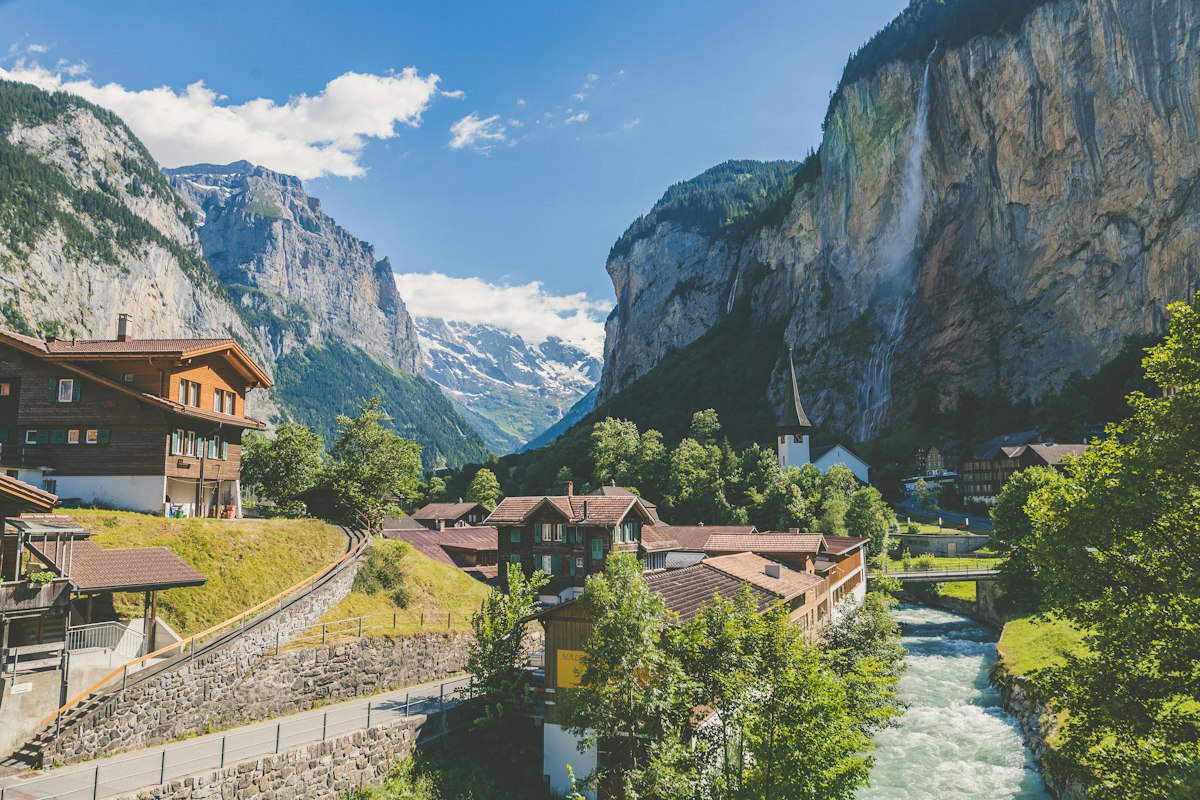
9. Staubbach Falls (Lauterbrunnen)
The 297-meter free-falling waterfall in Lauterbrunnen Valley, one of the highest in Europe. The sheer valley walls and green meadows create a perfect compositional frame.
| Getting there | 5-minute walk from Lauterbrunnen station |
| GPS | 46.5916, 7.9074 |
| Best time | Morning (the falls catch early light); Spring (May-June) for maximum water flow |
| Tips | Use a slow shutter speed (1/4 to 2 seconds) with a tripod for a silky water effect |
10. Trummelbach Falls (Lauterbrunnen Valley)
Ten glacier-fed waterfalls inside a mountain, illuminated by walkway lights. The most powerful subterranean waterfall in Europe.
| Getting there | Bus from Lauterbrunnen station to Trummelbach (5 minutes). CHF 12 entry (2026 prices) |
| GPS | 46.5753, 7.9133 |
| Best time | Mid-day (interior lighting is consistent); June-September for maximum flow |
Scenic railways and villages
11. Landwasser Viaduct (Graubunden)
The 65-meter-high, six-arched Landwasser Viaduct is the most photographed railway bridge in Switzerland. Trains curve across the viaduct before disappearing into a tunnel in the cliff face. It is part of the UNESCO-listed Rhaetian Railway.
| Best viewpoint | The platform at coordinates 46.6810, 9.6741 (10-minute walk from Filisur station along a marked trail) |
| Getting there | Train from Chur to Filisur (1h). The viaduct is visible from the train itself on the Bernina Express and regular Albula line trains |
| Best time | Morning light; Autumn for golden larch forests; Winter for snow |
| Tips | Check the SBB timetable for train crossing times. Position yourself early. Trains cross approximately every 30 minutes |
12. Chapel Bridge (Lucerne)
The Chapel Bridge (Kapellbrucke) is the most photographed structure in Lucerne and one of Switzerland's most iconic images. The wooden covered bridge with its octagonal Water Tower, with Mount Pilatus in the background.
| GPS | 47.0514, 8.3076 |
| Best time | Sunrise (the bridge is empty and the light is warm); blue hour (the bridge is illuminated) |
| Tips | Shoot from the south bank of the Reuss for the classic view with Pilatus behind. A telephoto lens (70-200mm) compresses the bridge with the mountain |
13. Lavaux vineyard terraces (Lake Geneva)
The UNESCO World Heritage terraced vineyards between Lausanne and Montreux, with Lake Geneva and the Alps as backdrop.
| Best viewpoint | The trail between Epesses and Dezaley (accessible from Cully station, 15 minutes from Lausanne) |
| GPS | 46.4912, 6.7292 |
| Best time | Golden hour (morning or evening); Autumn (October) for golden vine foliage; Spring for fresh green |
14. Iseltwald (Lake Brienz)
A tiny lakeside village with a wooden pier jutting into the turquoise waters of Lake Brienz, backed by forested mountains. This spot gained worldwide popularity and now has a small access fee.
| Getting there | Bus from Interlaken Ost to Iseltwald (20 minutes) or boat |
| GPS | 46.7175, 7.9615 |
| Access fee | CHF 5 for pier access (2026 prices; introduced to manage crowds) |
| Best time | Early morning for still water and no crowds; Summer for turquoise water color |
15. Appenzell village
The painted facades and traditional Appenzeller houses of Appenzell's Hauptgasse are among the most colorful and photogenic town scenes in Switzerland.
| Getting there | Train from St. Gallen to Appenzell (50 minutes) |
| GPS | 47.3310, 9.4090 |
| Best time | Morning light; market days for activity and local color |
Alpine panoramas
16. Schynige Platte (Bernese Oberland)
A panoramic viewpoint at 2'076m with sweeping views over the Jungfrau massif, Lake Thun, and Lake Brienz. The Alpine Garden (200+ species) provides colorful foreground subjects in Summer.
| Getting there | Historic cogwheel train from Wilderswil (7 minutes from Interlaken) -- 52 minutes, CHF 66 return |
| Best time | Sunrise (first train) or late afternoon; June-October only (railway is seasonal) |
17. Niederhorn (Beatenberg)
A less-visited panoramic summit at 1'950m with views spanning from the Jungfrau massif to Lake Thun. Known for ibex sightings.
| Getting there | Funicular and cable car from Beatenberg (above Interlaken). CHF 48 return (50% off with Swiss Travel Pass) |
| GPS | 46.7123, 7.7764 |
| Best time | Sunrise, year-round |
18. Saentis summit (Appenzell Alps)
The highest peak in the Alpstein massif (2'502m), offering a 360-degree panorama across six countries (Switzerland, Germany, Austria, Liechtenstein, France, and Italy on clear days).
| Getting there | Cable car from Schwagalp. CHF 50 return (50% off with Swiss Travel Pass) |
| GPS | 47.2494, 9.3433 |
| Best time | Clear mornings after a cold front; Winter for dramatic cloud inversions (Nebelmeer -- sea of fog) |
19. Uetliberg (Zurich's mountain)
Zurich's local mountain (871m) provides a panoramic view of the city, Lake Zurich, and the Alps. Easily accessible and free.
| Getting there | S-Bahn S10 from Zurich HB to Uetliberg (20 minutes). Free with Swiss Travel Pass |
| GPS | 47.3496, 8.4917 |
| Best time | Sunset, year-round. Autumn and Winter for sea-of-fog conditions (Nebelmeer) |
20. Gorner Gorge (Zermatt)
A narrow gorge carved by glacial meltwater, with walkways through the rock walls. Dramatic light shafts and green water.
| Getting there | 15-minute walk from Zermatt center. CHF 5 entry (2026 prices) |
| GPS | 46.0163, 7.7449 |
| Best time | Mid-day when sunlight enters the gorge; Summer for maximum water flow |
Seasonal highlights
21. Cherry blossoms in Basel/Liestal (Spring)
The cherry orchards around Liestal (Basel-Landschaft) and the Fricktal region bloom spectacularly in April.
| Getting there | Train from Basel to Liestal (15 minutes) |
| Best time | Early to mid-April (check local reports for bloom timing) |
22. Wildflower meadows (Grindelwald/Wengen, Summer)
Alpine meadows carpeted with wildflowers against the backdrop of the Eiger, Monch, and Jungfrau -- peak bloom in June and July.
| Best locations | Mannlichen (gondola from Wengen), Kleine Scheidegg, Grindelwald First |
| Best time | Late June to mid-July |
23. Larch forests in Autumn (Engadine)
The golden larch forests of the Upper Engadine (near St. Moritz) and the Lotschental (Valais) turn brilliant gold in October.
| Best locations | Staz forest near St. Moritz, Morteratsch valley, Lotschental above Blatten |
| Best time | Mid-October to early November |
24. Sea of fog (Nebelmeer, Autumn/Winter)
When the Swiss Plateau is covered in fog, mountaintops above 1'000-1'500m rise above it like islands. The effect is called Nebelmeer (sea of fog).
| Best viewpoints | Uetliberg (Zurich), Rigi, Pilatus, Niesen, Weissenstein (Solothurn) |
| Best time | October-January, early morning. Check MeteoSwiss webcams before going |
25. Frozen waterfalls (Lauterbrunnen, Winter)
The waterfalls of Lauterbrunnen valley transform into frozen ice cascades in deep Winter.
| Best location | Staubbach Falls and surrounding valley walls |
| Best time | January-February after sustained cold |
Hidden gems
26. Soglio (Graubunden)
A tiny stone village perched on a hillside in the Bregaglia valley with views of the Sciora peaks. Called "the threshold to paradise" by the painter Giovanni Segantini.
| Getting there | PostBus from Promontogno (from Chiavenna/St. Moritz) |
| GPS | 46.3490, 9.5277 |
27. Creux du Van (Jura)
A 160-meter vertical cliff face forming a natural amphitheater in the Jura Mountains. Ibex are frequently spotted on the cliffs.
| Getting there | Hike from Noiraigue station (2-hour ascent) |
| GPS | 46.9293, 6.7274 |
28. Rhine Gorge (Ruinaulta, Graubunden)
Called the "Swiss Grand Canyon," this 13-km gorge with white limestone cliffs and turquoise water is best seen from the Glacier Express route or by hiking.
| Best viewpoint | Il Spir viewing platform above Conn (20-minute walk from Conn bus stop) |
| GPS | 46.8167, 9.2333 |
29. Aletsch Glacier from Moosfluh/Bettmerhorn (Valais)
The Aletsch Glacier is the largest glacier in the Alps (23 km long, UNESCO World Heritage). The viewpoints from Moosfluh and Bettmerhorn above Bettmeralp provide sweeping views.
| Getting there | Cable car from Bettmeralp (accessible from Betten Talstation via train). Covered by Swiss Travel Pass |
| GPS (Moosfluh) | 46.4092, 8.0597 |
30. Gruyere medieval town at dawn
The hilltop medieval town of Gruyere, with its castle and cobblestone streets, is nearly empty at dawn and offers atmospheric photography opportunities.
| Getting there | Train to Gruyere station (from Bulle), then 15-minute walk uphill |
| GPS | 46.5827, 7.0810 |
| Best time | Dawn, any season. Misty mornings in Autumn create ethereal conditions |
Drone photography rules in Switzerland
Switzerland permits recreational drone flying, but with important rules:
| Rule | Detail |
|---|---|
| License required? | No license needed for drones under 250g (recreational use). Registration required for drones 250g-900g via BAZL (FOCA) |
| Maximum altitude | 120 meters above ground level |
| No-fly zones | Within 5 km of airports and military airfields; over crowds and gatherings; near emergency operations |
| National parks | Drone flying is prohibited in Swiss National Park (Engadine) and most nature reserves |
| Line of sight | Drone must remain within visual line of sight at all times |
| Urban areas | Permitted, but maintain safe distance from people and buildings. Some cities have local restrictions |
| Registration | Drones 250g+ must be registered with BAZL/FOCA (bazl.admin.ch). Display registration number on the drone |
| Insurance | Liability insurance is mandatory for all drone flights in Switzerland (minimum CHF 1 million coverage) |
Practical tips for drone photography:
- Always check the FOCA drone map (map.geo.admin.ch, select "Drones" layer) before flying -- it shows all restricted zones
- Sunrise is the best time for drone photography: calm winds, beautiful light, and fewer people
- The Lauterbrunnen valley, Lavaux vineyards, and lake panoramas are spectacular drone subjects
- Always respect privacy -- avoid flying over private property and people
Frequently Asked Questions
What is the single best photography spot in Switzerland?
The Matterhorn reflected in Riffelsee (above Zermatt) is Switzerland's most iconic photograph and one of the world's most recognizable mountain images. For a broader panoramic shot, Harder Kulm above Interlaken (two lakes and the Jungfrau massif in one frame) is hard to beat. Both are best at sunrise.
What camera equipment should I bring?
A versatile setup includes a wide-angle lens (16-35mm equivalent) for mountain panoramas and interiors, a telephoto zoom (70-200mm) for compressing mountains and isolating details, a sturdy tripod for sunrise and long exposures, and a circular polarizing filter (essential for reducing glare on lakes and boosting sky contrast). A weatherproof camera bag is important as mountain weather changes quickly.
When is the best season for photography in Switzerland?
Each season has strengths. Autumn (September-November) offers golden foliage, harvest scenes, sea-of-fog conditions, and dramatic light. Winter provides snow-covered landscapes, frozen waterfalls, and the Nebelmeer phenomenon. Summer (June-August) has the longest days, wildflowers, and access to high-altitude locations. Spring (April-May) brings cherry blossoms, waterfalls at peak flow, and fresh green meadows.
Can I fly a drone in Swiss cities?
Yes, in most areas, but with restrictions. Drones under 250g can be flown recreationally without a license. Drones 250g and above require registration with FOCA. You must stay below 120 meters, maintain line of sight, and avoid flying near airports, over crowds, and in restricted zones. Check the FOCA drone map before every flight. Some cities and cantons have additional local restrictions.
What is the Nebelmeer (sea of fog)?
The Nebelmeer is a meteorological phenomenon common in Autumn and Winter when a temperature inversion traps fog over the Swiss Plateau (400-800m) while mountaintops above 1'000-1'500m remain in sunshine above a flat white blanket of clouds. It is one of Switzerland's most dramatic photographic subjects. The best viewpoints are Uetliberg (Zurich), Rigi, Pilatus, and Weissenstein. Check MeteoSwiss for inversion forecasts and webcams before heading up.
Do I need a permit for professional photography?
For personal and editorial photography, no permit is generally required at public locations. For commercial photography involving large crews, equipment setups on public land, or drone operations above 900g, permits may be required from the local municipality (Gemeinde). National Parks and some nature reserves prohibit tripods and professional equipment in certain areas. Contact the local tourist office for guidance.
Source: ch.tours | Last updated: March 2026 | Data from MySwitzerland.com, FOCA/BAZL drone regulations (bazl.admin.ch), MeteoSwiss, Swisstopo