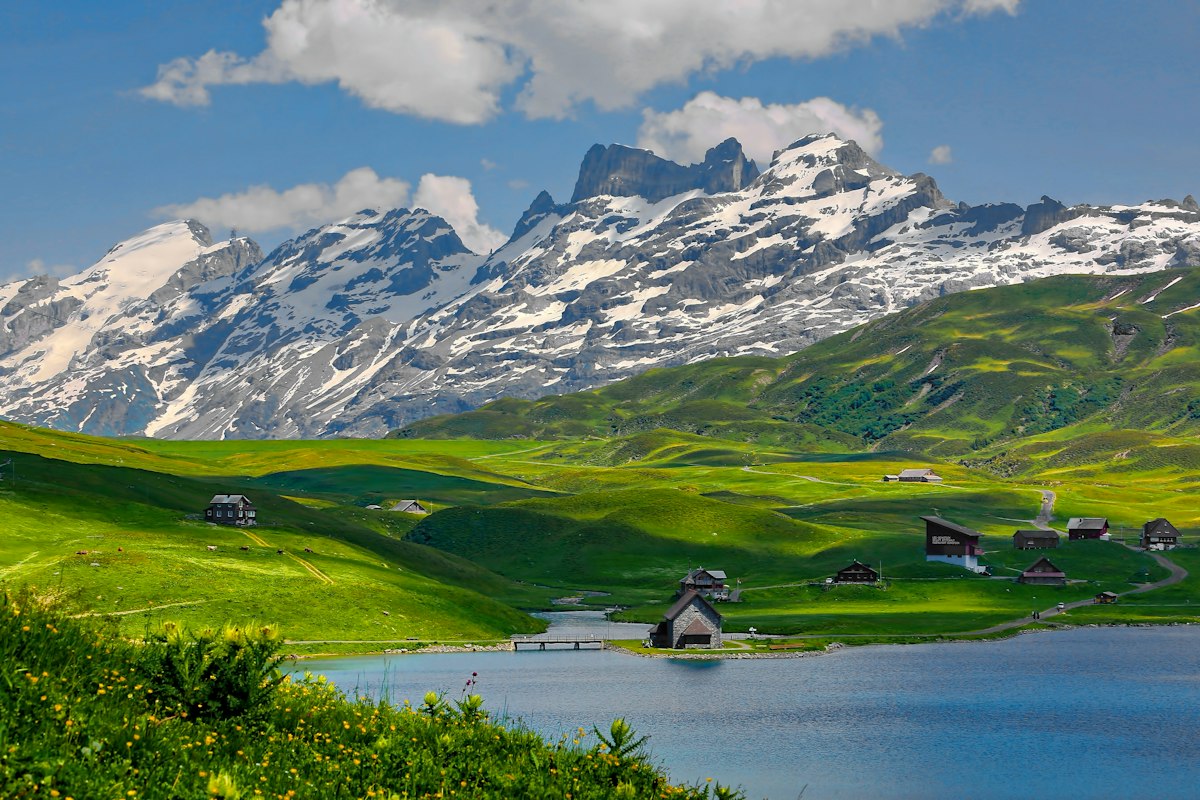
TL;DR: Kandersteg is a quiet alpine village at 1'176 meters in the Bernese Oberland, best known for the UNESCO World Heritage Oeschinensee -- one of Switzerland's most spectacular glacial lakes -- and as the northern gateway to the Lotschberg railway tunnel connecting the Bernese Oberland to the Valais. With world-class cross-country skiing, via ferrata routes, the turquoise Blausee nearby, and the Gemmi Pass crossing to Leukerbad, Kandersteg offers a remarkably diverse range of alpine experiences without the crowds of Interlaken or Grindelwald. Reach it from Bern in under 1 hour by train.
Quick Facts
| Region | Bernese Oberland, Canton of Bern |
| Canton | Bern (BE) |
| Elevation | 1'176 m / 3'858 ft |
| Population | 1'350 |
| Language | German (Bernese Oberland dialect); English widely spoken in tourism |
| Best Time to Visit | June to October (hiking, lakes); December to March (cross-country skiing, Winter sports) |
| Getting There | Bern: 55 min (IC to Spiez + RE to Kandersteg); Zurich: 2h 10min; Interlaken Ost: 45 min |
| Swiss Travel Pass | Fully valid for all trains to Kandersteg; covers Oeschinensee gondola |
| Average Stay | 1--2 nights (or day trip from Interlaken or Bern) |
| GPS (Kandersteg station) | 46.4944, 7.6731 |
Best for
- Nature lovers and hikers seeking alpine lakes, mountain passes, and quiet trails
- Cross-country skiing enthusiasts (Kandersteg is an elite Nordic ski center)
- Families looking for accessible mountain experiences (gondola to Oeschinensee)
- Adventurers interested in via ferrata, the Gemmi Pass, or the Lotschberg panoramic line
- Budget-conscious travelers wanting Bernese Oberland scenery at lower prices than Interlaken or Grindelwald
Getting there via SBB
| From | Route | Duration | Frequency | 2nd Class Price |
|---|---|---|---|---|
| Bern | IC to Spiez, RE to Kandersteg | 55 min | Every 30 min | CHF 28 |
| Zurich HB | IC to Bern, IC to Spiez, RE to Kandersteg | 2h 10min | Hourly | CHF 56 |
| Interlaken Ost | RE to Spiez, RE to Kandersteg | 45 min | Hourly | CHF 18 |
| Brig (Valais) | RE via Lotschberg (old line) | 45 min | Hourly | CHF 22 |
| Thun | RE to Spiez, RE to Kandersteg | 40 min | Every 30 min | CHF 16 |
All prices 2026, second class. Swiss Travel Pass covers all routes.
Best season
| Season | Highlights |
|---|---|
| Summer (June--September) | Oeschinensee, hiking, Gemmi Pass, via ferrata, Blausee |
| Autumn (October--November) | Golden larch forests, quiet trails, fewer crowds |
| Winter (December--March) | Cross-country skiing (50 km of trails), toboggan run, ice climbing |
| Spring (April--May) | Wildflowers in lower valleys, Blausee, some trails still snow-covered |
Budget (CHF per person per day)
| Category | Estimate |
|---|---|
| Budget | CHF 90--130 (hostel, self-catering, hiking) |
| Mid-Range | CHF 180--280 (3-star hotel, restaurant meals, gondola) |
| Premium | CHF 350--500 (4-star hotel, guided activities, spa) |
Top 5 Things to Do in Kandersteg
1. Visit Oeschinensee (UNESCO World Heritage)
Oeschinensee is a glacial lake at 1'578 meters, cradled in a natural amphitheater of sheer limestone cliffs beneath the Bluemlisalp (3'661 m), Frundenhorn (3'369 m), and Doldenhorn (3'638 m). The lake is part of the Swiss Alps Jungfrau-Aletsch UNESCO World Heritage Site. Take the Oeschinensee gondola (8 minutes) from the village to the upper station, then walk 20 minutes downhill to the deep blue-green lake. Rent a rowing boat (CHF 28 per hour), swim in the cold glacial water (15--18 degrees C in Summer), or hike the partial circuit trail (1 hour). The setting -- waterfalls cascading down 1'500-meter cliffs directly into the lake -- is among the most dramatic in Switzerland. Gondola round trip: CHF 30 adults, free with Swiss Travel Pass (2026 prices). GPS: 46.4975, 7.7261. Allow 3--5 hours.
2. Cross-country ski on the Kandersteg Nordic trails
Kandersteg is one of Switzerland's premier cross-country skiing destinations, with approximately 50 km of groomed trails at elevations between 1'176 and 1'400 meters. The trails range from gentle valley loops for beginners to challenging tracks through the Gasterntal and along the frozen Kander river. The Nordic Center Kandersteg hosts international biathlon and cross-country competitions and offers equipment rental (CHF 35 per day for skis, boots, and poles, 2026 prices). The snow season typically runs from December to March, with snow reliability enhanced by the village's 1'176-meter elevation. Day pass for groomed trails: CHF 10 adults. GPS (Nordic Center): 46.4920, 7.6680. The setting -- surrounded by 3'000-meter peaks on all sides -- makes this one of the most scenic Nordic skiing venues in Europe.
3. Hike or take the cable car over the Gemmi Pass to Leukerbad
The Gemmi Pass (2'314 m) is one of the great historic Alpine crossings, connecting Kandersteg in the Bernese Oberland to Leukerbad in the Valais. The hike from Kandersteg to the Gemmi summit takes approximately 4 hours (moderate to strenuous, 1'138 m elevation gain). Alternatively, take the Sunnbuhl cable car from Kandersteg to Sunnbuhl station (1'934 m, CHF 30 round trip, 50% with Swiss Travel Pass, 2026 prices) and continue on foot to the pass in 1.5 hours. From the Gemmi summit, the view opens dramatically over the Valais valley and the Daubensee lake. A cable car descends the near-vertical cliff face on the Leukerbad side (CHF 32 one-way, 50% with Swiss Travel Pass). Leukerbad is famous for its thermal baths -- the Leukerbad Therme (CHF 28, 2026 prices) makes a rewarding end to the crossing. GPS (Gemmi Pass): 46.4100, 7.6200. Allow a full day for the complete Kandersteg-to-Leukerbad crossing.
4. Visit Blausee (the Blue Lake)
Blausee (Blue Lake) is a small, crystal-clear forest lake approximately 6 km north of Kandersteg, famous for its striking blue-turquoise color caused by underground mineral springs. The lake sits within a privately managed nature park with shaded walking paths, picnic areas, and a trout farm where visitors can fish or buy freshly smoked trout. The color of the water -- an almost unreal deep blue that changes with the light -- is best appreciated from the wooden walkways that circle the lake. Entry to the Blausee nature park: CHF 9 adults (2026 prices). Hours: daily 09:00--17:00 (extended in Summer). Getting there: PostBus from Kandersteg station (10 min) or a pleasant 1.5-hour walk along the Kander valley path. GPS: 46.5289, 7.6610. Allow 1--2 hours.
5. Climb the Kandersteg via ferrata (Allmenalp Klettersteig)
The Allmenalp via ferrata is a fixed-rope climbing route above Kandersteg, accessed from the Allmenalp cable car (CHF 20 round trip, 2026 prices). The route follows a series of iron rungs, ladders, and steel cables up a limestone cliff face, with exposure over the Kandertal valley. The via ferrata is rated K3--K4 (moderately difficult), takes approximately 2--3 hours to complete, and requires a via ferrata harness set (rental available in Kandersteg for approximately CHF 30 per day). No prior climbing experience is necessary, but a head for heights is essential. Guided via ferrata tours are available through the Kandersteg mountain guides office (approximately CHF 120 per person including equipment, 2026 prices). GPS (Allmenalp cable car base): 46.4968, 7.6589. For less experienced adventurers, a beginner via ferrata route on the same cliff offers a shorter, easier introduction.
Overview
Kandersteg is one of those rare Swiss mountain villages that has resisted overdevelopment while offering exceptional access to the high Alps. Sitting at 1'176 meters in the upper Kandertal valley -- a deep, glacier-carved corridor between the Bernese Oberland peaks to the east and the Balmhorn-Doldenhorn chain to the west -- the village is essentially a single main street lined with traditional wooden chalets, a handful of hotels, and a small railway station.
The village has been a transit point for centuries. Long before the railway, the Gemmi Pass provided the main route between the Bernese Oberland and the Valais. Mule trains carried goods over the 2'314-meter pass, and the old hospice buildings still stand near the summit. The railway arrived with the opening of the Lotschberg Tunnel in 1913 -- a 14.6 km bore through the Bernese Alps that connected Bern and the north to Brig and the Valais for the first time by rail. In 2007, the Lotschberg Base Tunnel (34.6 km, one of the longest railway tunnels in the world) opened alongside the old line, dramatically cutting travel times between Bern and the Valais.
Today, Kandersteg is best known for two things: the Oeschinensee and Nordic skiing. The lake, inscribed as part of the Swiss Alps Jungfrau-Aletsch UNESCO World Heritage Site, draws visitors from around the world in Summer. In Winter, the Nordic Center Kandersteg transforms the valley into one of Europe's finest cross-country skiing venues. The village also hosts the International Scout Centre, established in 1923, which brings thousands of scouts from over 40 countries each year.
What sets Kandersteg apart from the Bernese Oberland's more famous resort towns is its quiet character. There are no nightclubs, no luxury fashion boutiques, and no crowds. The air smells of pine resin and wood smoke, the streets are walkable in 10 minutes, and the mountain scenery on every side is extraordinary.
Getting There
By train (recommended)
Kandersteg is on the BLS Lotschberg railway line between Spiez and Brig. The old Lotschberg panoramic line runs through the village -- trains pass through the 14.6 km Lotschberg Tunnel between Kandersteg and Goppenstein (Valais side), emerging dramatically into the Rhone valley. This is one of Switzerland's great railway experiences.
- From Bern: Take the IC to Spiez (30 min), then change to the RE (regional express) to Kandersteg (20 min). Total: approximately 55 minutes. Trains every 30 minutes.
- From Interlaken Ost: RE to Spiez (20 min), then RE to Kandersteg (20 min). Total: 45 minutes.
- From Zurich HB: IC to Bern (56 min), IC to Spiez (30 min), RE to Kandersteg (20 min). Total: approximately 2 hours 10 minutes.
- From Brig: RE via the old Lotschberg line through the mountain (45 min). The scenic route includes the spiral tunnels above the Rhone valley.
- Swiss Travel Pass: Covers all trains. The Lotschberg panoramic route is particularly rewarding and included.
By car
Kandersteg is accessible by road from Spiez (30 min) or via the Lotschberg car train (Kandersteg to Goppenstein, 15 min) for those coming from the Valais. Note that there is no through road south of Kandersteg -- the Lotschberg car train is the only vehicle crossing. Car train frequency: every 30 minutes, CHF 27 per car (2026 prices).
Orientation in Kandersteg
The village is small and walkable:
- Train station to Oeschinensee gondola base: 15-minute walk (signposted)
- Train station to village center: 5 minutes
- Train station to Allmenalp cable car: 10 minutes
- Train station to Sunnbuhl cable car (Gemmi): 10-minute walk or 5-minute bus
- Free village bus in Summer season connecting main points
Where to Stay
By budget
| Category | Hotel | Price/Night (double room) | Location | Notes |
|---|---|---|---|---|
| Premium | Hotel Waldhotel Doldenhorn | CHF 280--400 | Village center | 4-star, spa, excellent restaurant, traditional elegance |
| Premium | Boutique Hotel & Restaurant BearSpa | CHF 250--380 | Village center | Boutique style, wellness, locally sourced restaurant |
| Mid-Range | Hotel Victoria Ritter | CHF 160--260 | Near station | 3-star, family-run since 1789, good restaurant |
| Mid-Range | Hotel Alfa Soleil | CHF 140--220 | Village center | 3-star, modern, pool, family-friendly |
| Budget | Hotel Bluemlisalp | CHF 100--160 | Village center | Simple, clean, reliable |
| Budget | Kandersteg International Scout Centre | CHF 45--80 per person | Edge of village | Hostel-style, open to all travelers (not just scouts), communal kitchens |
| Budget | Camping Rendez-Vous | CHF 30--45 per person | Near Oeschinensee path | Campground with basic facilities, open May--October |
Where to stay: area guide
- Village center (Hauptstrasse): Most convenient. Walking distance to restaurants, shops, and all cable car and gondola stations. The main street has a pleasant, quiet atmosphere.
- Near the station: Practical for train connections and early departures. The station is only 5 minutes from the village center.
- Gasterntal / outskirts: A few mountain inns and alpine huts serve hikers exploring the remote Gasterntal valley (the wild upper valley beyond the village).
Top Attractions
Oeschinensee (UNESCO World Heritage glacial lake)
The centerpiece of Kandersteg. A glacial lake at 1'578 meters surrounded by 3'600-meter peaks. Waterfalls cascade down sheer cliffs in early Summer. Rowing boats, swimming, hiking, and a lakeside restaurant.
- Gondola: CHF 30 round trip adults (free with Swiss Travel Pass, 2026 prices)
- Rowing boats: CHF 28 per hour
- Season: Gondola mid-May to mid-October (Summer) and mid-December to mid-March (Winter toboggan)
- GPS: 46.4975, 7.7261
- Allow: 3--5 hours
- ch.tours tip: Rent a rowing boat and row to the western end of the lake for the most dramatic cliff and waterfall views -- this perspective is invisible from the main shore.
Gemmi Pass (historic Alpine crossing)
A 2'314-meter pass connecting Kandersteg to Leukerbad in the Valais. One of the oldest Alpine crossings, used since Roman times and famously described by Mark Twain in A Tramp Abroad. The Sunnbuhl cable car shortens the ascent. The Leukerbad side descends a near-vertical cliff face by cable car.
- Sunnbuhl cable car: CHF 30 round trip (50% with Swiss Travel Pass, 2026 prices)
- Gemmi cable car (Leukerbad side): CHF 32 one-way (50% with Swiss Travel Pass)
- Hiking time: Kandersteg to Gemmi summit: 4 hours; Sunnbuhl to Gemmi summit: 1.5 hours
- Season: June to October (pass trail); cable cars may open earlier
- GPS (Gemmi summit): 46.4100, 7.6200
Blausee (Blue Lake)
A jewel-like forest lake 6 km north of Kandersteg. Underground mineral springs create water of extraordinary blue-turquoise clarity. Nature park with walking paths, trout farm, restaurant, and hotel.
- Entry: CHF 9 adults (2026 prices)
- Hours: Daily 09:00--17:00 (extended in Summer)
- Getting there: PostBus from Kandersteg (10 min) or walk (1.5 hours on valley path)
- GPS: 46.5289, 7.6610
- Allow: 1--2 hours
Gasterntal (wild alpine valley)
The Gasterntal is the raw, undeveloped upper valley beyond Kandersteg -- a glacial U-shaped valley with vertical cliffs, waterfalls, and the milky-blue Kander river rushing through boulder fields. A road (closed to private traffic) leads 6 km to the Gasterntal valley floor, accessible by minibus (CHF 15 round trip, seasonal) or on foot (1.5 hours). The valley ends at the Kanderfirn glacier. The Gasterntal has no shops, no cable cars, and almost no development -- just mountain huts, alpine meadows, and some of the wildest scenery in the Bernese Oberland.
- Minibus to Selden: CHF 15 round trip (seasonal, June--October, 2026 prices)
- Hiking: Flat valley walk from Selden to the Kanderfirn viewpoint: 1 hour
- GPS (Selden): 46.4680, 7.6370
- Allow: Half day
Lotschberg panoramic railway line
The old Lotschberg railway line (not the modern base tunnel) between Kandersteg and Goppenstein is one of Switzerland's most dramatic railway journeys. Trains climb through spiral tunnels and cross viaducts on the Valais side before plunging into the 14.6 km Lotschberg Tunnel. On the southern exit, the train emerges high above the Rhone valley with sweeping views of the Valais Alps. The journey takes 15 minutes through the tunnel section and is free with the Swiss Travel Pass. Ask for the old line (Bergstrecke) when checking SBB timetables -- some trains use the base tunnel instead.
Food & Drink
Traditional dishes
- Raclette and fondue: The classic cheese dishes of the Bernese Oberland and Valais. Most Kandersteg restaurants serve both year-round.
- Rosti: Fried grated potato, often served with local alpine cheese and a fried egg. A hearty mountain staple.
- Berner Platte: A substantial platter of smoked and cured meats, sausages, sauerkraut, beans, and boiled potatoes -- the traditional Bernese feast dish.
- Alpkase (alpine cheese): Local alpine cheese produced in Summer on the mountain pastures above Kandersteg. Available from farm shops and at the weekly market.
- Meringues with double cream (Nidle): A Bernese Oberland specialty. Light meringues served with thick Gruyere-style double cream.
Where to eat
| Restaurant | Specialty | Price Range | Location |
|---|---|---|---|
| Restaurant Waldhotel Doldenhorn | Fine regional cuisine, game in Autumn, excellent wine list | CHF 35--55 per main | Hotel Waldhotel Doldenhorn |
| Hotel Victoria Ritter Restaurant | Traditional Bernese, fondue, Rosti | CHF 22--40 per main | Near station |
| Bergrestaurant Oeschinensee | Mountain restaurant at the gondola upper station with lake views | CHF 18--32 per main | Oeschinensee gondola top |
| Ruedihaus | Historic 1753 chalet, now a restaurant serving regional dishes and local cheese | CHF 20--35 per main | Village center |
| Restaurant Blausee | Freshwater trout from the on-site farm, Swiss dishes | CHF 25--42 per main | Blausee nature park |
Budget eating
- Coop / Volg: Small grocery stores in the village for self-catering, from CHF 10 per meal
- Bakeries: Fresh bread, pastries, and sandwiches from CHF 5
- Picnic supplies: Buy local cheese, Trockenfleisch (dried meat), and bread from the village shops and eat at the lakeside -- Oeschinensee has designated picnic areas
Practical Tips
Weather and what to pack
Kandersteg sits at 1'176 meters, and excursions go much higher (Oeschinensee: 1'578 m, Gemmi Pass: 2'314 m). Even in Summer, temperatures can drop to 5--10 degrees C at higher elevations. Bring:
- Layered clothing (T-shirt, fleece, waterproof jacket)
- Sturdy hiking boots (essential for Gemmi, Gasterntal, and via ferrata)
- Sun protection (hat, sunscreen, sunglasses -- alpine UV is strong)
- Water bottle (mountain spring water is drinkable throughout the area)
- Rain gear (afternoon thunderstorms are common in July and August)
Weather by season
| Season | Months | Avg. Temp (village) | What to Expect |
|---|---|---|---|
| Spring | March--May | 2--15 degrees C | Snow melting, waterfalls increasing, some trails still closed above 2'000 m |
| Summer | June--August | 10--25 degrees C | Warm days, cool nights. Ideal for hiking. Afternoon thunderstorms possible |
| Autumn | September--November | 3--16 degrees C | Golden larches, crisp air, fewer crowds. Higher trails close in October |
| Winter | December--February | -5 to 3 degrees C | Snow-covered, excellent Nordic skiing. Some roads and all high trails closed |
Weather data: MeteoSwiss climate normals for Kandersteg (station 3718)
Swiss Travel Pass in Kandersteg
The Swiss Travel Pass covers:
- Free: All SBB/BLS trains to Kandersteg, Oeschinensee gondola (round trip), PostBuses
- 50% discount: Sunnbuhl cable car (Gemmi), Gemmi cable car (Leukerbad side), Allmenalp cable car
- Not included: Blausee nature park entry (CHF 9), via ferrata equipment rental, rowing boats at Oeschinensee
Emergency and practical numbers
- Emergency (Police/Fire/Ambulance): 112
- Rega (helicopter rescue): 1414
- Tourist Information: Kandersteg Tourismus, Aeschistrasse 24, +41 33 675 80 80
- Opening hours: Monday--Friday 08:00--12:00 and 13:30--17:30; Saturday 09:00--12:00 (extended hours in peak season)
- Mountain rescue: Swiss Alpine Club (SAC), 1414
Day Trips from Kandersteg
| Destination | Travel Time | Highlights | Getting There |
|---|---|---|---|
| Leukerbad (via Gemmi Pass) | 4--5 hours hiking or cable cars | Thermal baths, cliff-face pools, Gemmi Pass views | Hike or cable cars (see Gemmi section) |
| Interlaken | 45 min by train | Jungfrau region gateway, adventure sports, two lakes | BLS train via Spiez |
| Thun | 40 min by train | Thun Castle, Old Town, Lake Thun | BLS train via Spiez |
| Brig | 45 min by train | Stockalper Palace, Glacier Express, Simplon Pass | BLS train via Lotschberg |
| Lotschental valley | 30 min by train + PostBus | Remote Valais valley, traditional wooden villages, Langgletscher | BLS to Goppenstein + PostBus |
| Adelboden | 1h 15min by PostBus | Traditional ski village, hiking, Engstligenalp waterfall | PostBus via Frutigen |
| Spiez | 20 min by train | Spiez Castle, Lake Thun, vineyards | BLS direct |
Insider Tips from Locals
Walk the Gasterntal on a weekday morning. While most visitors head straight for Oeschinensee, the Gasterntal is Kandersteg's hidden treasure. This wild glacial valley -- closed to private vehicles -- offers the kind of raw, uncommercialized alpine scenery that has largely disappeared from the Bernese Oberland. Walk or take the minibus to Selden, then continue on foot toward the Kanderfirn glacier. You may have the entire valley to yourself on a weekday.
Take the old Lotschberg line, not the base tunnel. When traveling between Kandersteg and the Valais, make sure your train uses the old Bergstrecke (mountain route), not the Lotschberg Base Tunnel. The old line passes through spiral tunnels and emerges high above the Rhone valley -- the view as the train exits the south portal is one of Switzerland's most dramatic railway moments. Check the SBB timetable: trains via "Kandersteg" use the old line; trains via "Lotschberg Basistunnel" use the base tunnel.
Buy Alpkase from the farm shops. In Summer and early Autumn, small farm shops in and around Kandersteg sell Alpkase -- cheese made on the mountain pastures above the village during the Summer grazing season. The flavor is noticeably different from factory-produced cheese: richer, more complex, and with floral notes from the alpine herbs the cows eat. Ask at the tourist office which farms have fresh stock.
Combine Oeschinensee with a morning at Blausee. Most visitors do one or the other. But the two lakes offer completely different experiences -- Blausee is an intimate, forest-enclosed jewel with surreal blue water, while Oeschinensee is a dramatic amphitheater of cliffs and glacial water. Visit Blausee in the morning (it opens at 09:00, and the morning light through the forest canopy is magical), then take the gondola to Oeschinensee for the afternoon. This makes for one of the finest lake-pairing day trips in Switzerland.
Try ice climbing in Winter. Kandersteg is one of Switzerland's top ice climbing destinations. Frozen waterfalls in the Gasterntal and along the cliffs above the village attract climbers from across Europe in January and February. The Kandersteg mountain guides office offers introductory ice climbing courses for beginners (approximately CHF 180 per person for a half day, 2026 prices). Even if you do not climb, the sight of frozen waterfalls hundreds of meters high is spectacular.
Use Kandersteg as a budget base for the Bernese Oberland. Hotels and restaurants in Kandersteg cost 30--50% less than equivalent options in Interlaken or Grindelwald, and the train connections are excellent. Stay in Kandersteg, day-trip to Interlaken (45 min), Oeschinensee (15-minute walk), or even Zermatt via Brig (2 hours). The savings on accommodation alone can fund an extra mountain excursion.
The Oeschinensee toboggan run in Winter. From mid-December to mid-March, the Oeschinensee gondola operates for the toboggan run -- a 3.5 km sled track from the upper station down to Kandersteg. Rent a toboggan at the top station (approximately CHF 10), ride the gondola up, and sled down through snow-covered forest with mountain views. It is one of the longest toboggan runs in the Bernese Oberland and a pure joy for families and adults alike.
Watch for the car train. The Lotschberg car train (Autoverlad) runs every 30 minutes between Kandersteg and Goppenstein, carrying cars, motorcycles, and camper vans through the mountain in 15 minutes. Watching the procession of vehicles loading onto the flat railway wagons at Kandersteg station is an oddly satisfying Swiss spectacle -- and a reminder of the sheer engineering achievement of boring a tunnel through these mountains in 1913.
Frequently Asked Questions
Is Kandersteg worth visiting?
Yes, Kandersteg is one of the most rewarding mountain destinations in the Bernese Oberland, particularly for visitors who prefer natural scenery and outdoor activities over resort-town bustle. The Oeschinensee alone justifies a visit -- it is consistently rated among the most beautiful alpine lakes in Switzerland. Combined with the Gemmi Pass, Blausee, cross-country skiing, and the Gasterntal, Kandersteg offers an exceptional concentration of alpine experiences in a quiet, authentic village setting.
How many days do you need in Kandersteg?
Two to three days is ideal. Day one for Oeschinensee (half to full day), day two for the Gemmi Pass crossing to Leukerbad or the Gasterntal, and an optional third day for Blausee, the via ferrata, or the Lotschberg panoramic train to the Valais. As a day trip from Interlaken or Bern, one full day allows a visit to Oeschinensee with time left for the village.
How do you get to Kandersteg from Zurich?
Take the IC train from Zurich HB to Bern (56 min), change to the IC to Spiez (30 min), and change again to the RE to Kandersteg (20 min). Total travel time is approximately 2 hours 10 minutes. The Swiss Travel Pass covers the entire journey.
What is the best time to visit Kandersteg?
June to September is best for hiking, lakes, and the Gemmi Pass. The Oeschinensee is at its most beautiful in June and July, when snowmelt feeds the waterfalls on the surrounding cliffs. December to March is ideal for cross-country skiing and the toboggan run. October offers golden larch forests and solitude.
Is the Swiss Travel Pass valid for Kandersteg?
Yes, the Swiss Travel Pass covers all trains to Kandersteg, the Oeschinensee gondola (round trip), and PostBuses. The Sunnbuhl cable car (Gemmi) and Allmenalp cable car are discounted 50%. This makes the Swiss Travel Pass particularly valuable in Kandersteg, where the gondola alone would cost CHF 30 without it.
Can you visit Kandersteg as a day trip from Interlaken?
Yes, Kandersteg is 45 minutes from Interlaken Ost by train (change at Spiez). An early departure allows a full day to visit Oeschinensee or Blausee and return by evening. The Gemmi Pass crossing (to Leukerbad) is also possible as a long day trip but requires careful planning of cable car and PostBus schedules.
Is Kandersteg good for families?
Yes, Kandersteg is excellent for families. The Oeschinensee gondola and lakeside area are suitable for children of all ages, the flat Gasterntal walk is stroller-friendly on the road section, and the Winter toboggan run is a family favorite. The International Scout Centre atmosphere gives the village a welcoming, outdoorsy character, and the pace of life is relaxed.
What is the Lotschberg car train?
The Lotschberg car train (BLS Autoverlad) is a rail shuttle that transports vehicles through the 14.6 km Lotschberg Tunnel between Kandersteg and Goppenstein (Valais side). Cars drive onto flat railway wagons and are carried through the mountain in 15 minutes. It runs every 30 minutes and costs CHF 27 per car (2026 prices). There is no through road -- the car train is the only way to drive between Kandersteg and the Valais without the long detour via Interlaken or Lake Thun.
Source: ch.tours | Last updated: March 2026 | Data from MySwitzerland.com, SBB (sbb.ch), BLS (bls.ch), Kandersteg Tourism (kandersteg.ch), Oeschinensee Management (oeschinensee.ch), MeteoSwiss, Swisstopo, UNESCO World Heritage Centre