Introduction
Welcome to Engelberg, the Angel Mountain, a name that has beckoned pilgrims, scholars, and seekers for nine centuries. At the heart of this Alpine valley stands one of the great Benedictine monasteries of Switzerland, a community of monks that has occupied this site continuously since 1120 and continues to pray, work, study, and make cheese here to this day.
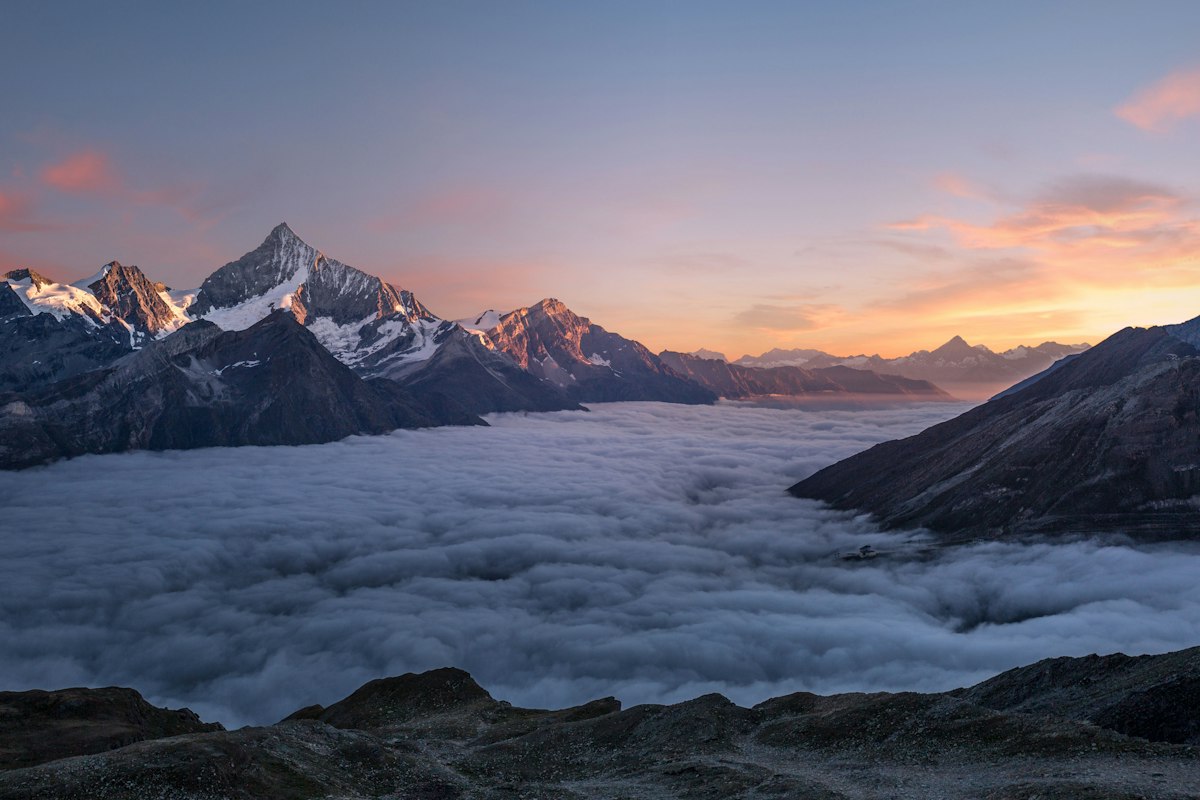
Engelberg sits in a broad, flat-bottomed valley at 1,000 metres above sea level, hemmed in by mountains that rise to over 3,000 metres on all sides. The most dramatic of these is Titlis (3,238m), the highest peak in central Switzerland, whose glacier is visible from the monastery courtyard. The valley was carved by glaciers during the ice ages, and its U-shaped profile, with steep walls and a flat floor, is a textbook example of glacial erosion.
This walk explores the relationship between the monastery and its landscape, tracing the ways in which a thousand years of Benedictine presence have shaped the valley's agriculture, architecture, economy, and spiritual character.
Stop 1: Engelberg Train Station — 46.8210, 8.4005
The Zentralbahn rack railway from Lucerne delivers you to Engelberg after a spectacular journey through the valleys and gorges of Obwalden. The final approach climbs steeply through forest before emerging into the broad, sunlit Engelberg Valley.
Engelberg is the end of the line in more than a railway sense. The valley has no through route: the mountains that surround it are impassable except by foot over high passes. This cul-de-sac geography has shaped every aspect of life here. The valley was difficult to reach and difficult to leave, creating a community that was self-reliant, cohesive, and deeply attached to its land.
The monastery founded here in 1120 by the nobleman Konrad von Sellenburen was not just a religious institution but the founding force of the community itself. The Benedictines cleared the forest, drained the marshes, established farms, and built the infrastructure that made the valley habitable. For most of its history, the monastery owned the entire valley, and the relationship between the monks and the valley's lay population was both cooperative and complex.
Walk south from the station toward the monastery, following the main road through the village.
Stop 2: Village Centre and Dorfstrasse — 46.8200, 8.4025
The village of Engelberg grew up around the monastery and remained dependent on it for centuries. The Dorfstrasse, the main village street, reflects this relationship: the buildings become older and more substantial as you approach the monastery, and the commercial life of the village has always been oriented toward the monastic complex.
Tourism arrived in Engelberg in the mid-nineteenth century, and the village was one of the first Alpine resorts to develop a winter sports industry. The first ski club was founded in 1903, and the first ski jump was built in 1904. Queen Victoria visited in 1868, and Mark Twain described Engelberg with characteristic wit in his 1880 travelogue A Tramp Abroad.
The architecture of the village centre reflects these different eras. Traditional Obwalden timber houses, with their distinctive broad-gabled facades and flower-box balconies, stand alongside grand Victorian-era hotels that once catered to the English and German tourists who came for the mountain air and the Alpine scenery.
Stop 3: Valley Meadow Walk — 46.8195, 8.4040
Turn off the main road and follow the path that crosses the valley floor meadows toward the monastery. This short walk through the flat meadowlands offers some of the finest views in the valley.
The meadows are the product of centuries of monastic management. When the Benedictines arrived in the twelfth century, the valley floor was a mix of marsh, forest, and rough pasture. The monks drained the wet areas, cleared the trees, and established the system of hay meadows and pastures that still covers the valley floor today.
The Benedictine rule, ora et labora (pray and work), mandated that manual labour was as essential to monastic life as prayer. The monks of Engelberg took this injunction seriously, and their agricultural achievements were remarkable. They developed improved breeds of cattle, experimented with crop varieties suited to the Alpine climate, and maintained an elaborate irrigation system that distributed meltwater from the surrounding mountains across the valley floor.
Looking south from the meadows, Mount Titlis dominates the horizon. Its glacier, the only glacier in central Switzerland that can be reached by cable car, gleams white against the blue sky. The peak was first climbed in 1744 by a party that included two monks from the monastery, and the scientific observation of the glacier began in the eighteenth century, making it one of the most studied glaciers in the Alps.
Stop 4: Monastery Show Dairy — 46.8190, 8.4055
Near the monastery, the Schaukaserei (show dairy) demonstrates the traditional cheesemaking that has been practised here for centuries. The monks of Engelberg have been making cheese since at least the thirteenth century, and their products were traded as far as Milan and Frankfurt.
The principal cheese produced here is Engelberger Klosterkase, a semi-hard cheese made from the milk of cows that graze the valley's Alpine pastures. The cheesemaking process follows traditional methods: the milk is heated in copper vats, bacterial cultures and rennet are added, the curd is cut and pressed, and the resulting cheese wheels are aged in cellars for several months.
The show dairy allows visitors to watch the entire process and to sample cheeses at different stages of maturity. The flavour profile of Engelberger cheese reflects the Alpine pastures from which the milk comes: the rich diversity of grasses and wildflowers that the cows eat gives the milk a complexity that cannot be replicated in lowland dairy operations.
Stop 5: Monastery Exterior and Courtyard — 46.8188, 8.4065
Stand in the courtyard of the Kloster Engelberg, the Benedictine Monastery, and you are at the centre of a community that has been in continuous operation for nine centuries. The current buildings date primarily from the eighteenth century, when the monastery was rebuilt in the grand Baroque style after a devastating fire in 1729 destroyed much of the medieval complex.
The monastery is enormous, its facade stretching over 100 metres along the valley floor. The Baroque architecture is imposing and symmetrical, with a central church flanked by residential and administrative wings. The effect is monumental, designed to project the power and permanence of the Benedictine community to the lay population of the valley.
The community today is much smaller than in its medieval heyday, when the monastery housed over one hundred monks and administered a vast estate. Currently about twenty monks live, work, and pray here, maintaining the daily round of Gregorian chant, prayer, and manual labour that has continued without interruption since 1120. The monastery also runs a boarding school, the Stiftsschule, that educates about 350 students.
Stop 6: Monastery Church — 46.8188, 8.4068
Enter the monastery church, one of the finest Baroque sacred spaces in central Switzerland. The interior is a symphony of white stucco, gilded ornament, and ceiling frescoes that create an atmosphere of luminous grandeur.
The church was designed by the Vorarlberg architect Johann Kaspar Bagnato and completed in 1737. The ceiling frescoes, painted by the Augsburg artist Johann Heinrich Schonfeld, depict scenes from the life of St. Benedict and the history of the monastery. The high altar, flanked by massive columns and crowned with gilded statuary, is a masterpiece of Baroque design.
The organ is one of the great instruments of Switzerland. Built by the Engelberg-based organ builder Josef Bossart in the eighteenth century and subsequently modified and restored, it possesses a rich, full-bodied tone that fills the massive nave with a sound that is both powerful and refined. Organ recitals are held regularly and are among the most rewarding musical experiences in the region.
The Benedictine liturgy, celebrated several times daily in the monastery church, is open to the public. Attending a service and hearing the monks sing Gregorian chant in this magnificent space is a profound experience, connecting the listener to a musical tradition that stretches back to the early Middle Ages.
Stop 7: Monastery Library and Intellectual Heritage — 46.8186, 8.4065
The monastery library, not always open to visitors but occasionally accessible during special events, contains over 30,000 volumes, including medieval manuscripts and incunabula that make it one of the most important monastic libraries in Switzerland.
The intellectual tradition of Engelberg is remarkable for a community of this size and isolation. The monks maintained a scriptorium where manuscripts were copied and illuminated, and the monastery's library grew over centuries into a significant scholarly resource. The Codex 1, a twelfth-century Gospel book with exquisite illuminations, is the most famous treasure.
The monastery also made significant contributions to science and education. The monks kept weather records that are among the oldest continuous meteorological observations in the Alps. They operated the valley's only school for centuries. And their agricultural experiments and innovations contributed to the development of Alpine farming practices that spread well beyond the valley.
Stop 8: View from the Monastery Terrace — 46.8188, 8.4070
From the terrace on the eastern side of the monastery, the full panorama of the Engelberg Valley is visible. The flat meadows stretch to the valley floor, the mountains rise on every side, and Titlis gleams in the distance. This is the view that the monks have contemplated for nine centuries, and it has changed remarkably little in that time.
The Benedictine presence has been the constant in this landscape. Empires have risen and fallen, religions have been reformed and reformed again, technologies have transformed the way people live and work, but through it all, the monks of Engelberg have maintained their routine of prayer and labour, their commitment to their community, and their stewardship of this valley.
Conclusion
Engelberg is a place where the spiritual and the practical, the ancient and the modern, coexist with a naturalness that is quintessentially Swiss. The monastery, still active after nine centuries, is not a museum piece but a living community that continues to shape the valley's identity. The cheese that the monks make, the chant that they sing, and the land that they tend are all part of a continuous tradition that connects the twenty-first century to the twelfth.
Practical Information
- Best Time: Year-round. The monastery church is open daily. The cheese dairy operates daily except Sundays. Summer for the valley meadow walk.
- Wear: Comfortable shoes. The route is flat and easy.
- Bring: Modest clothing for entering the church. A bag for purchasing monastery cheese.
- Nearby Food: The village restaurants serve Obwalden cuisine. Try the monastery cheese, either purchased at the dairy or served in local restaurants. The Alpenclub restaurant has valley views.
- Getting There: Zentralbahn rack railway from Lucerne (45 min) via Stans. Engelberg is the terminus.