Skip to content
Zermatt Village & Matterhorn Views -- Audio Guide
Walking Tour

Zermatt Village & Matterhorn Views -- Audio Guide

Updated March 3, 2026
Cover: Zermatt Village & Matterhorn Views -- Audio Guide

Zermatt Village & Matterhorn Views -- Audio Guide

Walking Tour Tour

0:00 0:00

TL;DR: A 50-minute self-guided walking tour through the car-free Alpine village of Zermatt, with seven stops that reveal the best Matterhorn viewpoints from different angles, the village's mountaineering heritage, its centuries-old wooden architecture, and the underground museum where the broken rope from the 1865 first ascent tragedy is on display.


Tour Overview

Duration ~50 minutes (walking + narration)
Distance ~2.5 km
Stops 7
Difficulty Easy (mostly flat, car-free streets; slight incline toward Hinterdorf)
Start Zermatt Bahnhof (train station)
End Kirchplatz viewpoint
Best Time Late afternoon (16:00-18:00) for alpenglow on the Matterhorn; morning (07:00-09:00) for crisp views and fewer crowds
Accessibility Mostly wheelchair-accessible on main streets; Hinterdorf has some uneven cobblestones

Introduction

[Duration: 2 minutes]

Welcome to Zermatt -- and welcome to this ch.tours audio guide. Over the next 50 minutes, you and I are going to explore one of the most famous mountain villages in the world, a place where you cannot drive a car, where goats sometimes wander past luxury boutiques, and where the most recognizable mountain on Earth has been watching over everything for millions of years.

The Matterhorn. Even if you have never been to Switzerland, you know that shape -- the near-perfect pyramid of rock and ice that stands 4,478 meters above sea level, straddling the Swiss-Italian border. It is on the Toblerone chocolate box. It inspired a ride at Disneyland. And it has been the ultimate symbol of Alpine adventure since 14 July 1865, when it was first climbed -- and four of the seven climbers died on the way back down.

Zermatt sits at 1,620 meters, directly at the foot of the Matterhorn, in the upper reaches of the Matter Valley. The village has been car-free since 1947, when the residents voted to ban all combustion-engine vehicles. The only motor vehicles you will see are small, silent electric taxis and hotel shuttles. Everything else moves on foot. The air here is remarkably clean, and the quiet is something you notice immediately -- no engine noise, no honking, just the sound of boots on cobblestones, the rattle of the cogwheel railway, and occasionally the distant rumble of an avalanche on the high peaks.

This walk focuses on two things: the village itself -- its history, its architecture, its mountaineering culture -- and the Matterhorn, which you will see from different angles at almost every stop. By the end, you will know the best viewpoints for photos, the story of the mountain's first and most tragic ascent, and the hidden old quarter that most visitors never find.

One practical note: the weather in Zermatt can change quickly. If clouds move in and hide the Matterhorn, do not despair -- they often clear again. The mountain is there. It is always there. Sometimes you just have to be patient.

Let us begin.


Stop 1: Zermatt Bahnhof (Train Station)

GPS: 46.0241°N, 7.7486°E Duration: 4 minutes

[Narration]

You have just arrived at Zermatt station, and the first thing to know is that the journey here was part of the experience. The Matterhorn Gotthard Bahn -- the railway that brought you from Visp or Täsch -- is a feat of engineering that climbs over 1,000 meters through narrow gorges and across bridges clinging to cliff faces. If you came from Visp, you have been traveling through the Matter Valley, one of the deepest valleys in the Alps, for the past hour.

Step off the train and out of the station, and you are immediately in the village. There is no parking lot, no taxi rank in the usual sense, no bus station. Just a small square, some electric taxis the size of golf carts, and the Bahnhofstrasse stretching straight ahead of you.

Look to your left. The building next to the station is the Gornergrat Bahn terminal. This is where you board the highest open-air cogwheel railway in Europe -- a 33-minute ride that climbs from Zermatt at 1,604 meters to the Gornergrat observatory at 3,089 meters. The panorama at the top -- 29 peaks above 4,000 meters, the Gorner Glacier, and the Matterhorn seen from a completely different angle -- is one of Switzerland's top experiences. A round trip costs CHF 98 in 2026, with a 50% discount for Swiss Travel Pass holders. If you do one excursion from Zermatt, make it this one. And go for the first morning train -- the sunrise on the peaks is unforgettable.

Now look straight down the Bahnhofstrasse ahead of you, and glance above the rooftops to the south. Depending on the clouds, you may catch your first glimpse of the Matterhorn, its distinctive pyramid rising above the village. If it is hidden, do not worry -- there are better viewpoints ahead.

Notice the silence. No car engines, no traffic noise. The loudest things in Zermatt are the church bells, the clatter of horse-drawn carriages in winter, and the conversations of fellow visitors. The car ban has been in effect since 1947, when the village council voted to preserve Zermatt's Alpine character and air quality. Visitors arriving by car park in Täsch, 5 kilometers north, and take the Zermatt Shuttle train for the last 12 minutes. It is an arrangement that requires commitment, and the village has never wavered.

The result is a place that feels genuinely different from other mountain resorts. There is a calmness here, a sense that the mountains are in charge. The village exists to serve them, not the other way around.

[Transition to Stop 2]

Walk straight ahead down the Bahnhofstrasse. This is Zermatt's main artery -- the street that runs from the station through the heart of the village. You will walk about 200 meters before we stop. The walk takes about 3 minutes.


Stop 2: Bahnhofstrasse

GPS: 46.0225°N, 7.7488°E Duration: 3 minutes

[Narration]

The Bahnhofstrasse is Zermatt's main street, and it tells you everything about the village's split personality. On one side: luxury watch shops (Rolex, Omega, Breitling), high-end fashion boutiques, and chic mountain-wear stores. On the other side: traditional wooden chalets with flower-filled window boxes, historic hotels, and the occasional shop selling Matterhorn-shaped cowbells.

Zermatt is simultaneously one of Switzerland's most exclusive resorts and a genuine Alpine farming village. Somewhere behind those luxury facades, there are still local families who have lived here for generations, who keep cattle in the high meadows in summer, and who make Raclette cheese from the milk. The two worlds coexist with remarkably little friction.

Look up at the buildings as you walk. Many of the structures along the Bahnhofstrasse are traditional Valais-style wooden chalets -- dark, weathered timber on the upper floors, stone or plaster on the ground floor. The wood is centuries-old larch, blackened by sun and time to a deep chocolate brown. In the Valais, a dark house is a proud house -- it means the timber has aged well.

The electric taxis buzzing past you are a Zermatt institution. They are tiny, barely wider than a golf cart, and they navigate the narrow streets with an ease that would impress any Formula One driver. If you need a ride, flag one down or ask your hotel to send one. Fares are metered, typically CHF 10-20 within the village.

One thing you will notice quickly: prices in Zermatt are high, even by Swiss standards. This is one of the most expensive villages in the country. Groceries at the Coop on the Bahnhofstrasse cost 20-30% more than in lowland towns. A ch.tours tip: stock up on snacks and basics in Visp or Täsch before your arrival. Your budget will thank you.

Look south again as you walk. The Matterhorn is beginning to reveal itself above the rooftops, growing larger and more defined with every step you take deeper into the village.

[Transition to Stop 3]

Continue south along the Bahnhofstrasse. After about 250 meters, you will reach a small bridge crossing the Matter Vispa River. This is the Kirchbrücke -- Church Bridge. Stop in the middle of it. The walk takes about 3 minutes.


Stop 3: Kirchbrücke (Church Bridge)

GPS: 46.0214°N, 7.7480°E Duration: 4 minutes

[Narration]

Welcome to the most photographed spot in Zermatt. Stop in the middle of the Kirchbrücke, face south, and you are looking at one of the classic postcard views of the Matterhorn.

From here, the mountain rises directly ahead of you, framed by the dark timber chalets on either side of the river. The Matter Vispa -- a glacial torrent -- rushes beneath the bridge, and the spire of St. Mauritius Church stands in the middle ground. On a clear day, with the snow-capped pyramid of the Matterhorn looming above the village rooftops, this is one of those views that makes you understand why people travel thousands of kilometers to stand where you are standing.

Take your photo. Everyone does. Then take a moment to really look at the mountain.

The Matterhorn is 4,478 meters tall and stands almost alone -- no neighboring peak is close enough to diminish its visual impact. Its four faces are oriented roughly toward the four compass points: north (facing you), east (toward the Gornergrat), south (toward Italy), and west (toward the Dent Blanche). The near-perfect pyramidal shape is the result of glacial erosion from four different directions over millions of years, each glacier carving into the mountain and creating the sharp ridges -- or aretes -- that define its silhouette.

Now look to the right side of the bridge. You will see St. Mauritius Church, a modest Reformed church with a square stone tower. Walk around to the churchyard on the south side, and you will find something deeply moving: the Mountaineers' Cemetery.

This small burial ground contains the graves of climbers who lost their lives on the Matterhorn and the surrounding peaks. Some of the headstones are simple crosses with names and dates. Others include brief inscriptions and the mountain where the climber died. Some graves are very old; others are painfully recent. Mountaineering in this area remains dangerous. Approximately 500 people have died on the Matterhorn since the first ascent, and several climbers are killed each year.

Walk through the cemetery quietly and read a few of the inscriptions. It is a sobering and humbling place, a reminder that the beautiful mountain you have been photographing is also a deadly one. The Mountaineers' Cemetery puts the Matterhorn's human story into perspective in a way that no museum can quite match.

[Transition to Stop 4]

From the church, walk south and slightly uphill into the narrow lanes behind the church. You are entering the Hinterdorf -- the oldest part of Zermatt. Look for the dark wooden buildings on stone pillars. The walk takes about 3 minutes.


Stop 4: Hinterdorf

GPS: 46.0200°N, 7.7470°E Duration: 5 minutes

[Narration]

This is the Hinterdorf, and it is my favorite corner of Zermatt. Most visitors stay on the Bahnhofstrasse and never find this place, which is a shame, because this is where Zermatt reveals its real character.

The Hinterdorf is the original village -- the cluster of buildings that existed long before the first tourist arrived. Look around you. The structures here are traditional Valais Stadel -- granary barns dating to the 16th and 17th centuries. They are built from massive larch timbers, blackened to near-ebony by centuries of sun and wind.

But the most distinctive feature is at the base of each building. Look closely: each Stadel sits on short stone pillars, like a house on stilts. Between the pillar and the wooden structure above, there is a flat, round stone disc -- sometimes called a mushroom stone or Mäuseplatte. These discs are rat guards. The smooth stone surface prevents mice and rats from climbing up into the granary where grain, cheese, and dried meat were stored. It is a brilliantly simple solution, developed centuries ago, and it is found throughout the Valais and nowhere else in Switzerland.

These buildings are not museums -- some are still used for storage, and others have been carefully converted into apartments and holiday rentals. But the exterior has been preserved, and walking through the Hinterdorf feels like stepping back 400 years. The lanes are narrow, the ground is uneven stone, and the dark wooden buildings lean slightly, as old buildings do.

Count the growth rings if you can see a cut end of timber anywhere. Some of these larch logs were felled in the 1500s. That means the wood in these walls was alive when Columbus was sailing to the Americas. The durability of Alpine larch is extraordinary -- it hardens with age and resists rot naturally, which is why these buildings have survived for half a millennium.

Take your time here. This is not a place to rush through. Notice the details: the carved dates above doorways, the iron hinges wrought by village blacksmiths, the stone troughs that once held water for livestock. This is where Zermatt comes from -- not the luxury boutiques on the Bahnhofstrasse, but these dark, sturdy barns built by farmers who never imagined that millions of people would one day travel here to look at their mountain.

[Transition to Stop 5]

Walk back toward the Bahnhofstrasse and head slightly north. Follow signs for the Matterhorn Museum -- it is at Kirchplatz, the church square. The walk takes about 4 minutes.


Stop 5: Matterhorn Museum (Zermatlantis)

GPS: 46.0215°N, 7.7495°E Duration: 4 minutes

[Narration]

The Matterhorn Museum -- also called Zermatlantis -- is built underground, beneath the Kirchplatz. The entrance is modest: a glass structure set into the square that leads down into the earth. But what is inside is remarkable.

The museum is designed as an archaeological excavation site. As you descend, you move through layers of Zermatt's history -- from the modern resort to the 19th-century tourist boom to the farming village to the geological forces that created the Matterhorn itself. It is a clever concept: digging down into the past, both literally and figuratively.

The centerpiece of the museum is the exhibit on the first ascent of the Matterhorn on 14 July 1865. Let me tell you that story, because it is one of the great dramas of Alpine history.

By the 1860s, the Matterhorn was the last unclimbed major peak in the Alps. Its sheer faces and exposed ridges had defeated every attempt. Two men were racing to be first: Edward Whymper, a young British illustrator and mountaineer, and Jean-Antoine Carrel, an Italian guide who considered the Matterhorn his mountain.

On that July morning, Whymper's team of seven -- Whymper himself, guides Michel Croz and Peter Taugwalder (father and son), and three other climbers -- set off from Zermatt via the Hornli Ridge. Against all expectations, the climb went smoothly. The rock was easier than it appeared, and by 1:40 in the afternoon, they stood on the summit. Whymper looked down the Italian side and saw Carrel's team, still 400 meters below. He shouted and rolled rocks to announce his victory.

The triumph lasted minutes. During the descent, the least experienced climber, Douglas Hadow, slipped. He knocked Michel Croz off his feet. The rope pulled Charles Hudson and Lord Francis Douglas after them. Four men fell nearly 1,200 meters down the north face. They did not survive. The rope between Douglas and the elder Taugwalder -- the rope that could have pulled the remaining three to their deaths as well -- snapped. It was later found to be the thinnest rope in the party's equipment.

That broken rope is here, in the museum. You can see it in a glass case -- a frayed length of manila hemp, impossibly thin, the object that separated life from death on the most famous day in mountaineering history. It is a small, quiet artifact, and it is one of the most powerful objects in any museum in Switzerland.

The museum entry costs CHF 10 and takes about an hour to explore thoroughly. Even if you do not go in, the story of the first ascent is now part of every view you have of the Matterhorn.

[Transition to Stop 6]

From the museum, walk north back toward the train station along the Bahnhofstrasse. The Gornergrat Bahn station is next to the main Zermatt station. The walk takes about 4 minutes.


Stop 6: Gornergrat Bahn Station

GPS: 46.0236°N, 7.7503°E Duration: 3 minutes

[Narration]

You are back near where you started, at the Gornergrat Bahn station. I brought you here for a reason: this is the gateway to the single best Matterhorn experience from Zermatt, and I want you to know what awaits you.

The Gornergrat Railway was built in 1898, making it the first fully electrified cogwheel railway in Switzerland. It climbs 9.3 kilometers from Zermatt at 1,604 meters to the Gornergrat observatory at 3,089 meters in exactly 33 minutes. The gradient is steep -- you gain nearly 1,500 vertical meters -- and the train threads through larch forests, past alpine meadows, and alongside the Gorner Glacier.

At the top, you step out onto a viewing platform surrounded by 29 peaks above 4,000 meters. Monte Rosa (4,634 m, the highest peak entirely in Switzerland) is directly across the glacier. The Gorner Glacier -- the second-largest glacier in the Alps, after the Aletsch -- flows below you like a frozen river. And the Matterhorn, seen from this angle, reveals its eastern face: steeper, more rugged, and more dramatic than the northern face you have been seeing from the village.

A round trip costs CHF 98 in 2026, with a 50% discount for Swiss Travel Pass holders. Trains depart every 24 minutes in summer.

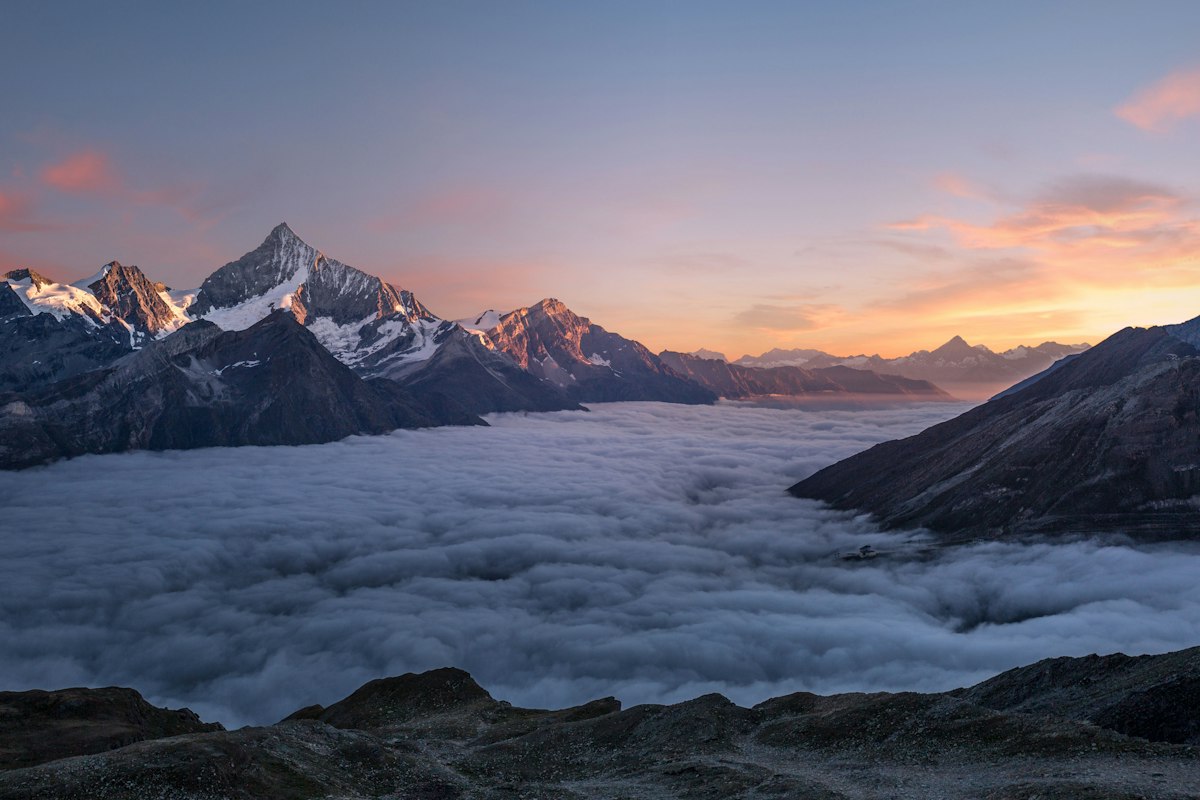
Here is the insider secret: get on the first train. In summer, that is around 07:00. The summit is nearly empty at that hour, the air is crystal clear, and if conditions are right, you will watch the Matterhorn catch the first rays of sunlight and glow orange-pink against a deep blue sky. It is called alpenglow, and it lasts only a few minutes. Those few minutes are worth the early alarm.

If you want the iconic reflection photograph -- the Matterhorn mirrored in still water -- exit the train one stop before the summit at Rotenboden. Walk 10 minutes downhill to the Riffelsee lake. On a calm morning before 09:00, the mountain's reflection in the lake is so perfect it looks digital. It is not. It is just Switzerland being Switzerland.

[Transition to Stop 7]

Walk south again through the village to Kirchplatz -- the church square where the Matterhorn Museum entrance is. This time, you are coming for the view, not the museum. Find a spot in the square or on the bridge with a clear southern sightline. The walk takes about 5 minutes.


Stop 7: Kirchplatz Viewpoint

GPS: 46.0210°N, 7.7478°E Duration: 4 minutes

[Narration]

You are back at Kirchplatz, and if you have timed this walk for late afternoon, what happens next is one of nature's great performances.

Find a spot with a clear view of the Matterhorn to the south. The church bridge is ideal, or the open area near the museum entrance. Now watch.

As the sun drops toward the western horizon, the light changes. The Matterhorn, which has been a grey-white presence all day, begins to warm. First, a faint golden glow touches the summit. Then, over the next 20 to 30 minutes, the entire pyramid turns from gold to amber to deep orange to an almost impossibly vivid red. This is alpenglow -- Alpenglühen in German -- and it happens when the low-angle sunlight travels through more of the atmosphere, filtering out the blue wavelengths and bathing the high peaks in warm reds and oranges.

The village below is already in shadow by this point. The contrast -- dark village, blazing mountain -- is extraordinary. Locals call the Matterhorn's evening performance the Feuermatter, the fire mountain. It happens nearly every clear evening, and it is different every time. The exact colors depend on the atmospheric conditions, the season, and the altitude of the clouds.

If you are here in summer, the alpenglow begins around 20:30 and lasts until approximately 21:00. In winter, it happens earlier, around 16:00-16:30, and the snow-covered peak catches the light even more brilliantly.

This is the view that has captivated painters, photographers, and travelers for 200 years. This is why people build hotels with south-facing windows and pay premium rates for Matterhorn view rooms. This is why Edward Whymper risked everything to stand on that summit. And this is why, despite the luxury shops and the adventure sports and the millions of visitors, Zermatt still feels like a place defined by something larger than itself.

Stand here for as long as you like. Let the light change. Watch the mountain turn from gold to red to purple. And when it finally fades to grey, and the first stars appear above the pyramid, you will understand why the Matterhorn is not just a mountain. It is an experience.


Closing

[Duration: 2 minutes]

That concludes your ch.tours Zermatt Village & Matterhorn Views walk. Over the past 50 minutes, you have explored a car-free village with roots stretching back centuries, stood before the graves of climbers who gave their lives on the surrounding peaks, touched the 500-year-old timber of the Hinterdorf barns, and watched the most famous mountain in the world put on its evening show.

Here are some suggestions for the rest of your time in Zermatt.

For the ultimate panorama: Take the Gornergrat Railway to 3,089 meters. Go early in the morning for the best light and the fewest crowds. A 50% discount applies with the Swiss Travel Pass.

For hiking: The 5-Seenweg (Five Lakes Trail) is Zermatt's most celebrated hike -- a 9.3-kilometer loop connecting five Alpine lakes, each with a different Matterhorn reflection. Take the Sunnegga funicular to Blauherd and walk downhill. Allow 2.5-3 hours.

For families: Sunnegga (2,288 m) is just a 3-minute funicular ride from the village. The Leisee lake at the top is heated to about 20 degrees by a natural spring and is one of the highest swimmable lakes in the Alps.

For the journey of a lifetime: The Glacier Express departs from Zermatt station and travels 8 hours across the Swiss Alps to St. Moritz. Check out the ch.tours Glacier Express Audio Companion for that ride.

For dinner: Try the Whymper-Stube on the Bahnhofstrasse for raclette and fondue, or hike 30 minutes from Sunnegga to Restaurant Chez Vrony in the hamlet of Findeln for gourmet mountain cuisine with a terrace view of the Matterhorn. Reserve ahead.

Thank you for walking with me through Zermatt. This is a village that belongs to its mountain, and I hope you felt that connection today. Safe travels, and clear skies.


Source: ch.tours | Audio Guide Script | Last updated: March 2026 | Data from MySwitzerland.com, SBB (sbb.ch), Matterhorn Gotthard Bahn (mgbahn.ch), Zermatt Tourism (zermatt.ch), Zermatt Bergbahnen (matterhornparadise.ch), Swisstopo

Transcript

TL;DR: A 50-minute self-guided walking tour through the car-free Alpine village of Zermatt, with seven stops that reveal the best Matterhorn viewpoints from different angles, the village's mountaineering heritage, its centuries-old wooden architecture, and the underground museum where the broken rope from the 1865 first ascent tragedy is on display.


Tour Overview

Duration ~50 minutes (walking + narration)
Distance ~2.5 km
Stops 7
Difficulty Easy (mostly flat, car-free streets; slight incline toward Hinterdorf)
Start Zermatt Bahnhof (train station)
End Kirchplatz viewpoint
Best Time Late afternoon (16:00-18:00) for alpenglow on the Matterhorn; morning (07:00-09:00) for crisp views and fewer crowds
Accessibility Mostly wheelchair-accessible on main streets; Hinterdorf has some uneven cobblestones

Introduction

[Duration: 2 minutes]

Welcome to Zermatt -- and welcome to this ch.tours audio guide. Over the next 50 minutes, you and I are going to explore one of the most famous mountain villages in the world, a place where you cannot drive a car, where goats sometimes wander past luxury boutiques, and where the most recognizable mountain on Earth has been watching over everything for millions of years.

The Matterhorn. Even if you have never been to Switzerland, you know that shape -- the near-perfect pyramid of rock and ice that stands 4,478 meters above sea level, straddling the Swiss-Italian border. It is on the Toblerone chocolate box. It inspired a ride at Disneyland. And it has been the ultimate symbol of Alpine adventure since 14 July 1865, when it was first climbed -- and four of the seven climbers died on the way back down.

Zermatt sits at 1,620 meters, directly at the foot of the Matterhorn, in the upper reaches of the Matter Valley. The village has been car-free since 1947, when the residents voted to ban all combustion-engine vehicles. The only motor vehicles you will see are small, silent electric taxis and hotel shuttles. Everything else moves on foot. The air here is remarkably clean, and the quiet is something you notice immediately -- no engine noise, no honking, just the sound of boots on cobblestones, the rattle of the cogwheel railway, and occasionally the distant rumble of an avalanche on the high peaks.

This walk focuses on two things: the village itself -- its history, its architecture, its mountaineering culture -- and the Matterhorn, which you will see from different angles at almost every stop. By the end, you will know the best viewpoints for photos, the story of the mountain's first and most tragic ascent, and the hidden old quarter that most visitors never find.

One practical note: the weather in Zermatt can change quickly. If clouds move in and hide the Matterhorn, do not despair -- they often clear again. The mountain is there. It is always there. Sometimes you just have to be patient.

Let us begin.


Stop 1: Zermatt Bahnhof (Train Station)

GPS: 46.0241°N, 7.7486°E Duration: 4 minutes

[Narration]

You have just arrived at Zermatt station, and the first thing to know is that the journey here was part of the experience. The Matterhorn Gotthard Bahn -- the railway that brought you from Visp or Täsch -- is a feat of engineering that climbs over 1,000 meters through narrow gorges and across bridges clinging to cliff faces. If you came from Visp, you have been traveling through the Matter Valley, one of the deepest valleys in the Alps, for the past hour.

Step off the train and out of the station, and you are immediately in the village. There is no parking lot, no taxi rank in the usual sense, no bus station. Just a small square, some electric taxis the size of golf carts, and the Bahnhofstrasse stretching straight ahead of you.

Look to your left. The building next to the station is the Gornergrat Bahn terminal. This is where you board the highest open-air cogwheel railway in Europe -- a 33-minute ride that climbs from Zermatt at 1,604 meters to the Gornergrat observatory at 3,089 meters. The panorama at the top -- 29 peaks above 4,000 meters, the Gorner Glacier, and the Matterhorn seen from a completely different angle -- is one of Switzerland's top experiences. A round trip costs CHF 98 in 2026, with a 50% discount for Swiss Travel Pass holders. If you do one excursion from Zermatt, make it this one. And go for the first morning train -- the sunrise on the peaks is unforgettable.

Now look straight down the Bahnhofstrasse ahead of you, and glance above the rooftops to the south. Depending on the clouds, you may catch your first glimpse of the Matterhorn, its distinctive pyramid rising above the village. If it is hidden, do not worry -- there are better viewpoints ahead.

Notice the silence. No car engines, no traffic noise. The loudest things in Zermatt are the church bells, the clatter of horse-drawn carriages in winter, and the conversations of fellow visitors. The car ban has been in effect since 1947, when the village council voted to preserve Zermatt's Alpine character and air quality. Visitors arriving by car park in Täsch, 5 kilometers north, and take the Zermatt Shuttle train for the last 12 minutes. It is an arrangement that requires commitment, and the village has never wavered.

The result is a place that feels genuinely different from other mountain resorts. There is a calmness here, a sense that the mountains are in charge. The village exists to serve them, not the other way around.

[Transition to Stop 2]

Walk straight ahead down the Bahnhofstrasse. This is Zermatt's main artery -- the street that runs from the station through the heart of the village. You will walk about 200 meters before we stop. The walk takes about 3 minutes.


Stop 2: Bahnhofstrasse

GPS: 46.0225°N, 7.7488°E Duration: 3 minutes

[Narration]

The Bahnhofstrasse is Zermatt's main street, and it tells you everything about the village's split personality. On one side: luxury watch shops (Rolex, Omega, Breitling), high-end fashion boutiques, and chic mountain-wear stores. On the other side: traditional wooden chalets with flower-filled window boxes, historic hotels, and the occasional shop selling Matterhorn-shaped cowbells.

Zermatt is simultaneously one of Switzerland's most exclusive resorts and a genuine Alpine farming village. Somewhere behind those luxury facades, there are still local families who have lived here for generations, who keep cattle in the high meadows in summer, and who make Raclette cheese from the milk. The two worlds coexist with remarkably little friction.

Look up at the buildings as you walk. Many of the structures along the Bahnhofstrasse are traditional Valais-style wooden chalets -- dark, weathered timber on the upper floors, stone or plaster on the ground floor. The wood is centuries-old larch, blackened by sun and time to a deep chocolate brown. In the Valais, a dark house is a proud house -- it means the timber has aged well.

The electric taxis buzzing past you are a Zermatt institution. They are tiny, barely wider than a golf cart, and they navigate the narrow streets with an ease that would impress any Formula One driver. If you need a ride, flag one down or ask your hotel to send one. Fares are metered, typically CHF 10-20 within the village.

One thing you will notice quickly: prices in Zermatt are high, even by Swiss standards. This is one of the most expensive villages in the country. Groceries at the Coop on the Bahnhofstrasse cost 20-30% more than in lowland towns. A ch.tours tip: stock up on snacks and basics in Visp or Täsch before your arrival. Your budget will thank you.

Look south again as you walk. The Matterhorn is beginning to reveal itself above the rooftops, growing larger and more defined with every step you take deeper into the village.

[Transition to Stop 3]

Continue south along the Bahnhofstrasse. After about 250 meters, you will reach a small bridge crossing the Matter Vispa River. This is the Kirchbrücke -- Church Bridge. Stop in the middle of it. The walk takes about 3 minutes.


Stop 3: Kirchbrücke (Church Bridge)

GPS: 46.0214°N, 7.7480°E Duration: 4 minutes

[Narration]

Welcome to the most photographed spot in Zermatt. Stop in the middle of the Kirchbrücke, face south, and you are looking at one of the classic postcard views of the Matterhorn.

From here, the mountain rises directly ahead of you, framed by the dark timber chalets on either side of the river. The Matter Vispa -- a glacial torrent -- rushes beneath the bridge, and the spire of St. Mauritius Church stands in the middle ground. On a clear day, with the snow-capped pyramid of the Matterhorn looming above the village rooftops, this is one of those views that makes you understand why people travel thousands of kilometers to stand where you are standing.

Take your photo. Everyone does. Then take a moment to really look at the mountain.

The Matterhorn is 4,478 meters tall and stands almost alone -- no neighboring peak is close enough to diminish its visual impact. Its four faces are oriented roughly toward the four compass points: north (facing you), east (toward the Gornergrat), south (toward Italy), and west (toward the Dent Blanche). The near-perfect pyramidal shape is the result of glacial erosion from four different directions over millions of years, each glacier carving into the mountain and creating the sharp ridges -- or aretes -- that define its silhouette.

Now look to the right side of the bridge. You will see St. Mauritius Church, a modest Reformed church with a square stone tower. Walk around to the churchyard on the south side, and you will find something deeply moving: the Mountaineers' Cemetery.

This small burial ground contains the graves of climbers who lost their lives on the Matterhorn and the surrounding peaks. Some of the headstones are simple crosses with names and dates. Others include brief inscriptions and the mountain where the climber died. Some graves are very old; others are painfully recent. Mountaineering in this area remains dangerous. Approximately 500 people have died on the Matterhorn since the first ascent, and several climbers are killed each year.

Walk through the cemetery quietly and read a few of the inscriptions. It is a sobering and humbling place, a reminder that the beautiful mountain you have been photographing is also a deadly one. The Mountaineers' Cemetery puts the Matterhorn's human story into perspective in a way that no museum can quite match.

[Transition to Stop 4]

From the church, walk south and slightly uphill into the narrow lanes behind the church. You are entering the Hinterdorf -- the oldest part of Zermatt. Look for the dark wooden buildings on stone pillars. The walk takes about 3 minutes.


Stop 4: Hinterdorf

GPS: 46.0200°N, 7.7470°E Duration: 5 minutes

[Narration]

This is the Hinterdorf, and it is my favorite corner of Zermatt. Most visitors stay on the Bahnhofstrasse and never find this place, which is a shame, because this is where Zermatt reveals its real character.

The Hinterdorf is the original village -- the cluster of buildings that existed long before the first tourist arrived. Look around you. The structures here are traditional Valais Stadel -- granary barns dating to the 16th and 17th centuries. They are built from massive larch timbers, blackened to near-ebony by centuries of sun and wind.

But the most distinctive feature is at the base of each building. Look closely: each Stadel sits on short stone pillars, like a house on stilts. Between the pillar and the wooden structure above, there is a flat, round stone disc -- sometimes called a mushroom stone or Mäuseplatte. These discs are rat guards. The smooth stone surface prevents mice and rats from climbing up into the granary where grain, cheese, and dried meat were stored. It is a brilliantly simple solution, developed centuries ago, and it is found throughout the Valais and nowhere else in Switzerland.

These buildings are not museums -- some are still used for storage, and others have been carefully converted into apartments and holiday rentals. But the exterior has been preserved, and walking through the Hinterdorf feels like stepping back 400 years. The lanes are narrow, the ground is uneven stone, and the dark wooden buildings lean slightly, as old buildings do.

Count the growth rings if you can see a cut end of timber anywhere. Some of these larch logs were felled in the 1500s. That means the wood in these walls was alive when Columbus was sailing to the Americas. The durability of Alpine larch is extraordinary -- it hardens with age and resists rot naturally, which is why these buildings have survived for half a millennium.

Take your time here. This is not a place to rush through. Notice the details: the carved dates above doorways, the iron hinges wrought by village blacksmiths, the stone troughs that once held water for livestock. This is where Zermatt comes from -- not the luxury boutiques on the Bahnhofstrasse, but these dark, sturdy barns built by farmers who never imagined that millions of people would one day travel here to look at their mountain.

[Transition to Stop 5]

Walk back toward the Bahnhofstrasse and head slightly north. Follow signs for the Matterhorn Museum -- it is at Kirchplatz, the church square. The walk takes about 4 minutes.


Stop 5: Matterhorn Museum (Zermatlantis)

GPS: 46.0215°N, 7.7495°E Duration: 4 minutes

[Narration]

The Matterhorn Museum -- also called Zermatlantis -- is built underground, beneath the Kirchplatz. The entrance is modest: a glass structure set into the square that leads down into the earth. But what is inside is remarkable.

The museum is designed as an archaeological excavation site. As you descend, you move through layers of Zermatt's history -- from the modern resort to the 19th-century tourist boom to the farming village to the geological forces that created the Matterhorn itself. It is a clever concept: digging down into the past, both literally and figuratively.

The centerpiece of the museum is the exhibit on the first ascent of the Matterhorn on 14 July 1865. Let me tell you that story, because it is one of the great dramas of Alpine history.

By the 1860s, the Matterhorn was the last unclimbed major peak in the Alps. Its sheer faces and exposed ridges had defeated every attempt. Two men were racing to be first: Edward Whymper, a young British illustrator and mountaineer, and Jean-Antoine Carrel, an Italian guide who considered the Matterhorn his mountain.

On that July morning, Whymper's team of seven -- Whymper himself, guides Michel Croz and Peter Taugwalder (father and son), and three other climbers -- set off from Zermatt via the Hornli Ridge. Against all expectations, the climb went smoothly. The rock was easier than it appeared, and by 1:40 in the afternoon, they stood on the summit. Whymper looked down the Italian side and saw Carrel's team, still 400 meters below. He shouted and rolled rocks to announce his victory.

The triumph lasted minutes. During the descent, the least experienced climber, Douglas Hadow, slipped. He knocked Michel Croz off his feet. The rope pulled Charles Hudson and Lord Francis Douglas after them. Four men fell nearly 1,200 meters down the north face. They did not survive. The rope between Douglas and the elder Taugwalder -- the rope that could have pulled the remaining three to their deaths as well -- snapped. It was later found to be the thinnest rope in the party's equipment.

That broken rope is here, in the museum. You can see it in a glass case -- a frayed length of manila hemp, impossibly thin, the object that separated life from death on the most famous day in mountaineering history. It is a small, quiet artifact, and it is one of the most powerful objects in any museum in Switzerland.

The museum entry costs CHF 10 and takes about an hour to explore thoroughly. Even if you do not go in, the story of the first ascent is now part of every view you have of the Matterhorn.

[Transition to Stop 6]

From the museum, walk north back toward the train station along the Bahnhofstrasse. The Gornergrat Bahn station is next to the main Zermatt station. The walk takes about 4 minutes.


Stop 6: Gornergrat Bahn Station

GPS: 46.0236°N, 7.7503°E Duration: 3 minutes

[Narration]

You are back near where you started, at the Gornergrat Bahn station. I brought you here for a reason: this is the gateway to the single best Matterhorn experience from Zermatt, and I want you to know what awaits you.

The Gornergrat Railway was built in 1898, making it the first fully electrified cogwheel railway in Switzerland. It climbs 9.3 kilometers from Zermatt at 1,604 meters to the Gornergrat observatory at 3,089 meters in exactly 33 minutes. The gradient is steep -- you gain nearly 1,500 vertical meters -- and the train threads through larch forests, past alpine meadows, and alongside the Gorner Glacier.

At the top, you step out onto a viewing platform surrounded by 29 peaks above 4,000 meters. Monte Rosa (4,634 m, the highest peak entirely in Switzerland) is directly across the glacier. The Gorner Glacier -- the second-largest glacier in the Alps, after the Aletsch -- flows below you like a frozen river. And the Matterhorn, seen from this angle, reveals its eastern face: steeper, more rugged, and more dramatic than the northern face you have been seeing from the village.

A round trip costs CHF 98 in 2026, with a 50% discount for Swiss Travel Pass holders. Trains depart every 24 minutes in summer.

Here is the insider secret: get on the first train. In summer, that is around 07:00. The summit is nearly empty at that hour, the air is crystal clear, and if conditions are right, you will watch the Matterhorn catch the first rays of sunlight and glow orange-pink against a deep blue sky. It is called alpenglow, and it lasts only a few minutes. Those few minutes are worth the early alarm.

If you want the iconic reflection photograph -- the Matterhorn mirrored in still water -- exit the train one stop before the summit at Rotenboden. Walk 10 minutes downhill to the Riffelsee lake. On a calm morning before 09:00, the mountain's reflection in the lake is so perfect it looks digital. It is not. It is just Switzerland being Switzerland.

[Transition to Stop 7]

Walk south again through the village to Kirchplatz -- the church square where the Matterhorn Museum entrance is. This time, you are coming for the view, not the museum. Find a spot in the square or on the bridge with a clear southern sightline. The walk takes about 5 minutes.


Stop 7: Kirchplatz Viewpoint

GPS: 46.0210°N, 7.7478°E Duration: 4 minutes

[Narration]

You are back at Kirchplatz, and if you have timed this walk for late afternoon, what happens next is one of nature's great performances.

Find a spot with a clear view of the Matterhorn to the south. The church bridge is ideal, or the open area near the museum entrance. Now watch.

As the sun drops toward the western horizon, the light changes. The Matterhorn, which has been a grey-white presence all day, begins to warm. First, a faint golden glow touches the summit. Then, over the next 20 to 30 minutes, the entire pyramid turns from gold to amber to deep orange to an almost impossibly vivid red. This is alpenglow -- Alpenglühen in German -- and it happens when the low-angle sunlight travels through more of the atmosphere, filtering out the blue wavelengths and bathing the high peaks in warm reds and oranges.

The village below is already in shadow by this point. The contrast -- dark village, blazing mountain -- is extraordinary. Locals call the Matterhorn's evening performance the Feuermatter, the fire mountain. It happens nearly every clear evening, and it is different every time. The exact colors depend on the atmospheric conditions, the season, and the altitude of the clouds.

If you are here in summer, the alpenglow begins around 20:30 and lasts until approximately 21:00. In winter, it happens earlier, around 16:00-16:30, and the snow-covered peak catches the light even more brilliantly.

This is the view that has captivated painters, photographers, and travelers for 200 years. This is why people build hotels with south-facing windows and pay premium rates for Matterhorn view rooms. This is why Edward Whymper risked everything to stand on that summit. And this is why, despite the luxury shops and the adventure sports and the millions of visitors, Zermatt still feels like a place defined by something larger than itself.

Stand here for as long as you like. Let the light change. Watch the mountain turn from gold to red to purple. And when it finally fades to grey, and the first stars appear above the pyramid, you will understand why the Matterhorn is not just a mountain. It is an experience.


Closing

[Duration: 2 minutes]

That concludes your ch.tours Zermatt Village & Matterhorn Views walk. Over the past 50 minutes, you have explored a car-free village with roots stretching back centuries, stood before the graves of climbers who gave their lives on the surrounding peaks, touched the 500-year-old timber of the Hinterdorf barns, and watched the most famous mountain in the world put on its evening show.

Here are some suggestions for the rest of your time in Zermatt.

For the ultimate panorama: Take the Gornergrat Railway to 3,089 meters. Go early in the morning for the best light and the fewest crowds. A 50% discount applies with the Swiss Travel Pass.

For hiking: The 5-Seenweg (Five Lakes Trail) is Zermatt's most celebrated hike -- a 9.3-kilometer loop connecting five Alpine lakes, each with a different Matterhorn reflection. Take the Sunnegga funicular to Blauherd and walk downhill. Allow 2.5-3 hours.

For families: Sunnegga (2,288 m) is just a 3-minute funicular ride from the village. The Leisee lake at the top is heated to about 20 degrees by a natural spring and is one of the highest swimmable lakes in the Alps.

For the journey of a lifetime: The Glacier Express departs from Zermatt station and travels 8 hours across the Swiss Alps to St. Moritz. Check out the ch.tours Glacier Express Audio Companion for that ride.

For dinner: Try the Whymper-Stube on the Bahnhofstrasse for raclette and fondue, or hike 30 minutes from Sunnegga to Restaurant Chez Vrony in the hamlet of Findeln for gourmet mountain cuisine with a terrace view of the Matterhorn. Reserve ahead.

Thank you for walking with me through Zermatt. This is a village that belongs to its mountain, and I hope you felt that connection today. Safe travels, and clear skies.


Source: ch.tours | Audio Guide Script | Last updated: March 2026 | Data from MySwitzerland.com, SBB (sbb.ch), Matterhorn Gotthard Bahn (mgbahn.ch), Zermatt Tourism (zermatt.ch), Zermatt Bergbahnen (matterhornparadise.ch), Swisstopo