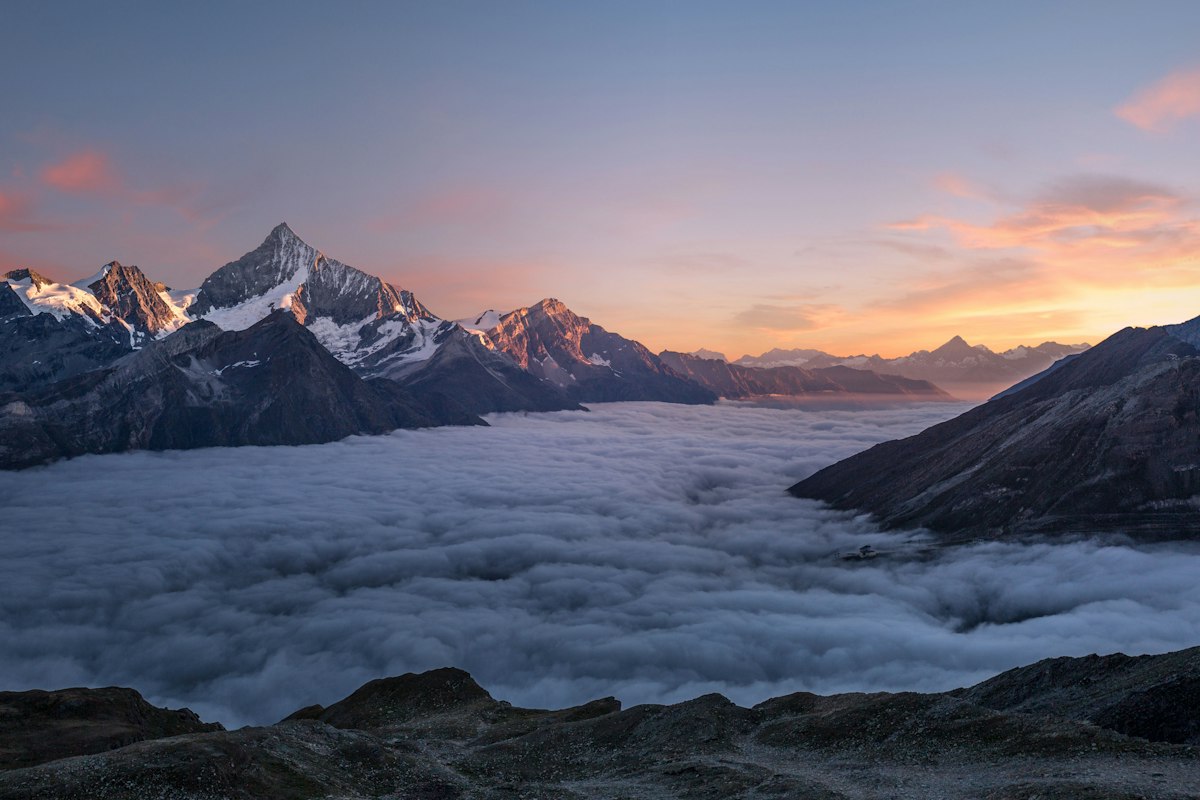
TL;DR: An audio guide for the Schilthorn cable car journey from Stechelberg (867 m) to Piz Gloria at 2,970 meters -- famous as the set of the 1969 James Bond film "On Her Majesty's Secret Service." This guide covers the four-stage cable car ascent through Gimmelwald, Murren, and Birg to the summit, where a 360-degree revolving restaurant serves fondue while the panorama of Eiger, Monch, and Jungfrau slowly rotates past your table.
Journey Overview
| Summit | Schilthorn, 2,970 m (9,744 ft) |
| Journey stages | Stechelberg (867 m) -- Gimmelwald (1,486 m) -- Murren (1,638 m) -- Birg (2,677 m) -- Schilthorn (2,970 m) |
| Total cable car time | Approximately 32 minutes (including transfers) |
| Operator | Schilthornbahn AG (schilthorn.ch) |
| Ticket price | CHF 105 return from Stechelberg (2026 prices) |
| Swiss Travel Pass | 50% discount |
| Key attractions | Piz Gloria revolving restaurant, Bond World 007 exhibition, Thrill Walk at Birg, Skyline Walk viewing platform |
| Audio guide duration | Approximately 45 minutes of narrated highlights |
| Best seat in cable car | Face south toward the Jungfrau massif on ascent |
Introduction -- Before the Ascent
[Duration: 3 minutes]
Welcome to this ch.tours audio guide for the Schilthorn. You are about to ascend from the deep Lauterbrunnen Valley to one of the most spectacular summit panoramas in the Bernese Oberland -- and to a mountain that became world-famous not through mountaineering, but through cinema.
In 1968, the producers of the James Bond film "On Her Majesty's Secret Service" were searching for a dramatic high-altitude location for the villain Blofeld's hideaway. They found it here, at the summit of the Schilthorn, where a revolving restaurant was already under construction. The Bond production team helped finance the completion of the restaurant in exchange for filming rights, and when the film premiered in 1969 starring George Lazenby as Bond, the Schilthorn's Piz Gloria became one of the most recognizable Bond locations ever. The restaurant still bears the name Piz Gloria, and the Bond connection is celebrated throughout the summit complex.
But the Schilthorn is far more than a film set. The panorama from the summit encompasses over 200 peaks, including the Eiger (3,967 m), Monch (4,107 m), and Jungfrau (4,158 m) directly across the Lauterbrunnen Valley, Mont Blanc (4,808 m) to the southwest, and the peaks of the Bernese, Valaisan, and central Swiss Alps in every direction. The revolving restaurant completes a full 360-degree rotation every 45 minutes, so the entire panorama passes your table while you eat.
Your ascent begins at Stechelberg in the valley floor. Four cable car stages will lift you 2,103 meters to the summit. Each stage reveals a different layer of the Alps -- from the pastoral valley to the car-free mountain village of Murren, to the exposed rocky platforms of Birg, and finally to the summit of the Schilthorn itself.
Let us begin.
Stage 1: Stechelberg to Gimmelwald
[Duration: 5 minutes of narration]
Stechelberg Valley Station
Elevation: 867 m
Stechelberg sits at the head of the Lauterbrunnen Valley, one of the deepest U-shaped glacial valleys in the Alps. Look up from the valley station. The cliffs rise 300 meters or more on either side -- sheer walls of Jurassic limestone carved by the glacier that once filled this valley during the last Ice Age, approximately 20,000 years ago.
The waterfalls are everywhere. The Lauterbrunnen Valley has 72 waterfalls -- "lautere Brunnen" means "clear springs" in the local dialect, and the valley was named for the water that pours endlessly from its cliffs. The most famous, the Staubbach Falls (297 m), is near the village of Lauterbrunnen downstream. But from Stechelberg, you can often see multiple cascades streaming down the rock walls, especially in late spring when snowmelt is at its peak.
The Ascent to Gimmelwald
Elevation: climbing to 1,486 m
As the cable car lifts away from the valley floor, watch the landscape transform. The flat, green valley bottom -- used for farming -- drops away beneath you, and the forested slopes of the valley walls rise alongside. Within minutes, you are at the level of the cliff tops, and the sense of the valley's depth becomes vivid. The Lutschine river is a silver thread far below.
Gimmelwald (1,486 m) is a tiny farming village of roughly 130 permanent residents, clinging to a steep mountainside above the Lauterbrunnen Valley. It is car-free -- there is no road to Gimmelwald. Everything arrives by cable car or on foot. The village is a cluster of dark wooden chalets, barns, and a small schoolhouse. Cows graze the steep meadows in summer, their bells audible even from the cable car.
Gimmelwald gained a cult following among budget travelers in the 1980s and 1990s, partly through the guidebook writer Rick Steves, who called it his "favorite Back Door" in Switzerland. The Mountain Hostel in Gimmelwald became legendary as one of the most beautifully located hostels in the Alps. The village remains remarkably unspoiled -- a working farming community at altitude.
Stage 2: Gimmelwald to Murren
[Duration: 6 minutes of narration]
Murren -- the Car-Free Village
Elevation: 1,638 m
The second cable car stage lifts you from Gimmelwald to Murren, and the panorama opens dramatically. As you gain altitude, look south. The wall of the Eiger, Monch, and Jungfrau is beginning to reveal itself across the valley -- three of the most famous peaks in the Alps, lined up in a row like a geological sermon.
Murren (1,638 m) is a car-free village perched on a narrow terrace 800 meters above the Lauterbrunnen Valley floor. Like Gimmelwald, it is unreachable by road -- access is only by cable car from Stechelberg or by the mountain railway from Lauterbrunnen via Grutschalp. The village has approximately 450 permanent residents and has been a destination for British tourists since the 1840s, when the Arnold Lunn family established a ski school here.
Murren has a special place in skiing history. Sir Arnold Lunn, a British ski pioneer, organized the first modern slalom race here in 1922, setting the gates on the slopes above the village. The Inferno Race, first run in 1928, is still held every January -- the longest downhill ski race in the world, dropping 2,170 meters from the Schilthorn summit to Lauterbrunnen. More than 1,800 amateur racers compete each year, and the atmosphere is part sporting event, part festival.
If you pause in Murren, walk to the village edge and look across the valley. The Jungfrau (4,158 m) is directly opposite -- so close that on a still morning, you can hear the thunder of avalanches releasing from its glaciers. The Silberhorn (3,695 m), a subsidiary peak of the Jungfrau, catches the light and gleams like its name suggests: the "silver horn."
Flora at this Altitude
At 1,638 meters, you are in the subalpine zone. The forests around Murren are dominated by Norway spruce (Picea abies) and European larch (Larix decidua). In the meadows between the trees, summer wildflowers are abundant: yellow mountain arnica, blue gentians, pink Alpine roses (Rhododendron ferrugineum), and the white-petaled Alpine aster. The Alpine rose is particularly common on the slopes below Murren and blooms in spectacular pink carpets in June and July.
Stage 3: Murren to Birg
[Duration: 7 minutes of narration]
The Steep Ascent
Elevation: climbing from 1,638 m to 2,677 m
The cable car from Murren to Birg is where the journey becomes dramatic. In a single stage, you climb over 1,000 meters, and the landscape transitions from alpine meadows to bare rock and permanent snow. The cable car cabin rises steeply, and the village of Murren shrinks to a cluster of toy-sized buildings on its terrace far below.
As you ascend, watch the vegetation thin. The tree line in the Bernese Oberland sits at approximately 1,800 to 2,000 meters, depending on aspect and exposure. As you pass through it, the dense coniferous forest gives way to scattered dwarf pines, then to low shrubs -- Alpine azaleas, blueberry bushes, and mosses. Above 2,200 meters, only grasses, lichens, and the hardiest cushion plants survive. The growing season at this altitude is barely three months long.
Look for ibex on the rocky slopes. The Alpine ibex (Capra ibex) was nearly hunted to extinction by the 19th century but was successfully reintroduced across the Swiss Alps beginning in 1906. The Bernese Oberland now has healthy populations, and the steep terrain around Birg is ideal habitat. The males have curved horns that can grow to nearly one meter in length.
Birg Station -- the Thrill Walk
Elevation: 2,677 m
Birg is the transfer station for the final cable car to the summit, but it deserves a stop. The Thrill Walk, opened in 2016, is a 200-meter cliffside walkway attached to the rock face below Birg station. The path includes a glass floor section, a wire mesh segment suspended over the void, and a tunnel through the rock. It is not for those with severe vertigo -- the drop beneath the glass floor is several hundred meters -- but it is engineered for safety and provides a visceral encounter with the mountain's exposure.
The Skyline Walk viewing platform extends out from Birg over the cliff edge, offering unobstructed views of the Eiger, Monch, and Jungfrau. From this altitude and angle, you can see the structure of these mountains with remarkable clarity: the dark limestone of the Eiger north face, the glaciers draped over the Monch's flanks, and the Jungfrau's summit ridge of wind-sculpted snow.
Notice the geology. The rock at Birg is Jurassic limestone -- the same formation that makes up much of the Bernese Oberland's high peaks. This limestone was deposited on the floor of a shallow tropical sea approximately 150 to 200 million years ago, when this part of Europe lay near the equator. The fossils of sea creatures are embedded in this rock, now lifted 2,677 meters above sea level by the collision of the African and European tectonic plates that created the Alps beginning approximately 65 million years ago. You are standing on an ancient seabed pushed into the sky.
Stage 4: Birg to Schilthorn Summit
[Duration: 6 minutes of narration]
The Final Ascent
Elevation: climbing from 2,677 m to 2,970 m
The final cable car stage lifts you the last 293 meters to the Schilthorn summit. The cabin clears the Birg rock face and rises into open sky, with the summit station growing above you. As you approach, the revolving restaurant dome of Piz Gloria is visible -- the distinctive circular structure that starred alongside George Lazenby, Diana Rigg, and Telly Savalas in 1969.
Arrival at Piz Gloria
Elevation: 2,970 m
Step out onto the summit platform. You have arrived at one of the great 360-degree panoramic viewpoints in the Alps. Orientation first.
North: The Bernese Mittelland stretches below you -- a patchwork of fields, forests, lakes, and towns. Lake Thun (Thunersee) and Lake Brienz (Brienzersee) are visible as blue ovals in the middle distance. On clear days, you can see the Jura Mountains beyond, and in exceptional conditions, the Black Forest in Germany.
East and South: The Eiger (3,967 m), Monch (4,107 m), and Jungfrau (4,158 m) dominate the view directly across the Lauterbrunnen Valley. The Sphinx Observatory on the Jungfraujoch is visible as a tiny glint of metal on the ridge between the Monch and Jungfrau. Below the three peaks, the glaciers of the Bernese Alps cascade in white tongues toward the valley.
South and Southwest: The Bluemlisalp (3,661 m), the Gspaltenhorn (3,436 m), and the peaks of the Kandertal line the southern horizon. Beyond them, on the clearest days, Mont Blanc (4,808 m) is visible to the southwest -- the highest peak in the Alps, 150 km away in France.
West: The Bernese Oberland peaks continue -- the Doldenhorn (3,638 m), the Balmhorn (3,698 m), and beyond them, the peaks of the Valais, including the distant silhouettes of the Weisshorn (4,506 m) and Matterhorn (4,478 m).
The information board on the viewing terrace names over 200 peaks visible from the summit. A panoramic map helps you identify them.
Stage 5: The Summit Experience
[Duration: 10 minutes of narration for approximately 1-2 hours of exploring]
Piz Gloria Revolving Restaurant
The revolving restaurant was designed by architect Konrad Wolf and engineer Robert Sobek, and construction began in 1961. It was the first revolving restaurant built on a mountain summit in Switzerland. The restaurant sits on a rotating platform that completes one full 360-degree turn every 45 minutes. You do not feel the movement -- it is slow and perfectly smooth -- but the panorama outside the windows changes continuously. Order a rosti, a fondue, or a coffee, sit back, and watch the Alps slowly parade past.
The Bond connection is everywhere. The restaurant was still under construction when Bond producers Harry Saltzman and Albert "Cubby" Broccoli scouted the location in 1967. They agreed to fund the final stages of construction -- including the helipad -- in exchange for exclusive filming rights. The production employed over 60 crew members and local extras during filming in late 1968 and early 1969, and many of the action sequences were filmed in genuinely dangerous conditions on the mountain's exposed ridges.
In the film, Piz Gloria is Blofeld's Alpine allergy research clinic -- a front for his plan to hold the world to ransom using biological warfare agents. The climactic battle, featuring explosions, helicopter assaults, and Bond skiing down the Schilthorn at night, made extensive use of the real mountain and cable car system. Several stunt sequences were performed by local ski instructors doubling for the actors.
Bond World 007 Exhibition
The Bond World exhibition on the summit level is included with your cable car ticket. It features original props, behind-the-scenes footage, and an interactive experience that recreates key scenes from the film. A flight simulation puts you in a helicopter attack on Piz Gloria, and a photo station lets you pose in Bond scenarios.
Whether you are a Bond fan or not, the exhibition provides a fascinating window into the logistics of filming a major action movie at nearly 3,000 meters altitude in the 1960s, when special effects were minimal and most stunts were done for real.
Geology and Glaciology
The Schilthorn itself is composed of flysch -- a geological term for a sequence of alternating sandstones and shales that were deposited in a deep ocean trench and later thrust upward during the Alpine orogeny. The flysch of the Schilthorn is distinct from the hard limestone of the Eiger, Monch, and Jungfrau across the valley. This geological difference is why the Schilthorn has a smoother, more rounded profile, while the Jungfrau massif is sharp and dramatic. Flysch erodes more evenly than limestone, creating the dome-shaped summit you are standing on.
The Bernese Alps visible from the Schilthorn are part of the Helvetic nappe system -- a series of massive rock sheets that were pushed northward over the Swiss Mittelland during the collision of the European and African plates. The Eiger, for example, is a stack of these nappes, with the oldest rock (Jurassic limestone, approximately 170 million years old) at the top and younger rock below -- a geological inversion that took decades for scientists to explain.
Wildlife at the Summit
At 2,970 meters, you are above the range of most large mammals, but Alpine choughs (Pyrrhocorax graculus) -- the yellow-billed black birds with acrobatic flight -- are abundant at the summit, attracted by food scraps from visitors. These birds are among the highest-nesting in Europe, breeding at altitudes of up to 3,800 meters. Watch them soar on the updrafts that sweep over the summit ridge.
Golden eagles (Aquila chrysaetos) are also present in the region, though they are more commonly seen from a distance, circling over the Lauterbrunnen Valley or the Sefinental to the south. The Bernese Oberland has an estimated 40 to 50 breeding pairs of golden eagles.
The Descent
[Duration: 3 minutes of narration]
Returning to the Valley
The descent retraces your route through Birg, Murren, Gimmelwald, and Stechelberg. In the afternoon light, the views are often different from the morning -- the Eiger north face, which may have been in shadow during your ascent, catches the western sun and reveals every buttress and gully in sharp relief.
If you have time, stop in Murren on the way down. The village has excellent restaurants and a relaxed, car-free atmosphere that rewards a leisurely afternoon. The Hotel Eiger's terrace has one of the finest views of the Jungfrau group from any restaurant in the Bernese Oberland.
Alternatively, consider taking the mountain railway from Murren to Grutschalp and then the cable car to Lauterbrunnen, rather than descending back to Stechelberg. This gives you a different perspective on the valley and deposits you in the village of Lauterbrunnen, where the Staubbach Falls and the Trummelbach Falls (ten glacier waterfalls inside a mountain) are both within walking distance.
Closing
[Duration: 2 minutes]
Your ch.tours Schilthorn audio guide ends here. Today you have ascended from 867 meters to 2,970 meters -- a vertical gain of over 2,100 meters -- passing through one of the most beautiful car-free villages in the Alps and arriving at a summit that combines one of the great Alpine panoramas with one of cinema's most memorable locations.
The Schilthorn is proof that a mountain does not need to be the highest to be the most impressive. At 2,970 meters, it is lower than the Jungfraujoch, lower than the Eiger, lower than dozens of peaks in view. But its position -- isolated, with unobstructed views in every direction -- makes it one of the finest viewpoints in Switzerland.
James Bond may have put the Schilthorn on the map, but the mountain was here long before 007. And long after the last print of the film has faded, the panorama of the Eiger, Monch, and Jungfrau from Piz Gloria will remain one of the great sights of the Alps.
Thank you for traveling with ch.tours today.
Source: ch.tours | Audio Guide Script | Last updated: March 2026 | Data from Schilthornbahn AG (schilthorn.ch), MySwitzerland.com, SBB (sbb.ch), Swisstopo, Swiss Alpine Club (SAC)