TL;DR: An audio guide for the Niederhorn cable car from Beatenberg (1,129 m) to the Niederhorn summit at 1,950 meters -- one of the finest viewpoints for the Eiger, Monch, and Jungfrau trio and a hotspot for ibex, marmots, and paragliding. This guide covers the two-stage gondola ascent from the sunny terrace village of Beatenberg above Lake Thun, the summit panorama, and the wildlife-rich slopes of the Niederhorn nature reserve.
Journey Overview
| Summit | Niederhorn, 1,950 m (6,398 ft) |
| Journey stages | Beatenberg (1,129 m) -- Vorsass (1,580 m) -- Niederhorn (1,950 m) |
| Total cable car time | Approximately 16 minutes (two stages) |
| Operator | Niederhornbahn AG (niederhorn.ch) |
| Ticket price | CHF 52 return from Beatenberg (2026 prices) |
| Swiss Travel Pass | 50% discount |
| Key attractions | Eiger/Monch/Jungfrau panorama, ibex colony, paragliding launch site, Gemmenalphorn ridge hike |
| Audio guide duration | Approximately 30 minutes of narrated highlights |
| Getting there | Interlaken West -- Beatenberg: 25 min by bus (PostBus line 21) |
Introduction -- the Eiger Grandstand
[Duration: 3 minutes]
Welcome to this ch.tours audio guide for the Niederhorn -- a mountain that many experienced Swiss travelers consider the finest front-row viewpoint for the Bernese Oberland's most famous peaks.
The Niederhorn sits on the northern ridge above Lake Thun, directly opposite the wall of the Eiger, Monch, and Jungfrau. At 1,950 meters, it is a modest summit, but its position is extraordinary. You are close enough to the great peaks to see individual glaciers, rock bands, and climbing routes, yet far enough away to take in the entire panorama in a single sweeping glance. Lake Thun glitters 1,500 meters below you. The Eiger north face fills the sky to the south. And because the Niederhorn is less famous than the Jungfraujoch, the Schilthorn, or the Harder Kulm, it is often blissfully uncrowded.
The Niederhorn is also one of the best wildlife mountains in the Bernese Oberland. The slopes are home to a thriving population of Alpine ibex, chamois, and marmots, and the summit area is part of a nature reserve that protects the alpine meadows and the animals that depend on them. If you visit in the early morning or late afternoon, ibex sightings are almost guaranteed.
The journey begins in Beatenberg, a village perched on a sunny terrace at 1,129 meters above the north shore of Lake Thun. Two gondola stages will lift you from the village to the summit in approximately 16 minutes.
Stage 1: Beatenberg to Vorsass
[Duration: 5 minutes of narration]
Beatenberg -- the Sun Terrace
Elevation: 1,129 m
Beatenberg is one of the longest villages in Switzerland -- a string of chalets, hotels, and farms stretching for 7 km along a south-facing terrace above Lake Thun. The village sits at 1,129 meters and enjoys exceptional sunshine hours, sheltered from the north winds by the Niederhorn ridge behind it. The views from Beatenberg across the lake to the Bernese Alps are celebrated, and the village has been a quiet resort since the 19th century.
The name Beatenberg comes from Saint Beatus, a 6th-century Irish monk who, according to legend, was sent by Pope Gregory the Great to Christianize the region. Beatus is said to have lived in a cave above Lake Thun (the Beatushohlen, or St. Beatus Caves), where he drove out a dragon that terrorized the local population. The caves -- a 1-km system of stalactite caverns -- are open to visitors and are one of the most popular attractions on Lake Thun.
The Lower Gondola
As the gondola lifts from Beatenberg, look south. Lake Thun (Thunersee) stretches below, its deep blue surface reflecting the peaks beyond. The lake is 17.5 km long and up to 217 meters deep, formed by glacial erosion during the Ice Ages. The town of Thun is visible at the western end; the town of Interlaken at the eastern end, where Lake Thun and Lake Brienz are separated by a narrow strip of land.
The meadows below the gondola are grazed in the traditional manner -- cattle in summer, sheep in autumn. The farming landscape of the Beatenberg terrace has been cultivated for centuries, and the pattern of meadows, orchards, and dark wooden chalets is characteristic of the Bernese Oberland's north-facing valleys.
Stage 2: Vorsass to Niederhorn Summit
[Duration: 5 minutes of narration]
Vorsass -- the Transfer Station
Elevation: 1,580 m
Vorsass is the mid-station where you transfer to the upper gondola. The alpine meadows around Vorsass are excellent for wildflowers in summer -- look for yellow mountain arnica, purple Alpine clovers, pink Alpine roses, and blue gentians. The meadows are also the habitat of the Niederhorn's marmot colony, and their sharp warning whistles may be audible from the station area.
The Upper Ascent
Elevation: climbing from 1,580 m to 1,950 m
The upper gondola climbs steeply through the final 370 meters to the summit. The vegetation transitions from alpine meadow to sparse grassland, with rocky outcrops becoming more prominent. Watch the slopes for ibex -- the Alpine ibex (Capra ibex) is abundant on the Niederhorn, and the rocky terrain around the summit is ideal habitat. The best ibex viewing is in the early morning (before 09:00) and late afternoon (after 16:00), when the animals are most active. Males with their massive curved horns are particularly impressive -- the horns can grow to over 90 cm and weigh up to 15 kg.
Stage 3: The Niederhorn Summit Experience
[Duration: 12 minutes of narration for approximately 1-2 hours of exploring]
The Summit Panorama
Elevation: 1,950 m
Step off the gondola and walk to the summit viewpoint. The panorama is dominated by the south -- the Bernese Alps in their full glory.
South -- the Bernese Oberland: Directly across the Lauterbrunnen Valley, the Eiger (3,967 m), Monch (4,107 m), and Jungfrau (4,158 m) form an unbroken wall of rock and ice. From the Niederhorn, the perspective on these peaks is different from the views at Harder Kulm or Schilthorn -- you are looking at them from a more oblique angle, which reveals the depth and layering of the mountain massif. The Eiger's north face is prominent, its dark limestone wall catching the light differently depending on the time of day. The Sphinx Observatory on the Jungfraujoch is visible as a tiny metallic gleam on the ridge between the Monch and the Jungfrau.
To the left (southeast), the Wetterhorn (3,692 m), the Schreckhorn (4,078 m), and the Finsteraarhorn (4,274 m) extend the Alpine chain. The Finsteraarhorn is the highest peak in the Bernese Alps, though it is often overlooked in favor of its more photogenic neighbors.
To the right (southwest), the Bluemlisalp (3,661 m), the Doldenhorn (3,638 m), and the Niesen (2,362 m) -- the distinctive pyramid-shaped peak on the south shore of Lake Thun -- are all visible.
North -- the Emmental and Jura: Behind you, the gentle hills of the Emmental roll northward -- a landscape of farms, forests, and the traditional Emmental farmhouses with their enormous hipped roofs. The Jura Mountains form a long ridge on the northern horizon, and on clear days, the Chasseral (1,607 m), the highest point of the Bernese Jura, is visible.
Below -- Lake Thun: Lake Thun lies 800 meters directly below, its surface shifting between deep blue and turquoise depending on light and season. The medieval castles along its shores -- Spiez, Oberhofen, Thun -- are visible as tiny structures on the lakefront. The Stockhorn (2,190 m) and the Simmental peaks rise beyond the lake's southern shore.
Wildlife -- Ibex, Chamois, and Marmots
The Niederhorn is one of the most reliable locations in the Bernese Oberland for observing Alpine wildlife, particularly ibex. The ibex population on the Niederhorn ridge numbers approximately 100 to 120 animals, and they are frequently seen near the summit, on the rocky outcrops along the ridge, and on the steep slopes below the cable car line.
Chamois (Rupicapra rupicapra) are also present, though they tend to stay in the forested zones below the summit. Chamois are smaller and more agile than ibex, with distinctive short, hooked horns and a dark facial stripe.
Alpine marmots (Marmota marmota) are common in the meadows around Vorsass and on the gentler slopes below the summit. Listen for their whistles -- a sharp, high-pitched sound that carries over long distances. Marmots use different whistle patterns for different threats: a single whistle for an aerial predator (eagle), and a series of whistles for a ground predator (fox).
Golden eagles (Aquila chrysaetos) patrol the sky above the Niederhorn, hunting marmots and young chamois. With a wingspan of up to 2.2 meters, the golden eagle is the largest raptor in the Alps and one of the most magnificent birds in Europe. Sightings are not guaranteed but are frequent enough to make the Niederhorn a popular spot for birdwatchers.
Paragliding
The Niederhorn summit is one of the most popular paragliding launch sites in the Bernese Oberland. The south-facing slopes generate reliable thermals, and the landing zone by the shores of Lake Thun provides a long, safe approach. On summer days, the sky above the Niederhorn is dotted with colorful paragliders spiraling upward on the thermals, sometimes rising to heights well above the summit.
Tandem paragliding flights are available from the Niederhorn for visitors who want to experience the descent by air rather than by gondola. The flight takes approximately 15 to 20 minutes and lands near the village of Beatenberg or on the shores of Lake Thun. Several operators offer flights directly from the summit area.
Ridge Hike to Gemmenalphorn
For hikers, the ridge walk from the Niederhorn to the Gemmenalphorn (2,061 m) is a classic Bernese Oberland excursion. The trail follows the ridgeline northwest for approximately 1.5 to 2 hours, with continuous panoramic views in both directions -- the Alps to the south, the Emmental to the north. The path is well-marked and not technically difficult, though some sections are exposed and require sure-footedness.
From the Gemmenalphorn, you can descend to the Justistal, a wild valley on the north side of the ridge that is known for its autumn cow festival (Justistaler Alpabfahrt), when the decorated cattle are driven down from the summer pastures in a procession of flower-crowned cows, herdsmen in traditional dress, and the enormous cowbells that are the sonic signature of the Bernese Oberland.
Geology of the Niederhorn
The Niederhorn ridge is composed of Cretaceous limestone -- the same Schrattenkalk formation that makes up much of the Pre-Alpine chain. This limestone, deposited on a shallow tropical sea floor approximately 110 to 120 million years ago, was uplifted and folded during the Alpine orogeny. The ridge's north face shows dramatic cliff exposures where the limestone layers have been tilted to near-vertical angles by tectonic forces.
The south-facing slopes are more gentle, covered with alpine meadow and scree, reflecting the asymmetric erosion pattern typical of folded limestone ridges. The north side, steeper and more exposed, has been sculpted by frost action and rockfall into the cliff faces that provide nesting habitat for cliff-breeding birds and shelter for the ibex.
Karst features are visible on the summit area -- small sinkholes, solution hollows, and weathered limestone surfaces called lapiez (karren in German) where rainwater has dissolved the rock along its fractures and bedding planes. These features indicate that the limestone is being slowly dissolved by slightly acidic rainfall, a process that has been ongoing for millions of years and contributes to the distinctive landscapes of limestone mountains worldwide.
Seasonal Highlights
The Niederhorn rewards visits in every season, though each has its distinct character. In spring (May and June), the alpine meadows burst with wildflowers, and the ibex are particularly visible as they descend from the highest ridges to feed on the fresh growth. In summer (July and August), the paragliders fill the sky, and the views are at their most expansive in the clear, warm air. In autumn (September and October), the larch forests on the surrounding slopes turn golden, the air is crisp and often exceptionally clear, and the ibex rut begins -- males compete with dramatic horn-clashing duels on the rocky ridges. In winter, the Niederhorn is a popular snowshoeing and winter hiking destination, with marked trails from the cable car stations through the snow-covered landscape.
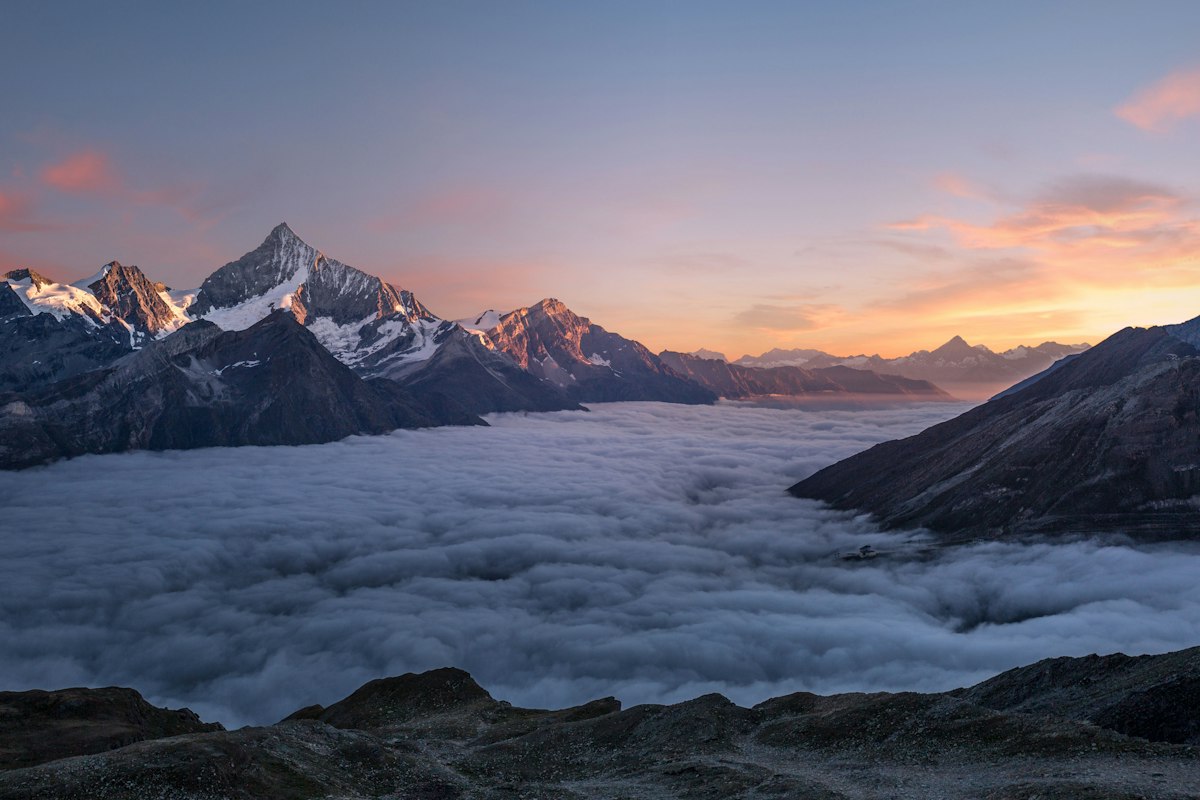
The cable car operates year-round, with reduced winter hours. In winter, the summit area often rises above the inversion fog layer (Nebelmeer) that blankets the Mittelland, offering the spectacular sight of a white sea of fog stretching to the horizon below you while the sun shines brilliantly above.
Beatenberg and St. Beatus Caves
Before or after your Niederhorn visit, the village of Beatenberg and the St. Beatus Caves (Beatushohlen) below it are well worth exploring. The cave system extends approximately 1 km into the limestone cliff above Lake Thun and features stalactites, stalagmites, underground waterfalls, and narrow passages carved by water over hundreds of thousands of years. The caves are named for Saint Beatus, the Irish monk who allegedly drove out the dragon and made the cave his hermitage in the 6th century. Whether or not you believe in dragons, the cave is a genuine geological wonder and one of the most popular natural attractions on Lake Thun.
The entrance to the cave is dramatic: a waterfall cascades from the cave mouth down the cliff face toward the lake. Inside, the cave is lit and walkways provide safe access through the largest chambers. The temperature inside is a constant 9 to 10 degrees Celsius, making a light jacket advisable.
Closing
[Duration: 2 minutes]
Your ch.tours Niederhorn audio guide ends here. You have ascended from the sunny terrace of Beatenberg to a summit that delivers one of the best-proportioned views of the Bernese Oberland -- close enough to the great peaks to feel their presence, elevated enough above the lake to comprehend the landscape, and wild enough to share the mountaintop with ibex, marmots, and soaring eagles.
The Niederhorn is the kind of mountain that rewards repeat visits. The light changes with the seasons. The wildlife changes with the time of day. The panorama is never exactly the same twice. It is a mountain for those who have been to the famous summits and want something quieter, closer, and more intimate.
For more Bernese Oberland experiences, the ch.tours guides for Harder Kulm, Niesen, Stockhorn, and the Schilthorn all cover summits visible from where you are standing.
The Niederhorn is also one of the few mountains in the Bernese Oberland where the sound of cowbells in summer, the whistle of marmots, and the cry of eagles can be heard in the same afternoon. This sensory richness, combined with the visual spectacle of the Eiger-Monch-Jungfrau panorama, makes the Niederhorn an experience that engages more than just the eyes. It is a mountain for all the senses.
Thank you for traveling with ch.tours today.
Source: ch.tours | Audio Guide Script | Last updated: March 2026 | Data from Niederhornbahn AG (niederhorn.ch), Interlaken Tourism (interlaken.ch), MySwitzerland.com, SBB (sbb.ch), Swisstopo