TL;DR: An audio companion for the Glacier Express, the legendary 8-hour train journey from Zermatt to St. Moritz across 291 bridges, through 91 tunnels, and over the Oberalp Pass at 2,033 meters. This guide highlights the most spectacular moments across 5 segments -- from the Matterhorn farewell to the UNESCO-listed Landwasser Viaduct -- so you know exactly when to look up, which side to watch, and what story lies behind the landscape rushing past your window.
Journey Overview
| Route | Zermatt (1,604 m) to St. Moritz (1,775 m) -- or reverse |
| Duration | Approximately 8 hours |
| Distance | 291 km |
| Bridges | 291 |
| Tunnels | 91 |
| Highest Point | Oberalp Pass, 2,033 m |
| Operator | Matterhorn Gotthard Bahn (Zermatt-Disentis) + Rhaetian Railway (Disentis-St. Moritz) |
| Ticket Price | CHF 153 second class, CHF 273 first class (2026 prices); seat reservation mandatory (CHF 49 in Summer) |
| Swiss Travel Pass | Journey included free; seat reservation (CHF 49) still required |
| Excellence Class | CHF 470 supplement -- premium car with 7-course meal, open bar, concierge |
| Audio Companion Duration | ~4 hours of narrated highlights (you will not need narration for the entire 8 hours) |
| Best Seat | Left side facing forward from Zermatt; right side from St. Moritz |
Introduction -- Before You Depart
[Duration: 4 minutes]
Welcome aboard the Glacier Express -- and welcome to this ch.tours audio companion. Over the next 8 hours, you are going to travel on what is justly called the slowest express train in the world. The name is not ironic. It is a promise. This train is slow on purpose, because the 291 kilometers between Zermatt and St. Moritz contain some of the most extraordinary landscapes on earth, and the whole point is to see them.
Let me give you the big picture first. The Glacier Express crosses the entire width of the Swiss Alps from southwest to northeast. It climbs from the deep Mattertal valley at Zermatt (1,604 m), drops into the Rhone Valley, climbs again through the remote Goms villages of the upper Valais, plunges through the Furka base tunnel, emerges in the Urseren valley at Andermatt, ascends to the Oberalp Pass (2,033 m) -- the highest point of the journey -- then descends through the Rhine Gorge, the Swiss Grand Canyon, to the Rhaetian capital of Chur, before climbing one final time through the UNESCO-listed Albula line to the Engadin and St. Moritz. Along the way, the train crosses 291 bridges, passes through 91 tunnels, and traverses three language regions -- German, Romansh, and Italian influences blending seamlessly.
A few practical notes before you settle in.
Which side should you sit on? If you are traveling from Zermatt to St. Moritz -- the classic westbound-to-eastbound direction -- the left side offers the best views for the first half of the journey (Matterhorn farewell, Rhone Valley, Oberalp Pass). The right side is better for the second half (Rhine Gorge, Landwasser Viaduct). If you can only choose one side, sit on the left from Zermatt, or the right from St. Moritz. That said, the panoramic windows on both sides are enormous, and you can always stand up and cross to the other side for the key moments -- I will tell you when.
Meals: Lunch is served at your seat, typically between Andermatt and Disentis. In first and second class, you can order from a menu (main courses CHF 30-45). In Excellence Class, a 7-course meal with wine pairings is included. The food is decent but not the reason you are here. The reason you are here is outside the window.
The tilting wine glass: At some point during the journey, you will notice that the wine glasses have slanted stems. This is the Glacier Express's signature souvenir -- designed so the wine stays level while the train climbs gradients of up to 11%. You can buy one in the onboard shop for approximately CHF 15. It is kitsch. It is also a lot of fun.
Now, settle into your seat. The train is about to depart. And say goodbye to the Matterhorn -- it is going to give you one last show.
Segment 1: Zermatt to Brig
[Duration: approximately 1 hour of travel; 15 minutes of narration]
Departure from Zermatt
Time from departure: 0 minutes Elevation: 1,604 m
[Narration]
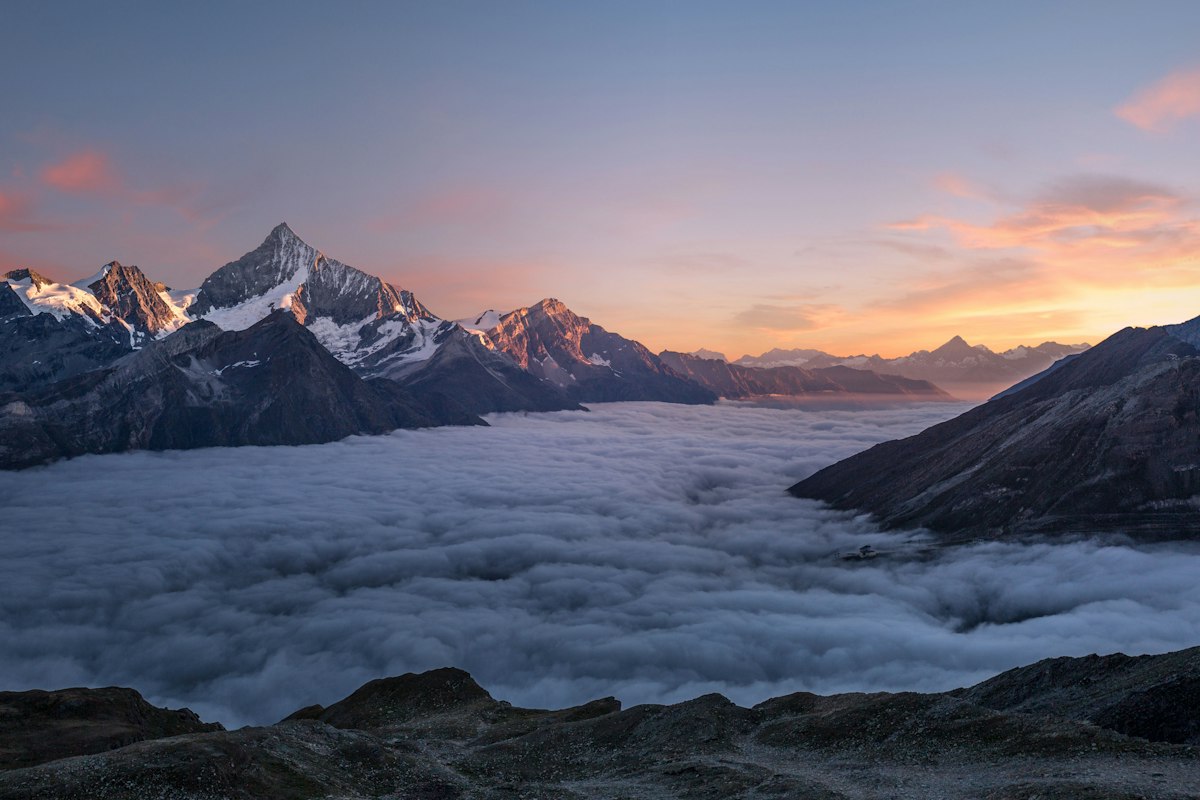
The train eases out of Zermatt station and immediately begins descending the Matter Valley -- the Mattertal in German. For the first 10 minutes, look to the left and behind you. On a clear day, the Matterhorn (4,478 m) is visible above the rooftops of Zermatt, its distinctive pyramidal peak rising like no other mountain on earth. This is your farewell to the most famous silhouette in the Alps. Watch it for as long as you can -- it disappears quickly as the valley curves.
Zermatt itself is car-free. The town you just left has banned combustion engines since 1947, and the only motorized vehicles on its streets are electric taxis and delivery carts. The Glacier Express is the lifeline -- the only rail connection to the outside world.
The Mattertal descent
Time from departure: 10-35 minutes
[Narration]
The Mattertal is one of the deepest valleys in the Alps, and the train descends through it in a series of curves, crossing the Matter Vispa river repeatedly. Look out the window at the valley walls. They are steep -- almost vertically so in places -- and you can see evidence of the raw geological forces at work: rockfall scars, avalanche channels, and the occasional protective gallery that shields the railway from debris.
The villages you pass through -- Tasch, Randa, Herbriggen, St. Niklaus -- are traditional Valaisan settlements, with dark wooden chalets and granaries raised on stone stilts called Stadel. The stilts kept rats away from the stored grain. You will see these distinctive mushroom-shaped stone discs -- Mauseplatten, or mouse plates -- between the stilts and the wooden structure above. It is an ingenious Alpine solution that has been in use for centuries.
At Randa, if you look up to the right, you will see the massive scar left by a rockslide in 1991, when 30 million cubic meters of rock broke away from the mountainside. The debris dammed the river and flooded part of the valley. The event reshaped the entire valley floor, and the evidence is still clearly visible.
Arrival in Visp and Brig
Time from departure: 45-60 minutes Elevation: 681 m (Brig)
[Narration]
The train descends to Visp and then Brig, dropping nearly 1,000 meters from Zermatt. You have reached the floor of the Rhone Valley -- the great east-west trough that the Rhone River has carved through the heart of the Alps.
Brig is worth noting. This small town at the foot of the Simplon Pass has been a crossroads for centuries -- the gateway between Switzerland and Italy. The dominant building in town, visible from the train, is the Stockalper Palace -- the largest private palace ever built in Switzerland. It was constructed in the 17th century by Kaspar Stockalper von Thurm, a merchant who made a fortune controlling the trade route over the Simplon. He was one of the richest men in Europe, and his palace -- with its three gilded onion domes dedicated to the Three Magi -- is a statement of that wealth. The palace is now a museum and well worth a visit if you ever return to Brig.
The train pauses briefly at Brig station. This is where the Matterhorn Gotthard Railway takes over, and the character of the journey is about to change. You are leaving the deep valley behind and climbing into one of the most remote and beautiful corners of Switzerland.
Segment 2: Brig to Andermatt
[Duration: approximately 1.5 hours of travel; 20 minutes of narration]
The Goms Valley -- upper Rhone
Time from Zermatt: approximately 1h 10min Elevation: climbing from 681 m to 1,431 m
[Narration]
After Brig, the Glacier Express turns east and begins climbing the upper Rhone Valley -- a region known as the Goms, or Obergoms. This is one of my favorite stretches of the entire journey, and it is the one that most tourists do not expect.
The Goms is a wide, gentle valley, almost absurdly picturesque. In summer, the meadows are green and dotted with wildflowers. In winter, the entire valley is a cross-country skiing paradise. The villages -- Fiesch, Niederwald, Munster, Reckingen, Oberwald -- are clusters of dark wooden chalets and white Baroque churches. Each village has a church, and the churches of the Goms are famous for their baroque interiors -- ornate altarpieces and painted ceilings that seem impossibly lavish for such tiny communities. The Jesuits and Capuchins were active here during the Counter-Reformation, and the result is some of the richest religious art in the Alps.
Watch for Niederwald on the left side. This is the birthplace of Caesar Ritz -- yes, that Ritz, founder of the Ritz Hotel in Paris and the man whose name became synonymous with luxury. He was born in this tiny Goms village in 1850, the youngest of 13 children in a farming family. From a hamlet of fewer than 200 people to the most famous hotelier in history. The Swiss are full of these stories.
As the train climbs higher, you may notice the Rhone River beside the tracks. Here, near its source, the Rhone is a modest mountain stream. It is hard to believe that this is the same river that flows through Lyon and Marseille and into the Mediterranean, 812 km away. You are seeing it at the very beginning of its life.
The Furka Base Tunnel
Time from Zermatt: approximately 2h 15min
[Narration]
At Oberwald, the train enters the Furka Base Tunnel -- a 15.4 km bore that takes approximately 20 minutes to traverse. This is the least scenic part of the journey, so let me use the time to tell you something remarkable about the route above your head.
Before the tunnel opened in 1982, the Glacier Express crossed the Furka Pass at 2,431 meters on an open-air rack railway. That route -- clinging to the mountainside with views of the Rhone Glacier -- was one of the most spectacular railway journeys in the world. But it could only operate in summer. Snow and avalanche danger closed the line for 6 to 7 months each year, isolating the communities on either side.
The Furka Base Tunnel solved the practical problem -- year-round service, faster connections, weather independence -- but at the cost of one of the great railway views. The good news is that the old Furka route was preserved. The Dampfbahn Furka-Bergstrecke (DFB) operates vintage steam trains over the pass from June to October, and the ride across the Furka with the Rhone Glacier below is considered one of the top heritage railway experiences in Europe. If you ever return to this region, that ride is unmissable.
For now, sit back. The tunnel will end in a few minutes, and when daylight returns, you will be in a completely different valley.
Arrival in Andermatt
Time from Zermatt: approximately 2h 30min Elevation: 1,437 m
[Narration]
The train emerges from the Furka Base Tunnel into the Urseren Valley and the town of Andermatt. Look out both sides -- the landscape has changed dramatically. The gentle Goms Valley is behind you. Ahead, the mountains are steeper, the valley narrower, and the military history is palpable.
Andermatt sits at the crossroads of four Alpine passes: the Furka, the Oberalp, the Gotthard, and the Susten. For centuries, whoever controlled Andermatt controlled the heart of the Swiss Alps. The Gotthard Pass, just south of here, has been the most important north-south route through the Alps since the Middle Ages -- the road that connected northern Europe to Italy. The Devil's Bridge over the Schollenen Gorge, just below Andermatt, is the stuff of legend: a stone arch over a roaring canyon that Swiss myth says was built by the Devil himself.
In recent years, Andermatt has undergone a massive transformation. Egyptian billionaire Samih Sawiris invested over CHF 1.5 billion in a luxury resort development, including the Chedi Andermatt hotel and a golf course designed by the firm of Kurt Rossknecht. The result is an old mountain village that now has a 5-star hotel, Michelin-starred dining, and a modern ski area linked to Sedrun. It is a jarring contrast -- and a fascinating one.
The train pauses briefly at Andermatt. The next stretch is the climax of the journey's first half.
Segment 3: Andermatt to Disentis
[Duration: approximately 1 hour of travel; 15 minutes of narration]
The climb to Oberalp Pass
Time from Zermatt: approximately 2h 45min Elevation: climbing from 1,437 m to 2,033 m
[Narration]
This is it. The train is now climbing toward the Oberalp Pass -- the highest point of the entire Glacier Express journey at 2,033 meters. The ascent is steep, and the train uses a rack railway (Zahnradbahn) to grip the tracks on the steepest sections. You might hear a change in the sound of the wheels -- a deeper, grinding engagement as the cogwheel meshes with the rack rail.
Look out the windows. The landscape is becoming increasingly alpine -- bare rock, sparse grass, patches of late-lying snow in early summer. The tree line is behind you. Ahead, the Oberalp Pass is a wide, windswept saddle between peaks.
Oberalp Pass -- the summit
Time from Zermatt: approximately 3h 00min Elevation: 2,033 m
[Narration]
You have reached 2,033 meters -- the roof of the Glacier Express. Look to the left. That small lake beside the tracks is the Oberalpsee, and its waters flow east, joining the Vorderrhein -- the front branch of the Rhine. You have just crossed the continental divide. Behind you, every river you passed flowed toward the Rhone and the Mediterranean. Ahead, every river flows toward the Rhine and the North Sea. This is one of the great watershed boundaries of Europe, and you are crossing it at walking pace in a panoramic train.
On a clear day, the Oberalp is magnificent -- a treeless, windswept landscape of rock and water, with peaks stretching to the horizon in every direction. In winter, the pass is buried under meters of snow, and the train cuts through it between high white walls. In either season, it feels like the top of the world.
The Oberalp is also the linguistic boundary. Behind you, the Urseren Valley speaks German. Ahead, in the Surselva, the dominant language is Romansh -- the fourth national language of Switzerland, spoken by fewer than 60,000 people. Romansh is a Romance language, descended from Latin, and it survives here in the mountain valleys of Graubunden as a living connection to the language of the Roman Empire. You may hear station announcements in Romansh as the train descends -- listen for the lilting, musical quality.
Descent into Disentis
Time from Zermatt: approximately 3h 30min Elevation: descending to 1,130 m
[Narration]
The descent from the Oberalp Pass toward Disentis is rapid and dramatic. The train uses the rack railway again for the steepest sections, and the valley opens below you with increasing speed. Pine forests return. Mountain streams cascade alongside the tracks. The villages have a distinctly different character from the Valais -- stone houses with Romansh names on the signs.
Disentis -- Mustair in Romansh -- is dominated by the massive Benedictine monastery visible on the hillside above the town. The Monastery of Disentis was founded in approximately 720 AD, making it one of the oldest monasteries in Switzerland. For over 1,300 years, monks have lived and worked on this site. The current buildings, in their gleaming white Baroque form, date to the 17th and 18th centuries, but the foundation is ancient.
At Disentis station, the Glacier Express changes operators. The Matterhorn Gotthard Bahn hands over to the Rhaetische Bahn -- the Rhaetian Railway (RhB), which will take you the rest of the way to St. Moritz. The RhB is itself a UNESCO-listed railway (for its Albula/Bernina lines), and the engineering on the final segment of this journey is nothing short of extraordinary.
Segment 4: Disentis to Chur
[Duration: approximately 1 hour of travel; 10 minutes of narration]
The Rhine Gorge -- the Swiss Grand Canyon
Time from Zermatt: approximately 4h 00min Elevation: descending from 1,130 m to 585 m
[Narration]
After Disentis, the train follows the Vorderrhein downstream through the Surselva. The valley widens, then narrows, and then -- look to the right -- the river drops into an extraordinary chasm. This is the Ruinaulta, the Rhine Gorge, often called the Swiss Grand Canyon.
The Ruinaulta stretches for approximately 13 km and is up to 400 meters deep. It was created roughly 10,000 years ago when an enormous rockslide -- one of the largest in the Alps -- collapsed from the Flimserstein mountain and dammed the Rhine. The river gradually cut through the debris, carving the dramatic gorge you see today. The white limestone walls, the turquoise river far below, and the dense forest clinging to the slopes create a landscape that is startling in its wildness -- especially after the pastoral valleys you have been traveling through.
The train runs along the northern rim of the gorge, and for several minutes the views are spectacular. The best views are on the right side. If you are sitting on the left, now is the time to stand and cross to the right windows or the space between cars.
The Rhine Gorge is also a popular rafting destination in summer. If you look down, you may see brightly colored rafts navigating the rapids far below. The contrast between those tiny boats and the immense scale of the gorge gives you a sense of the canyon's depth.
Arrival in Chur
Time from Zermatt: approximately 5h 00min Elevation: 585 m
[Narration]
The train descends into Chur -- the capital of the canton of Graubunden and the oldest city in Switzerland. Archaeological evidence shows continuous settlement here for over 5,000 years. The Romans called it Curia Raetorum, and traces of their presence are still visible in the Old Town.
Chur is where the Glacier Express reaches its lowest point before the final climb to St. Moritz. Some passengers alight here to explore the compact, car-free Old Town -- and it is worth a visit if you ever return. The Cathedral of the Assumption, with its Late Gothic interior and gilded triptych, is one of the finest churches in eastern Switzerland.
But you are staying on the train, because the best is yet to come. The final segment -- Chur to St. Moritz via the Albula line -- is the crown jewel of the Glacier Express. It is the reason the Rhaetian Railway is a UNESCO World Heritage Site.
Segment 5: Chur to St. Moritz -- The UNESCO Albula Line
[Duration: approximately 2 hours of travel; 25 minutes of narration]
Departure from Chur -- into the Albula Valley
Time from Zermatt: approximately 5h 15min Elevation: climbing from 585 m to 1,775 m
[Narration]
The train leaves Chur and begins the climb into the Albula Valley. Over the next 2 hours, the railway will gain nearly 1,200 meters of elevation while covering only 89 km of distance. The engineering required to accomplish this -- without any rack railway, using only the friction of steel wheels on steel rails -- is what earned the Albula line its UNESCO World Heritage status in 2008.
The RhB engineers who built this line between 1898 and 1903 faced an extraordinary challenge: how to gain elevation in narrow, steep-sided valleys where a straight railway is impossible. Their solution was a system of spiral tunnels, helical viaducts, and sinuous curves that allows the train to wind its way uphill in a series of loops. In several places, you will see the same bridge or village from above that you just passed below. The track literally spirals around itself to gain height.
Watch for the village of Filisur -- a small railway junction that marks the beginning of the most dramatic stretch of the entire Glacier Express journey.
The Landwasser Viaduct -- THE photo
Time from Zermatt: approximately 6h 00min
[Narration]
This is the moment. If you have not yet picked up your camera or phone, do it now.
In the next few minutes, the train will cross the Landwasser Viaduct -- the single most photographed railway structure in Switzerland. The viaduct is 65 meters high and 136 meters long, a graceful curve of six stone arches that carries the train across the Landwasser valley and directly into a tunnel cut into the vertical rock face on the far side. The approach is the drama: the train curves along the mountainside, and the viaduct appears below and ahead of you -- a slender stone ribbon suspended over the void. Then you are on it, 65 meters above the river, the valley floor far below, pine forests on both sides.
If you are sitting on the right side, you will have the best view as the train approaches the viaduct from the north. Look out and slightly ahead. You will see the viaduct's arches curving away from you. If you are on the left side, look out as the train crosses -- you will see straight down into the gorge.
The Landwasser Viaduct was built in 1901 and 1902, during the original construction of the Albula line. It was designed by the railway engineer Friedrich Hennings and is a masterpiece of early 20th-century engineering. The limestone for the pillars was quarried locally, and the entire structure was built without modern cranes -- using wooden scaffolding and human labor. The viaduct appears on the Swiss 10-franc banknote (the current series) and has become the global icon of Swiss railway engineering.
The tunnel on the far side swallows the train immediately -- there is no space between the last arch and the cliff face. The transition from open air to darkness is instant and dramatic.
The Albula spiral tunnels
Time from Zermatt: approximately 6h 15min Elevation: climbing steeply
[Narration]
After the Landwasser Viaduct, the train enters the most intense section of spiral tunnel engineering on the line. Between Berguen and Preda, the railway climbs 416 meters of elevation over a horizontal distance of only 5 km. To achieve this, the track winds through a series of loops and spiral tunnels, passing the same points at multiple levels.
Look out the window and try to spot the village of Berguen below you. You will see it once, then the train enters a tunnel and loops upward, and when you emerge, Berguen is below you again -- but now from a higher vantage point. This happens multiple times. The effect is dizzying and wonderful. Children on the train love this section, and so do adults who understand just how clever the engineering is.
The summit of the Albula line is the Albula Tunnel (5.9 km long, at 1,820 m). The train passes through in near-silence -- a long, dark passage under the Albula Pass that emerges into a completely different world on the far side.
The Engadin Valley -- arrival in St. Moritz
Time from Zermatt: approximately 7h 00min - 8h 00min Elevation: 1,775 m
[Narration]
You emerge from the Albula Tunnel into the Upper Engadin, and the landscape transformation is immediate. Behind you: steep, forested Alpine valleys. Ahead: a wide, high-altitude plateau flooded with sunlight. The Engadin receives more than 300 days of sunshine per year -- a microclimate created by its elevation and its sheltered position between mountain ranges. The light here has a clarity and intensity that has attracted painters for centuries. Giovanni Segantini, the great Divisionist painter, spent his final years in the Engadin because of the light. Friedrich Nietzsche wrote parts of "Thus Spoke Zarathustra" in Sils Maria, a village nearby, calling the Engadin "the most lovable corner of the earth."
The train follows the Inn River -- yes, this is the same river that gives Innsbruck its name, flowing east through Austria and eventually joining the Danube. You are now in a completely different watershed from where you started. Zermatt's rivers flow to the Mediterranean via the Rhone. The Engadin's rivers flow to the Black Sea via the Inn and the Danube. In 8 hours, you have crossed the entire hydrological spine of the Alps.
Look out for the Engadin lakes -- Lej da Champfer and the St. Moritzersee -- shimmering in the valley ahead. These are high-altitude lakes of an almost unnatural blue-green, surrounded by larch forests and framed by mountains. On a still day, the reflections are perfect.
And there, at the head of the valley, is St. Moritz.
St. Moritz has been a resort town since 1864, when hotelier Johannes Badrutt famously bet a group of British summer guests that the Engadin winter was sunny and pleasant. He told them that if they came back in winter and did not enjoy it, he would pay for their entire stay. They came. They stayed until spring. Winter tourism was born. The first Winter Olympics were held in St. Moritz in 1928, and the second in 1948. The town has been synonymous with alpine glamor ever since -- and with the champagne-dry air, the blazing sunshine, and the frozen lake that hosts everything from polo matches to horse racing in winter, the appeal is obvious.
The train pulls into St. Moritz station, and your 8-hour, 291-kilometer journey is complete.
Closing
[Duration: 3 minutes]
And that brings your ch.tours Glacier Express Audio Companion to an end. Over the past 8 hours, you have crossed the Swiss Alps from southwest to northeast, traveling through two UNESCO World Heritage sites, over 291 bridges, through 91 tunnels, and across the continental divide at 2,033 meters. You have descended into the deepest valleys and climbed to windswept passes. You have traveled through three language regions, past 13th-century monasteries and 21st-century luxury resorts, along routes that have been connecting communities for centuries.
The Glacier Express is more than a train ride. It is a demonstration of something the Swiss do better than almost anyone: the refusal to let geography win. Every tunnel, every viaduct, every spiral loop you passed through represents a decision by engineers, politicians, and communities to connect places that mountains tried to keep apart. The Landwasser Viaduct was built by hand in 1902. The Furka Base Tunnel was bored through granite in the 1970s and 80s. The rack railway sections that carried you over the Oberalp Pass use technology invented in the 19th century. And the whole thing works, every day, on schedule, in a country the size of Vermont.
Here is what I hope stays with you: the landscapes you have just crossed are not just beautiful. They are the product of a relationship between people and mountains that has been evolving for over a thousand years. The terraced vineyards above the Rhone, the dark wooden chalets of the Goms, the Romansh villages of the Surselva, the Benedictine monastery at Disentis, the railway viaducts of the Albula line -- these are all expressions of the same impulse: to make a life, and a living, in one of the most challenging landscapes on earth.
If you are continuing your Swiss journey, check out the ch.tours guides for Zermatt, St. Moritz, Andermatt, Chur, and the Bernina Express -- the Glacier Express's sister route from St. Moritz to Tirano, Italy, which crosses the Alps in an entirely different direction and is equally spectacular.
Thank you for traveling with me today. I hope the mountains impressed you as much as they impress me, every single time.
Source: ch.tours | Audio Companion Script | Last updated: March 2026 | Data from Glacier Express AG (glacierexpress.ch), Rhaetian Railway (rhb.ch), Matterhorn Gotthard Bahn (mgbahn.ch), MySwitzerland.com, SBB (sbb.ch), UNESCO World Heritage Centre, Swisstopo